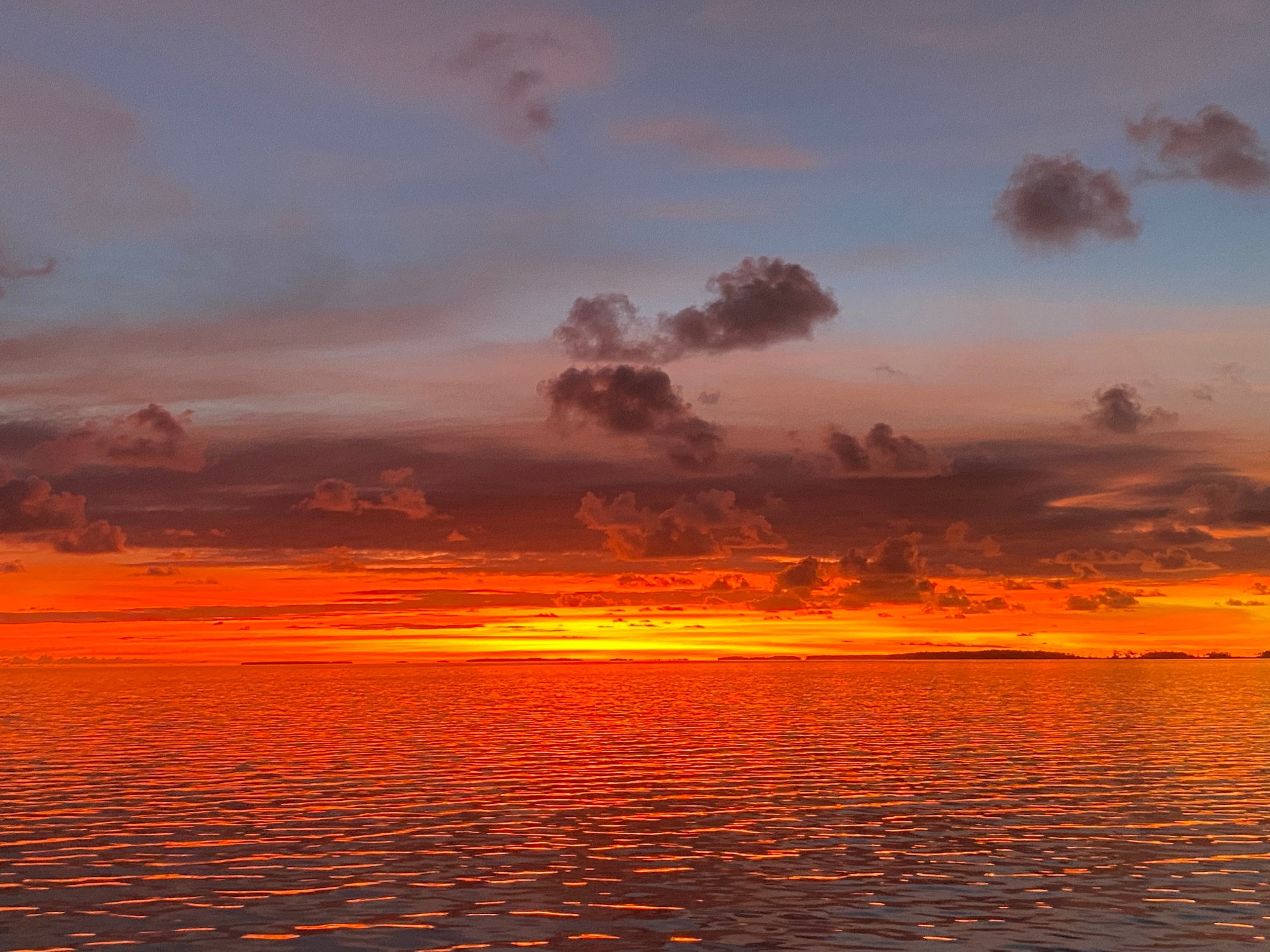
July 2026
Our spirits were high as we weighed anchor in Bora Bora for the 600 nm passage to Penrhyn (or Tongareva which is the indigenous name for the island), the most northern and remote of the Cook Islands. The forecast was favourable, and it had been stable for at least a week. We planned an afternoon departure for a daylight arrival. That afternoon and night brought a soft start with very pleasant downwind conditions. Things became harder early the next day as successive rain cells robbed us of wind and then returned it in force. It was a busy time in the cockpit with frequent sail adjustments. By early evening the clouds were clearing away and we were buoyed by the updated forecast that predicted the unstable air producing those rain cells would move away ahead of us. A much more settled, but nonetheless, sporty night meant sleep uninterrupted by changing conditions.
Pleasant relaxed sailing followed for a few days until the night before our arrival when the wind increased and became gusty. Despite our planning, we found ourselves near the pass around 3.30am so we marked time until daylight after which we entered the atoll. We carefully picked our way around to the anchorage in windy conditions and tried to find a sandy spot where we could drop the anchor, but it was impossible to see the bottom. This anchorage outside the Omoka village is notorious for having a rock and coral strewn bottom on which anchors and chain regularly get stuck, but it’s a requirement to anchor there for check in. Further the wind here is usually on-shore, and as it travels over the whole atoll, it can whip up some waves making life very uncomfortable at times. We dropped our anchor and crossed our fingers that it would come up when the time came. As it was Sunday, we had to wait until the next day for check in.
Come Monday morning, the friendly officials visited our boat and we completed the check in process.
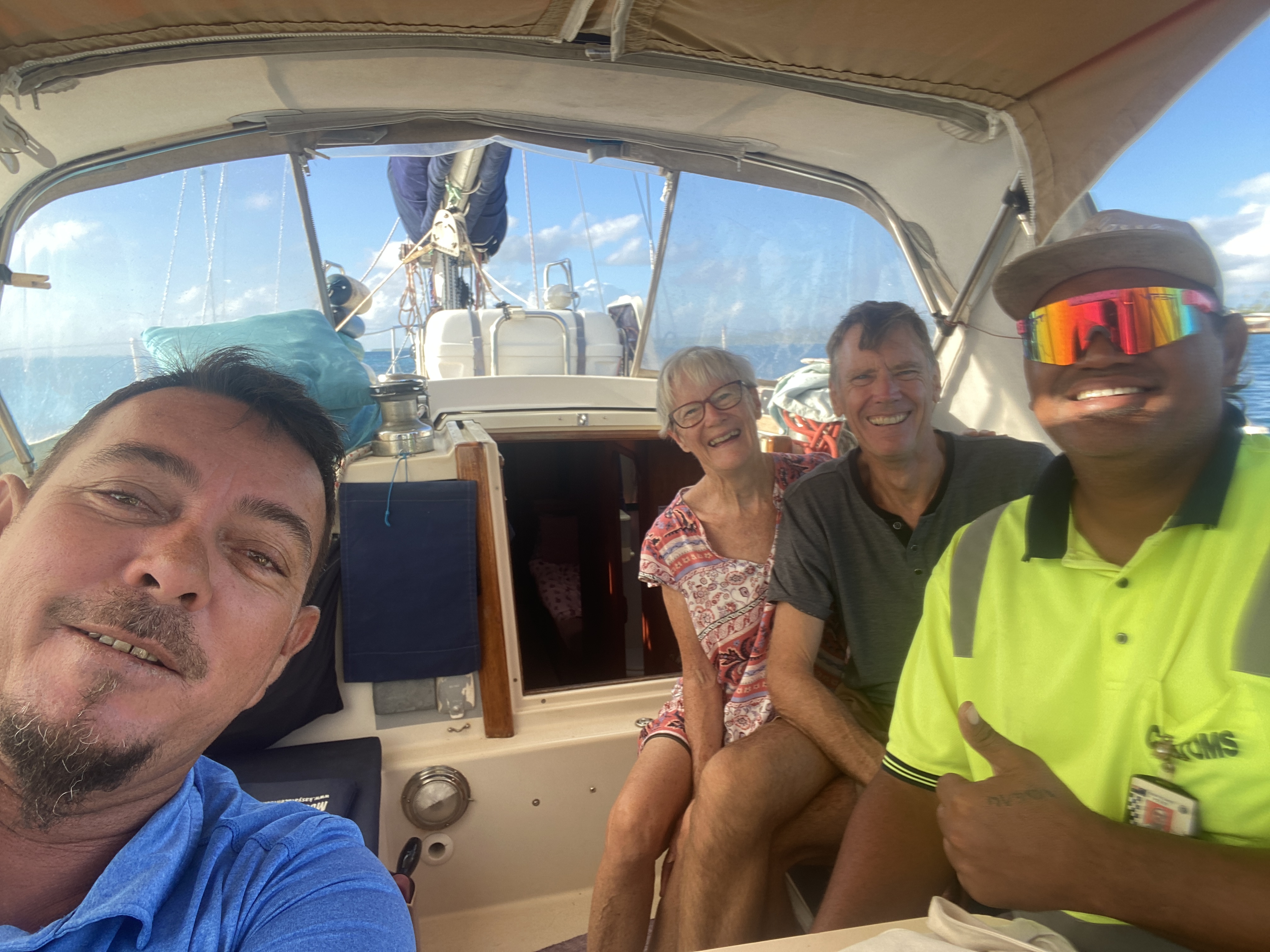
Penrhyn customs and health officers doing their duty. The health officer on the left, Tuku Masters, is a descendent of William Masters an English adventurer who came to Penrhyn in the 1860’s, taking several wives and eventually moving his family to Palmerston, another of the Cook Islands, where the whole population there today are his descendants.
We wanted to go ashore to see the village and even though the weather was not conducive we went anyway, puddled around in the rain showers and chatted to the kids on their way home from school.
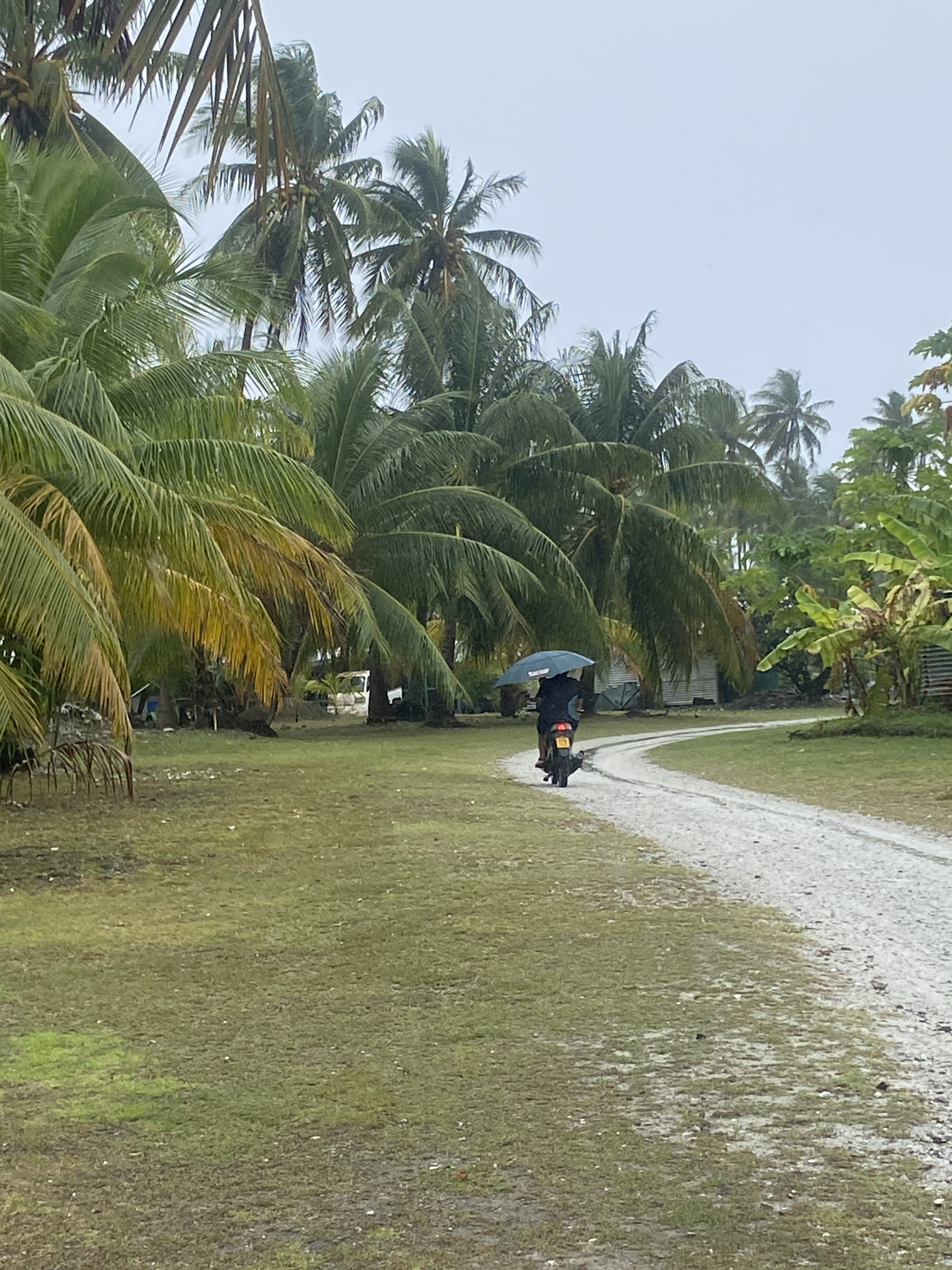
That’s one way to stay dry during the rain showers
We decided to wait until Tuesday to make the one-hour motor over to the more sheltered anchorage at the Te Tautua village, the conditions would be better for spotting and dodging the coral bommies on the way. After listening to the anchor chain grinding it’s way over the rock and coral all night, we were very relieved the next morning when the anchor and chain came up without getting caught. The anchorage at Te Tautua is just as delightful as promised – crystal clear water, lots of sandy patches for dropping the anchor, and an attractive waterfront view.
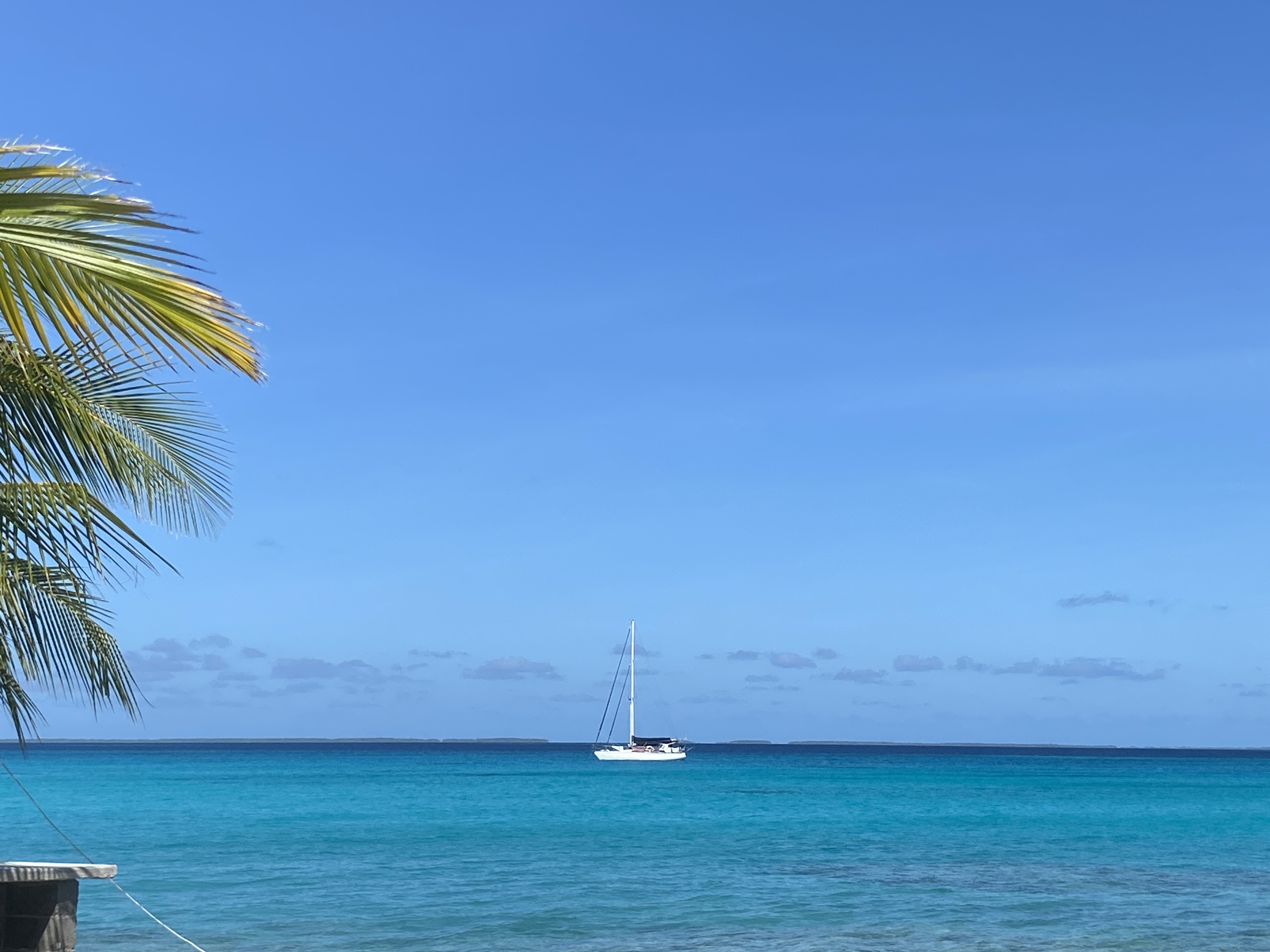
Paseafique at anchor off Te Tautua, Penrhyn
The population of Penrhyn is about 230 people, 40 of whom live in the Te Tautua village. The village has a church, a school (with one teacher and 5 students), a cyclone/storm shelter which doubles as an administrative office, and a community boat for travelling to the other side of the atoll. It functions like one large family that do pretty much everything together. The household belonging to Kura and Rio is the base for yachties. There is a dock at the front where we could tie our dinghies and a rotunda outside their house where we were always welcome to sit and chat with whoever was around. When we were there, Kura was alone as Rio and their three children were living on Rarotonga, the main island of the Cook Island group. This was not an unusual situation, as many families have members living and working elsewhere in the Cooks or New Zealand, since there are very few jobs on Penrhyn.
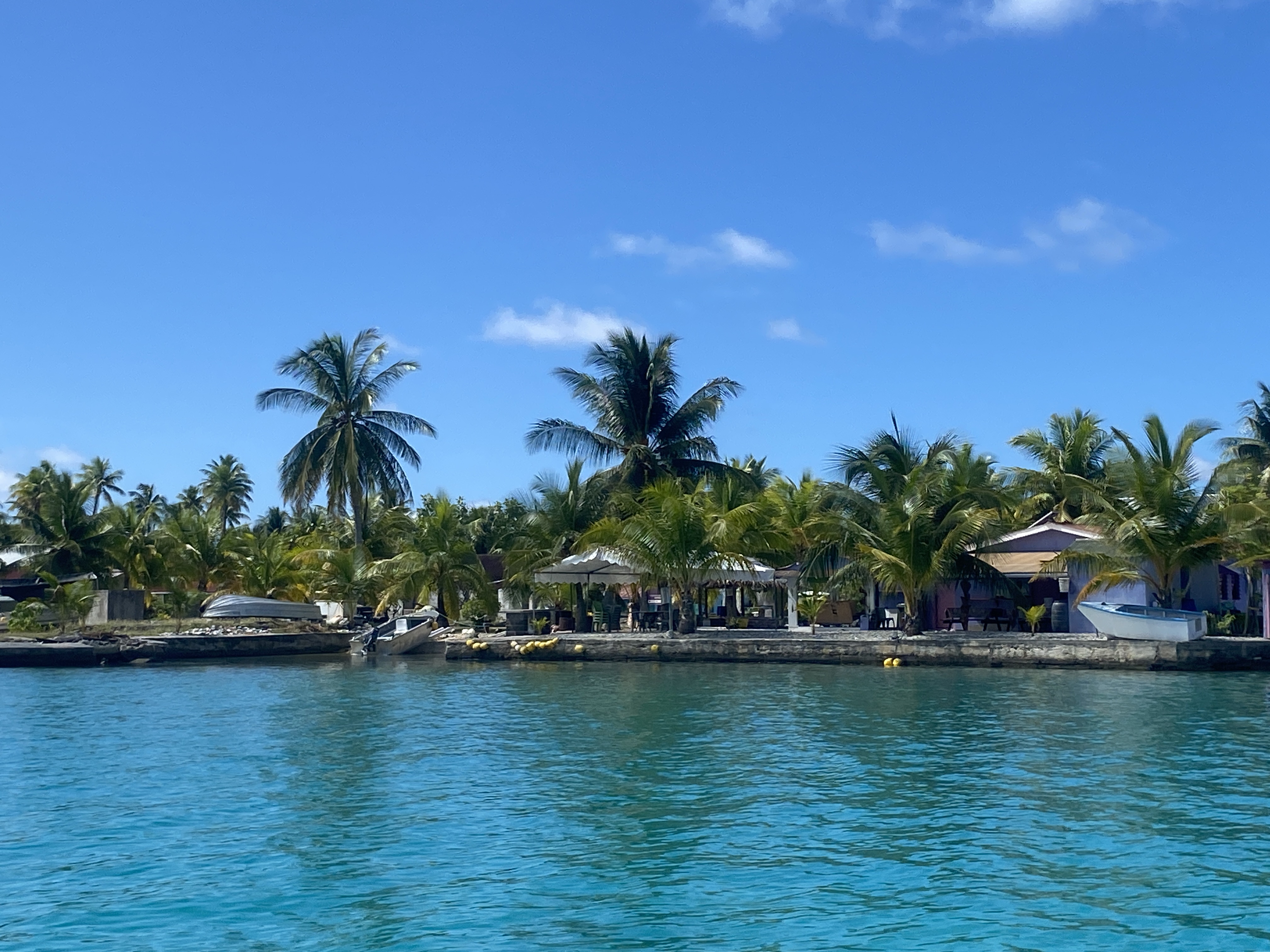
Kura and Rio’s house Te Tautua village
We were warmly welcomed by Kura in her quiet understated way. Over the course of the next two weeks, we were slowly infused with her kindness as she fed us, made sure we were included in the village activities, and generally looked out for us. When Phil needed to go over to the other side to check out and the community boat was delayed, she even took him over in her own speed boat. She actually said to me that while we were there she considers us part of her family and it’s her job to look after us.
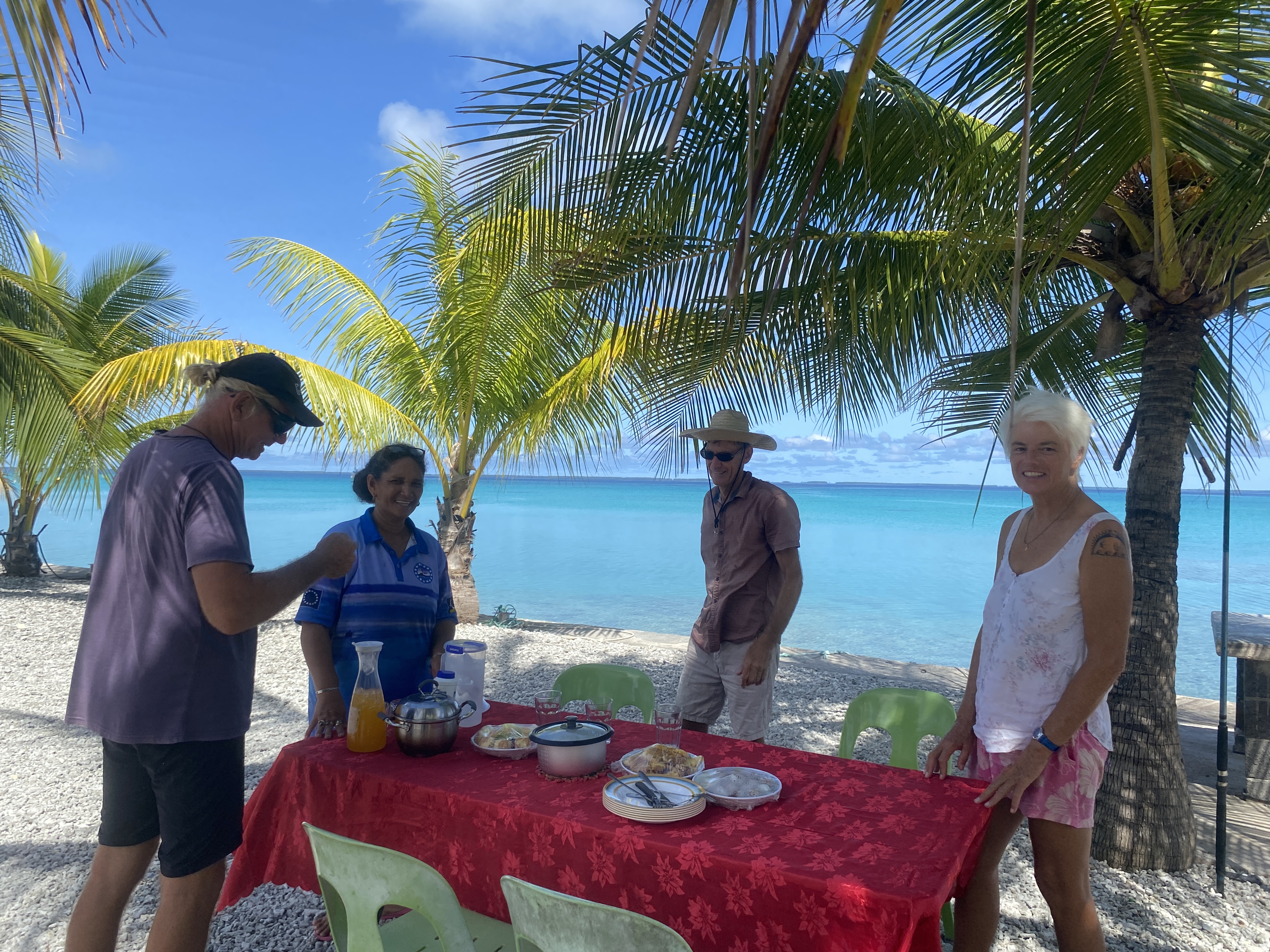
We went ashore one morning and before we knew it, Kura had a breakfast laid out for us
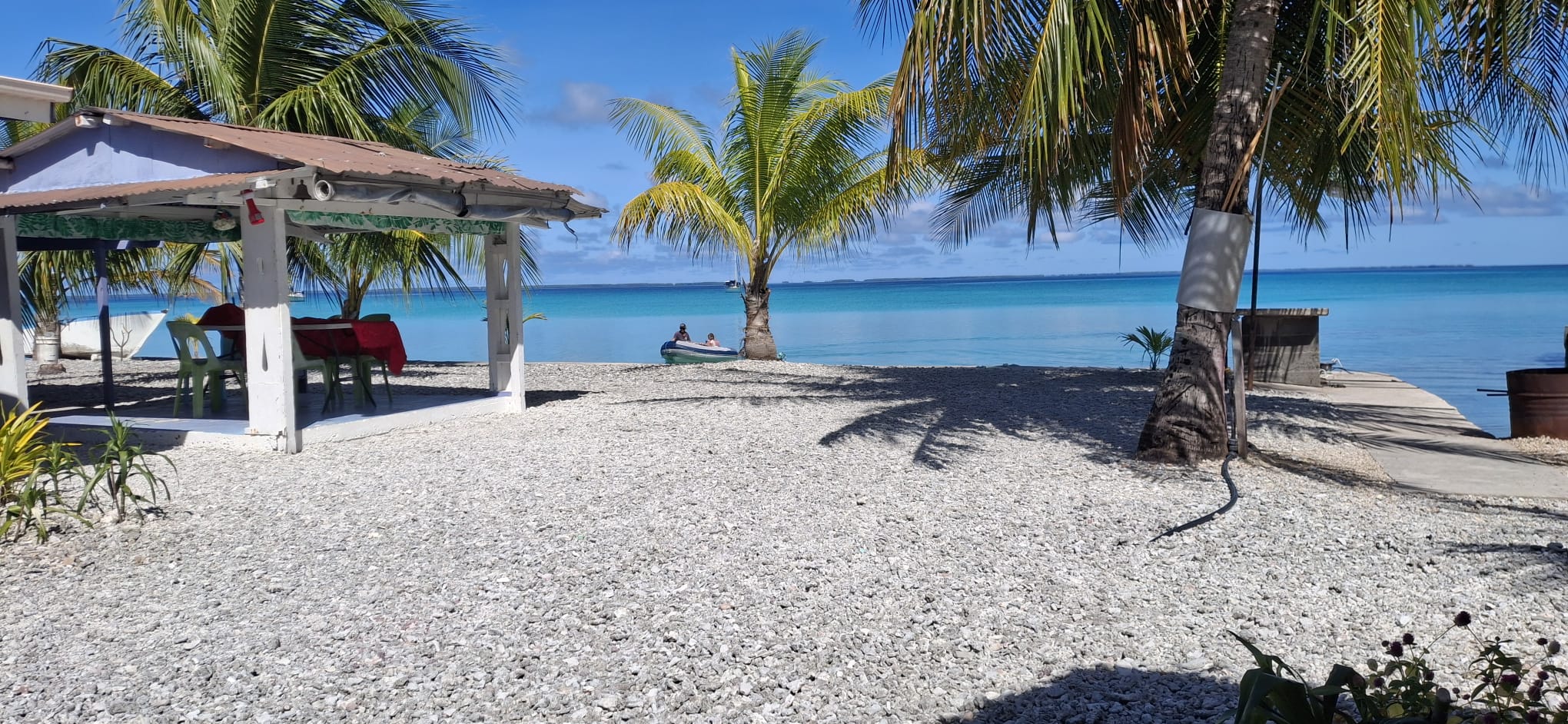
The gorgeous view from Kura’s property
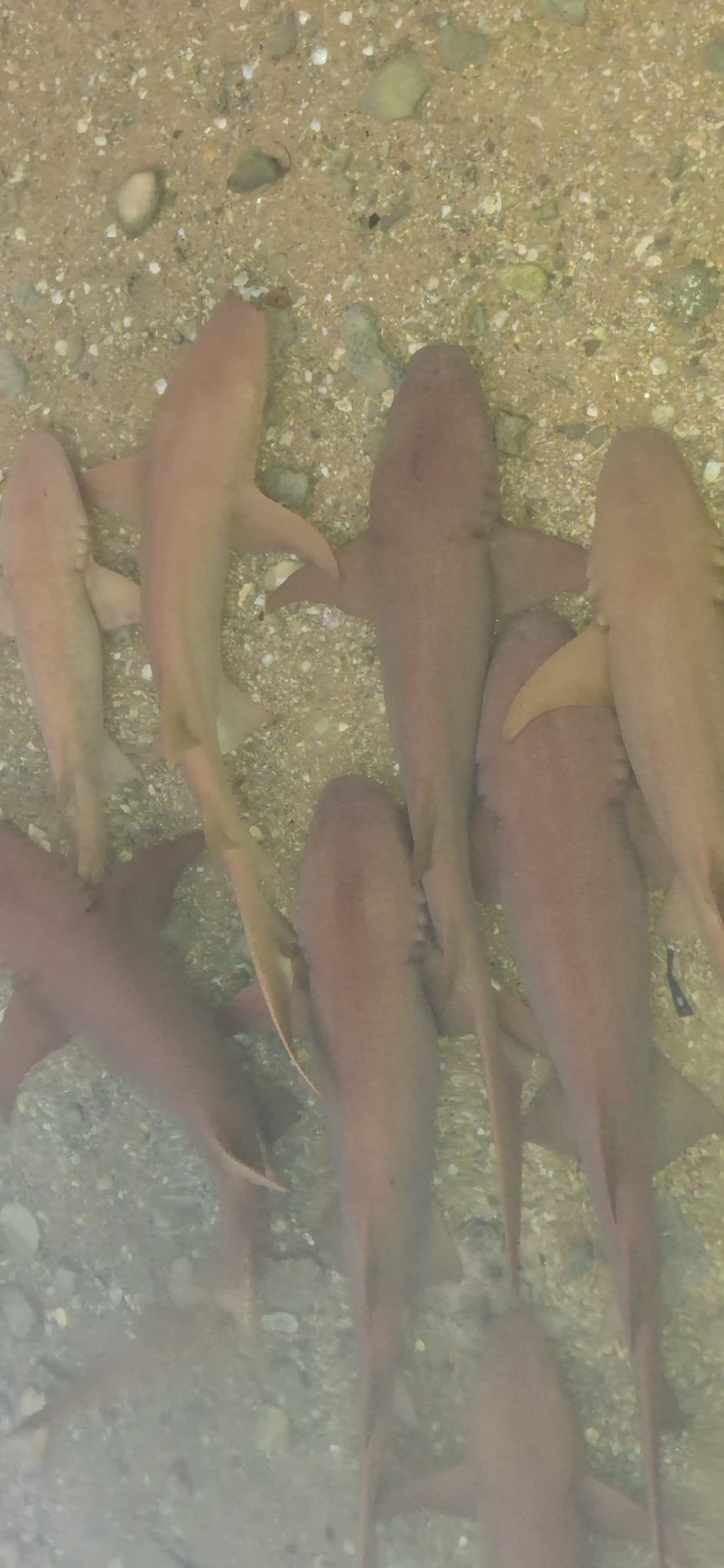
These nurse sharks hang around out the front of Kura’s house, like pets waiting to be fed
You might think that life would be rather slow in such a small place, and while life here does have a quietness, there was certainly no shortage of community events and related activity while we were there. We were lucky to be invited to attend the final day of culture week at the school. This involved a trip in the community boat over to Omoka on the other side. We watched with interest as the boat was loaded with food and other supplies, and then a number of plastic chairs. We thought these were for the celebration but not so -they were unpacked and placed in rows in the boat for everyone to sit in for the trip. We all piled in and off we went with much merriment. On the way, the 5 school children practiced their song that they were to perform later that day.
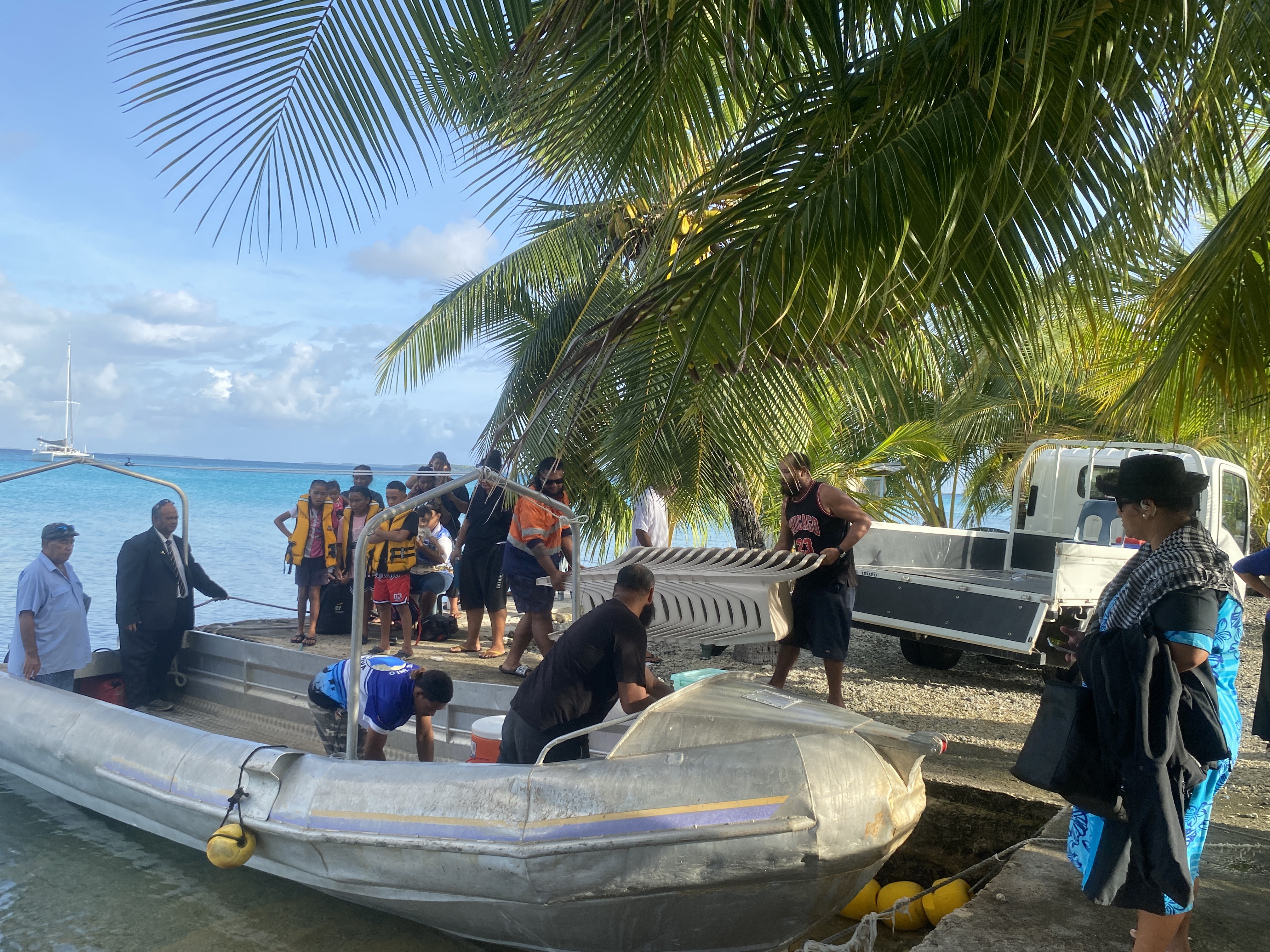
The community boat being loaded for the trip to Omoka, chairs included. The minister in the suit at the back of the boat said a prayer before we left, and one when we safely returned.
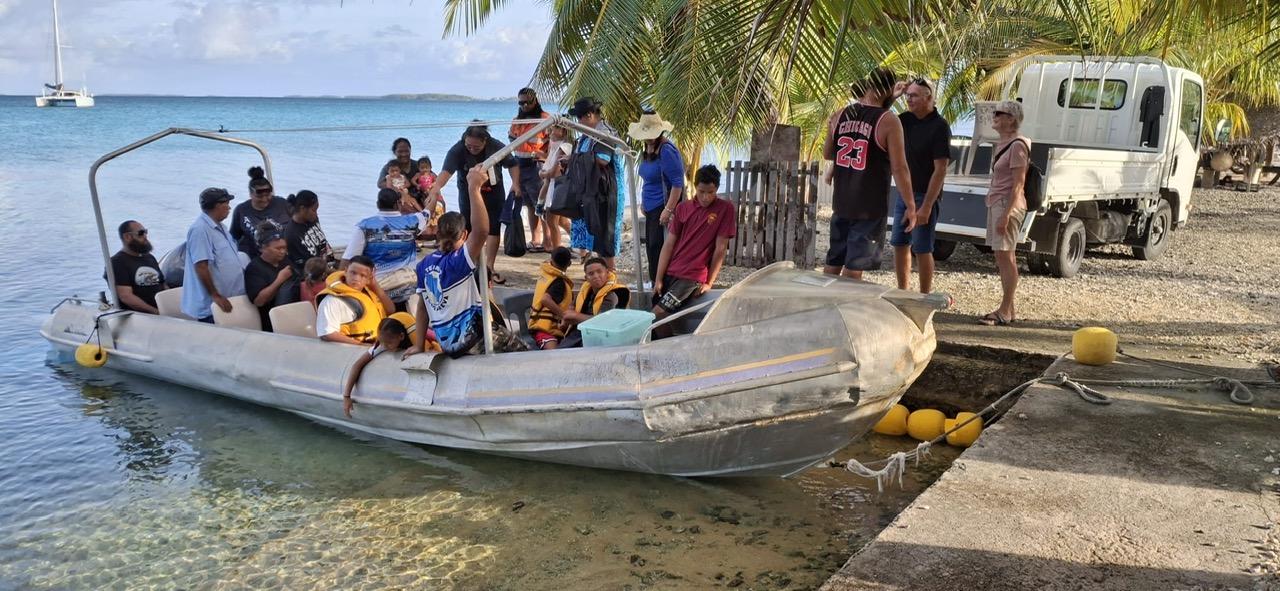
And in we get
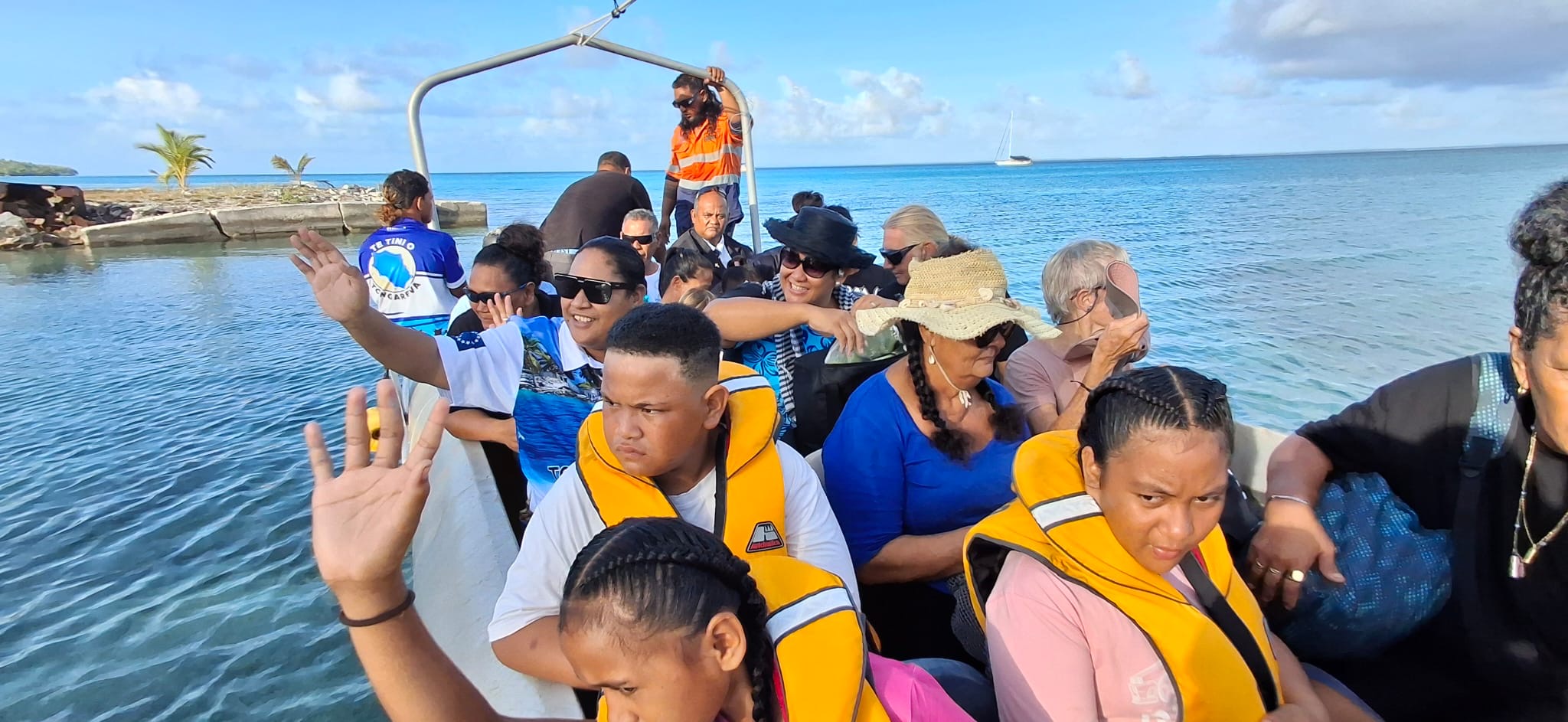
And we are off!
We arrived at Omoka and shuffled off to the school where a large marquee had been set up for the student performances, which were to be followed by lunch. About 7 individual students had been selected to perform a cultural piece, in their own language, which each one had to develop around a central theme, along the lines of what their gods and culture meant to them. Some were more nervous than others, some had a good stage presence, and the senior ones (year 10) displayed genuine respect for their culture.
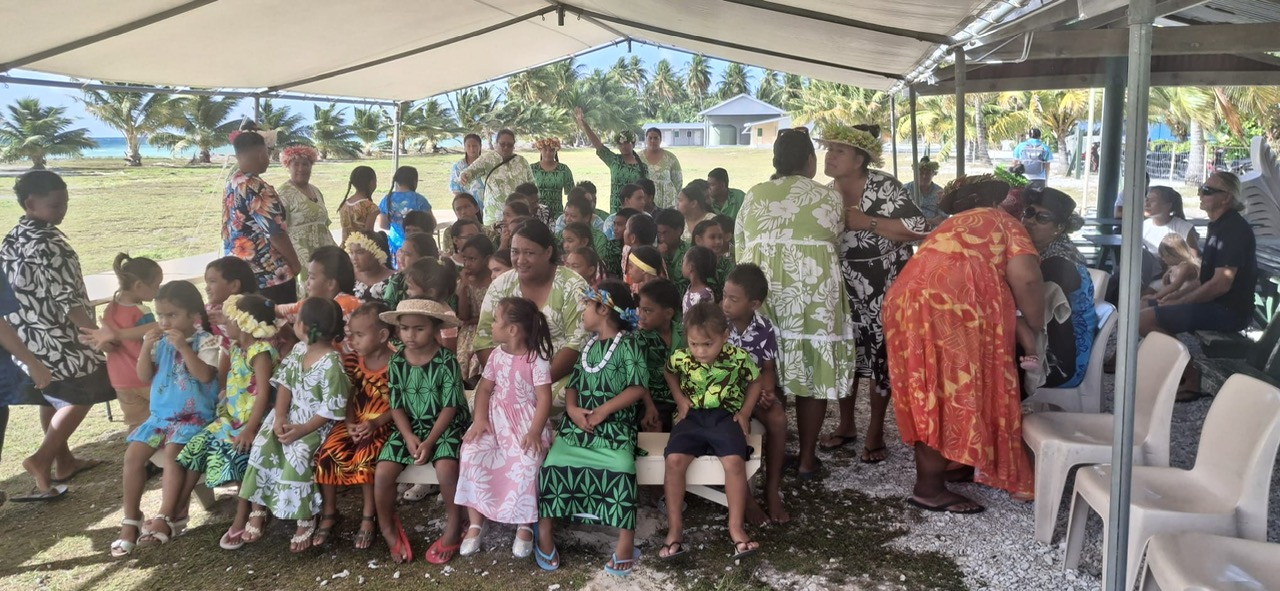
The school children ready for their concert
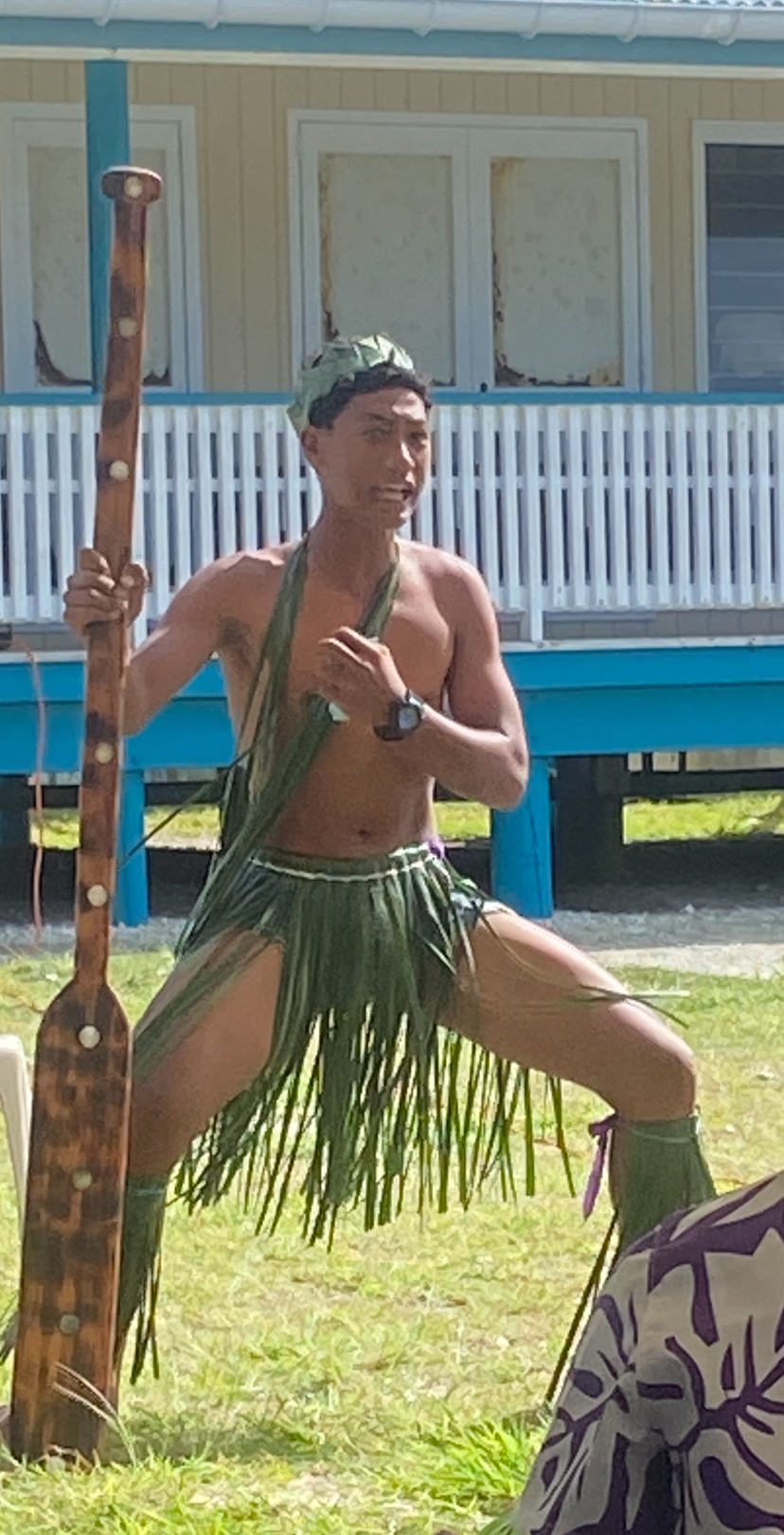
One of the senior boys doing his presentation
The song of “our” students was very well received by the other students, teachers and parents. Lunch was an extravaganza of traditional food – curried clams, fish baked in banana leaves, local pork and chicken, accompanied by loads of different starch dense vegetables. No rice, as this is not a traditional food. The students had all helped to prepare the food, along with their families.
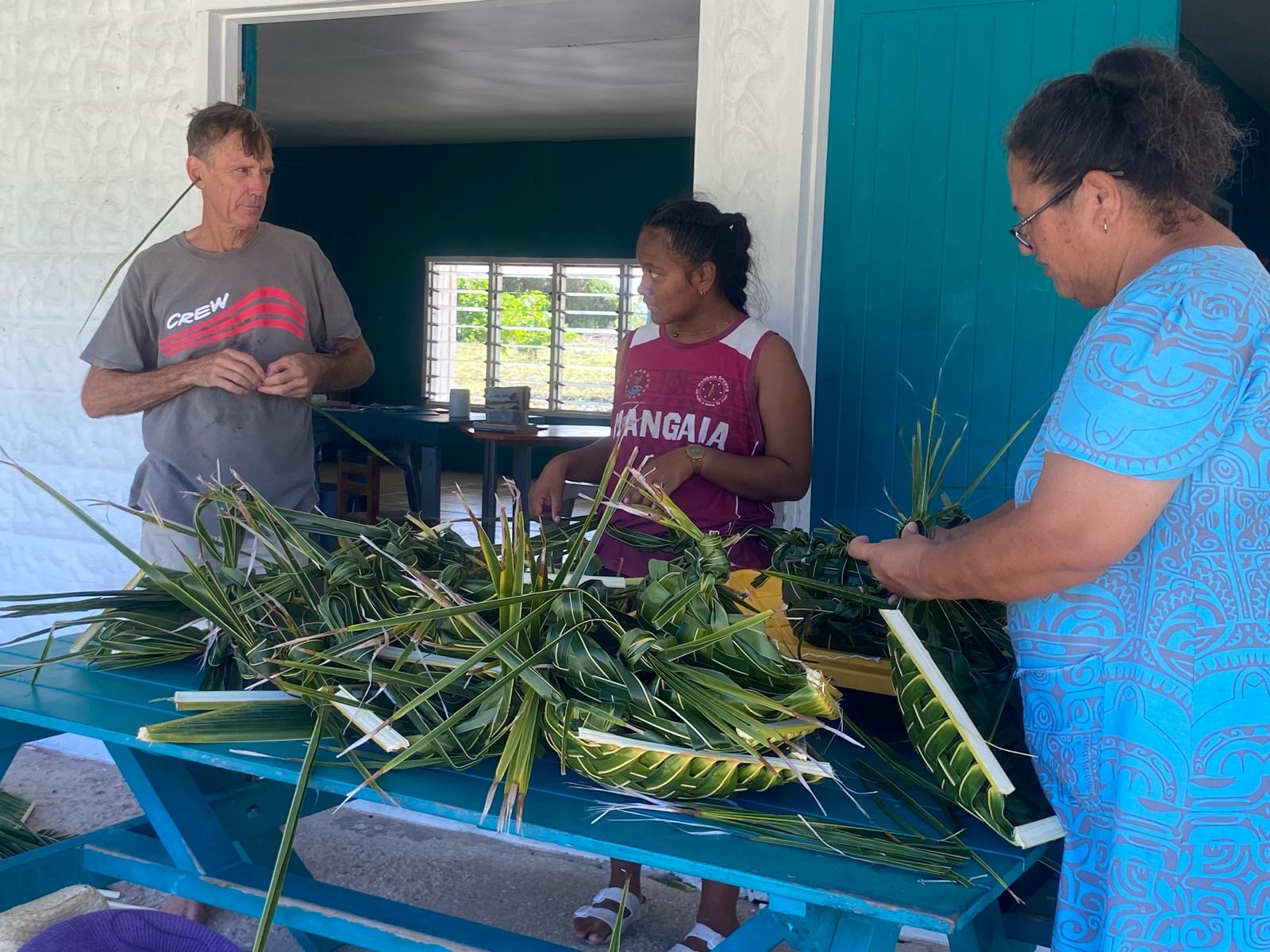
Making the plates at the Te Tautua school the day before the concert
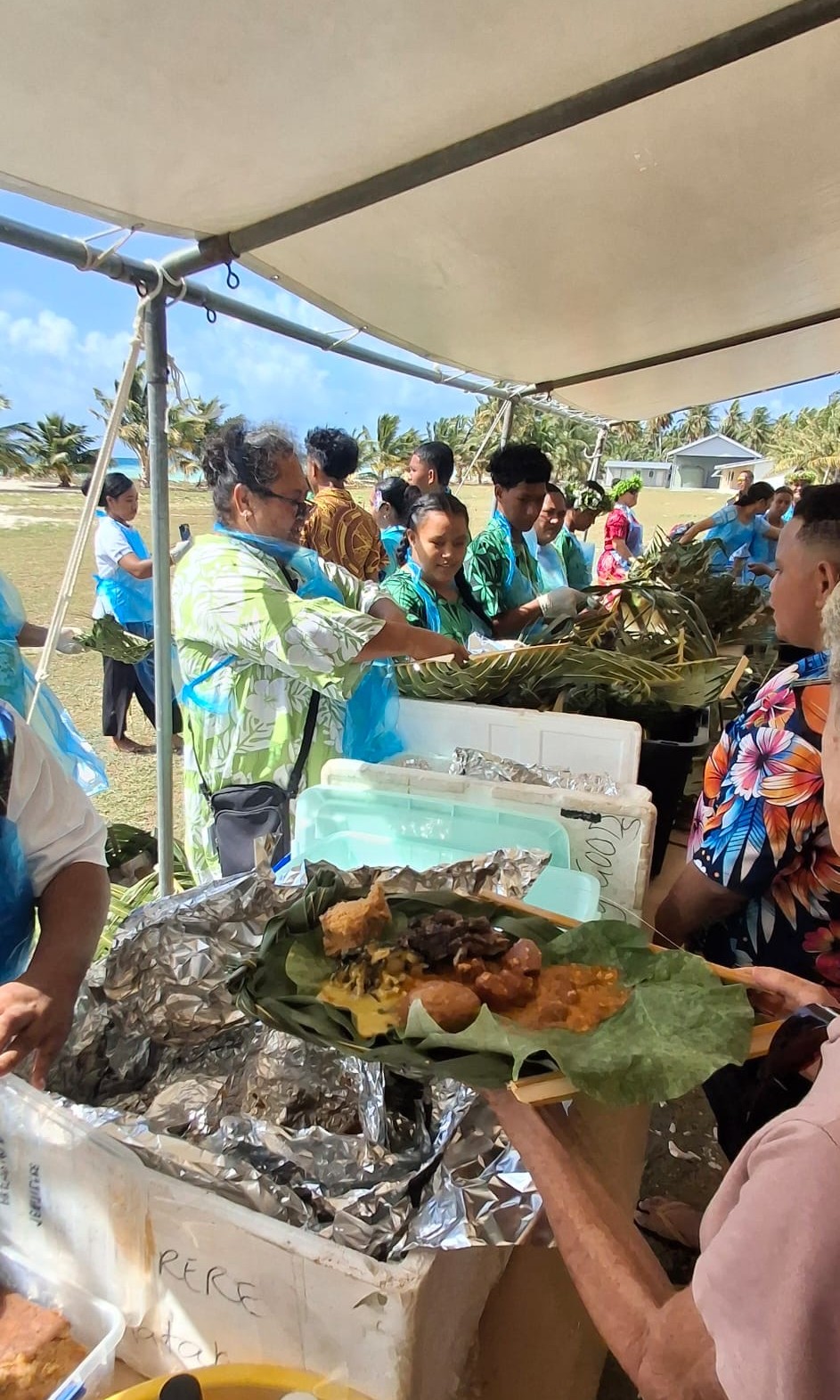
Plates being put to good use at the lunch
As soon as lunch was over, everyone pitched in and packed up the tables, chairs and the marquee. The left-over food was divided up into portions for the families to take home. Then we all piled back into the community boat for a much more subdued and wet ride back to Te Tautua.
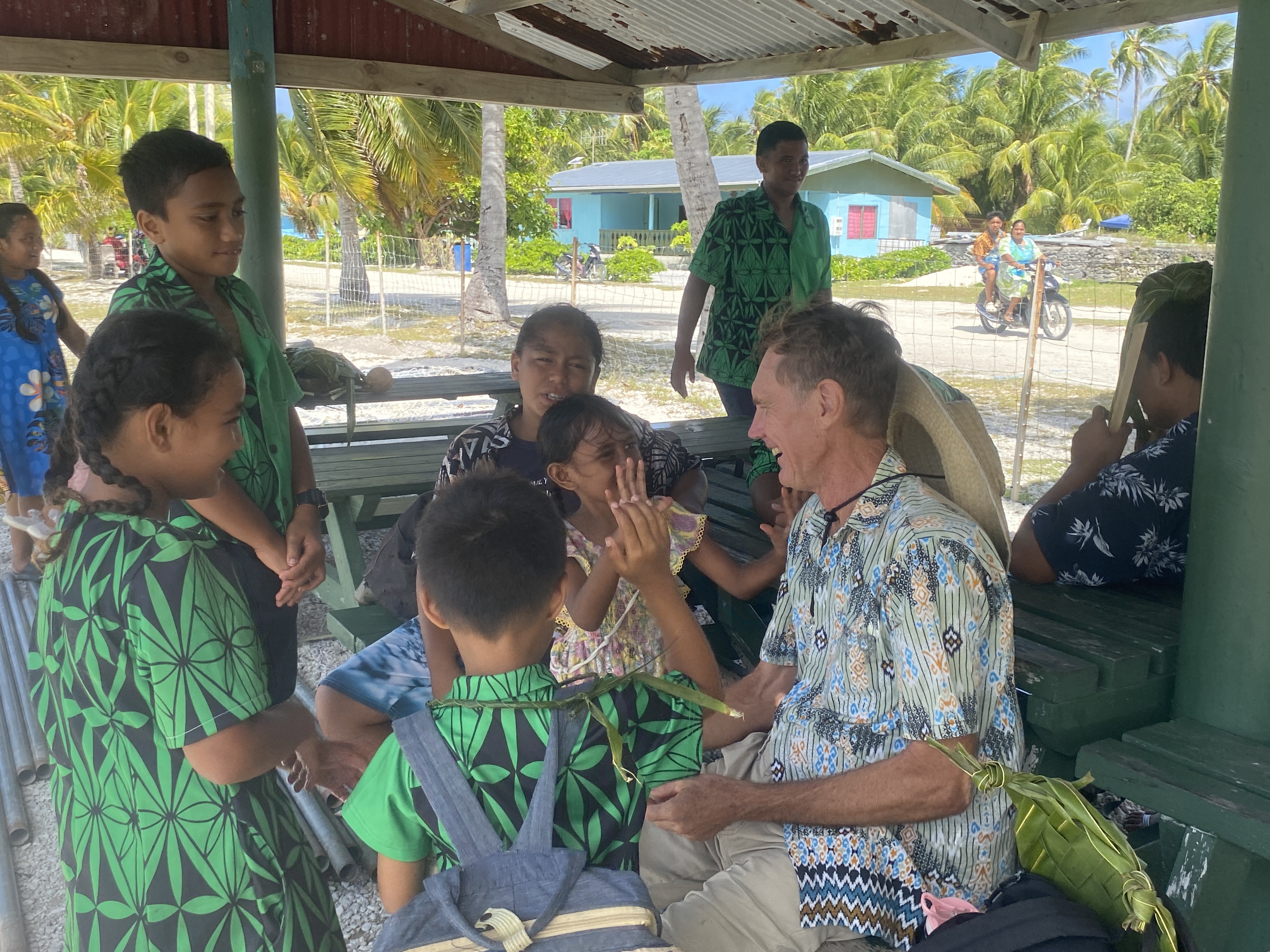
Phil entertaining the school children
We learnt that the two schools come under the direction of one principal who works closely with the teachers, including the teacher from the small Te Tautua school. The children can complete up to year 10 on the island, but the rest of their education has to be completed in Rarotonga. But not all the students get that opportunity. Only the ones whose year 10 marks reach the level required to obtain a scholarship which funds their travel and further education, and whose families can support their accommodation on Rarotonga. Fortunately, there is no limit on the number of scholarships.
Our time at Te Tautua co-incided with two birthday celebrations. One for Celine, the three-year old daughter of one of the other cruisers. Food appeared from everywhere, and someone made a birthday cake. Kura presented Celine with a simply beautiful woven hat and a fragrant lei of white flowers. Celine was delighted with our gift of a kangaroo stamp, notebook and pink hair band that we happened to have in our ‘give-away” box.
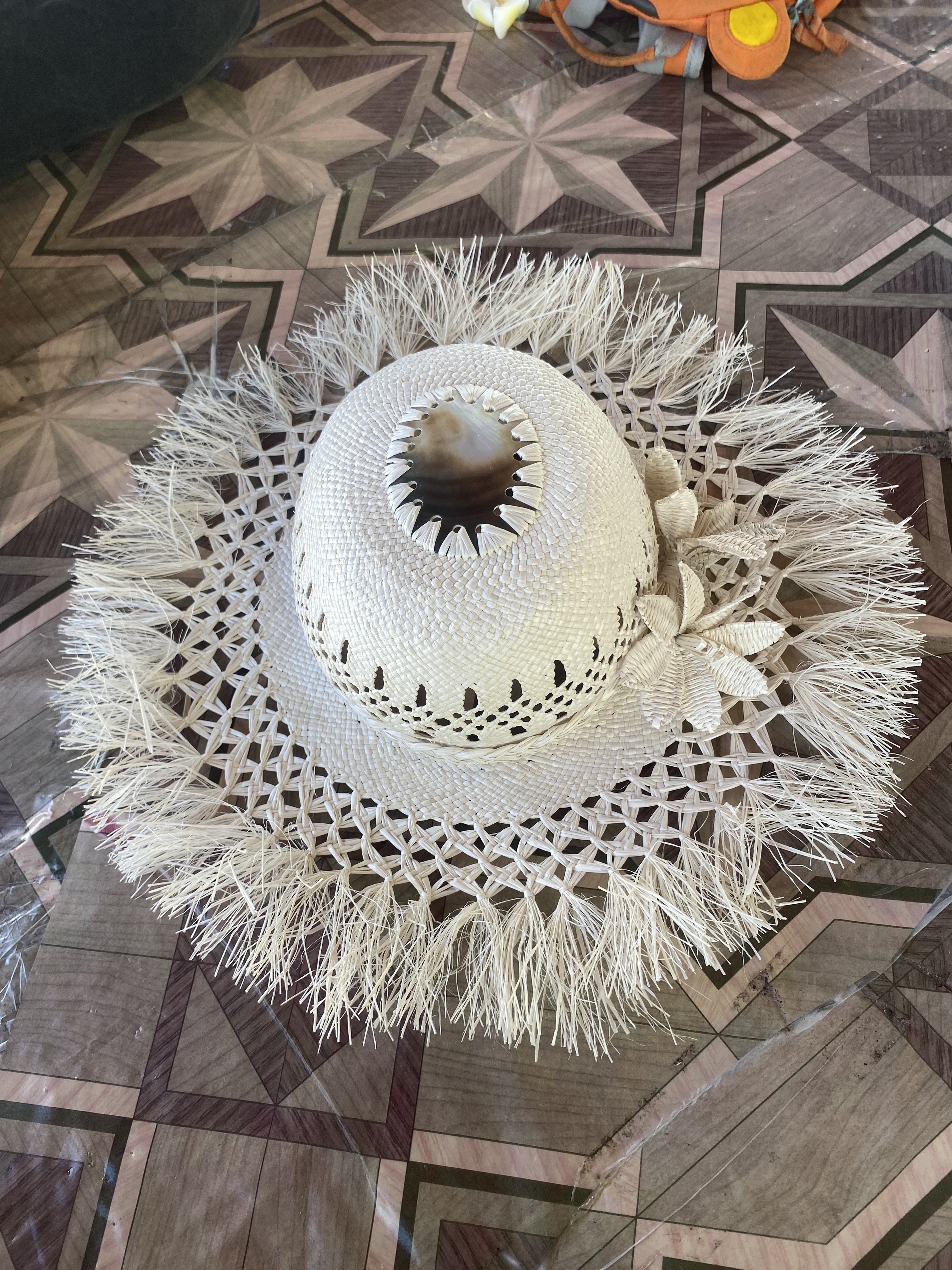
One of Kura’s creations – her hats typically sell for hundreds of dollars in Raratonga
The other celebration was for a local family’s one year old, Simoro. Preparations started days in advance, with the local men going fishing, clam and oyster harvesting, and lobster gathering. The first lobster trip was unsuccessful, so some birds were captured for roasting instead. There must also have been pig slaughtering somewhere also. On the morning of the party, Kura’s house was abuzz with activity, as the men cooked curried clams, and Kura made a giant pot of potato salad.
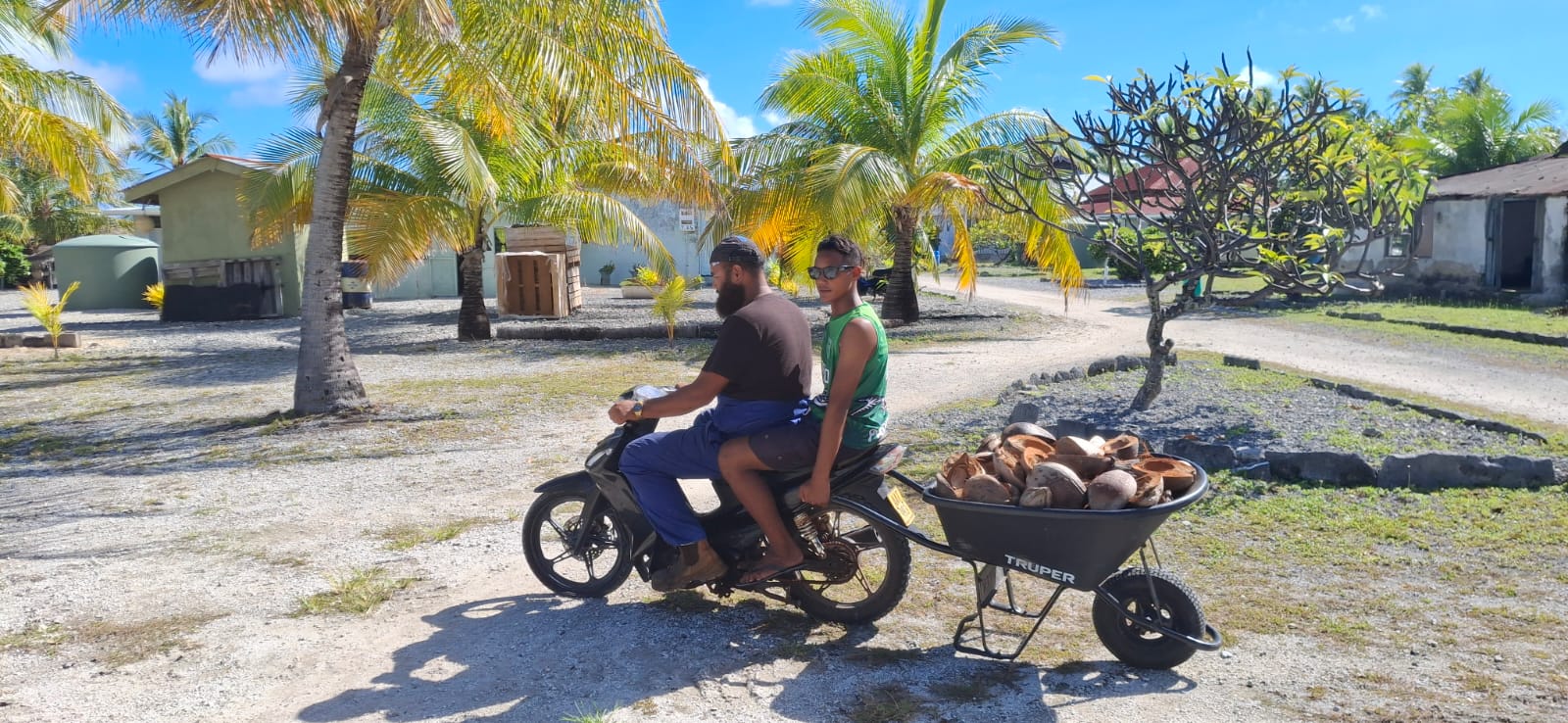
Motorbike trailer, island style, bringing coconut husks for the fire
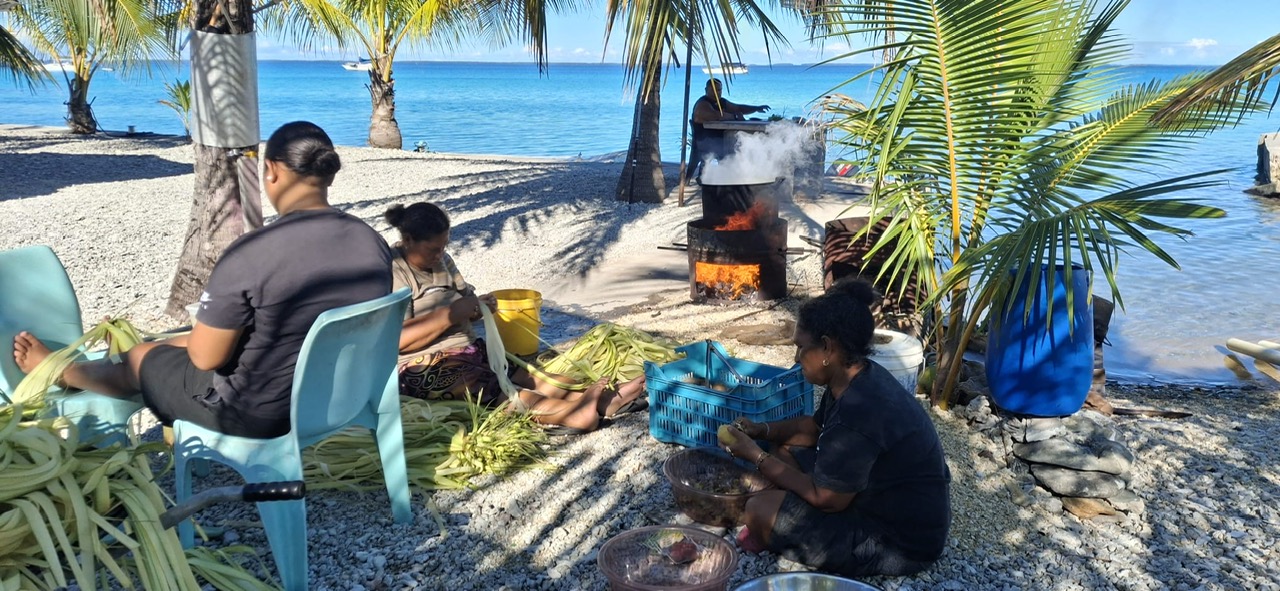
It’s all happening here: food preparation at the far table, curried mussels cooking on the fire, Kura peeling potatoes, and the ladies preparing the coconut palm leaves for weaving
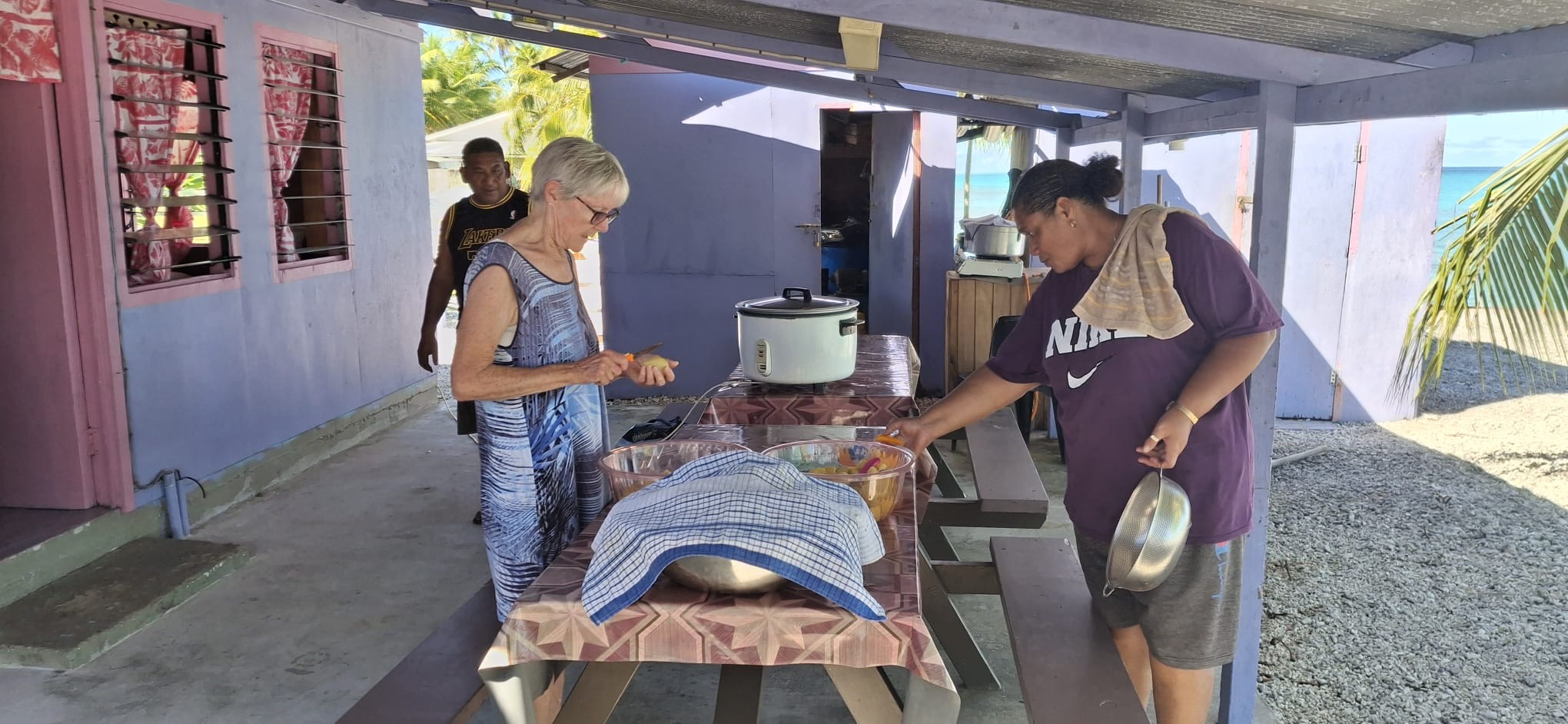
Pitching in, cutting up the cooked potatoes
We had all been duly invited, and so each cruising boat prepared some food to share, not that any more food was necessary. However, we were all totally unprepared for the significance of a first birthday in their culture. The church congregation from Omoka had all been invited so there were maybe 80 people, all dressed in their best clothes. There were long tables at the front for the birthday boy and his extended family. Behind these tables were giant happy birthday posters printed with his photo. There was singing and long speeches, some of which were no doubt prayers. After lunch, which again was served on tables absolutely groaning under the weight of the food, Simoro was presented with a lei which was not only covered in flowers, but also envelopes of money in lieu of presents since there are no shops. We learnt later that the money was likely to be in the thousands of dollars! Unlike Aussie parties there was no lingering and chatting after lunch, as the whole show was cleared away and packed up very efficiently. Again the left-over food was divided among the families.
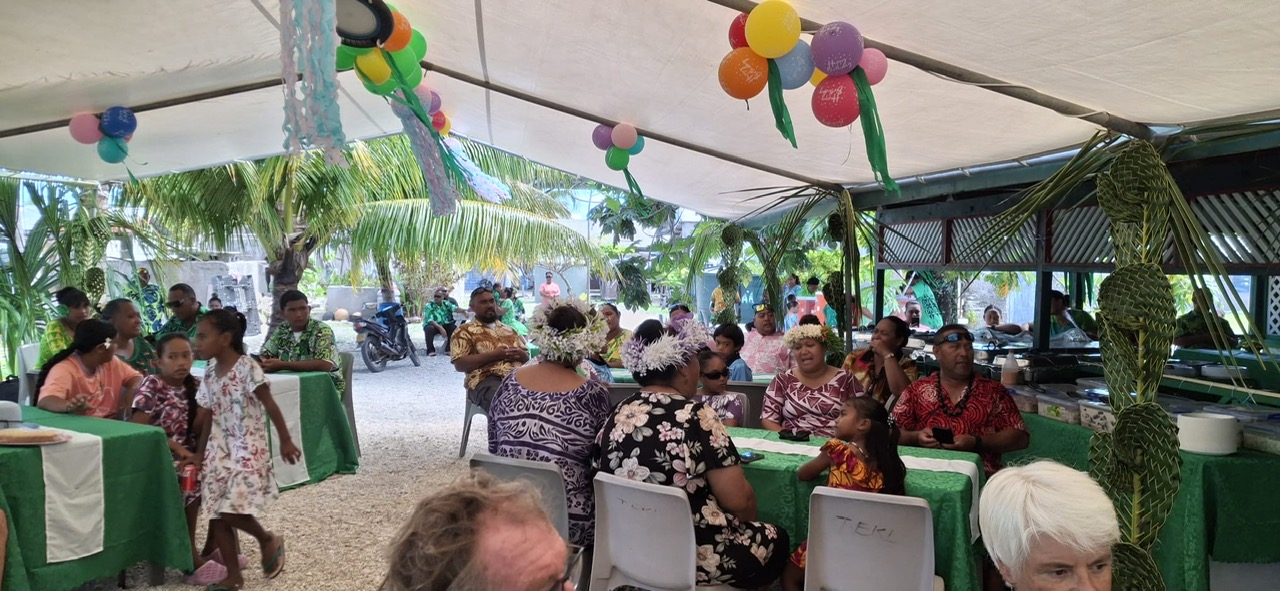
Ready for the first birthday party
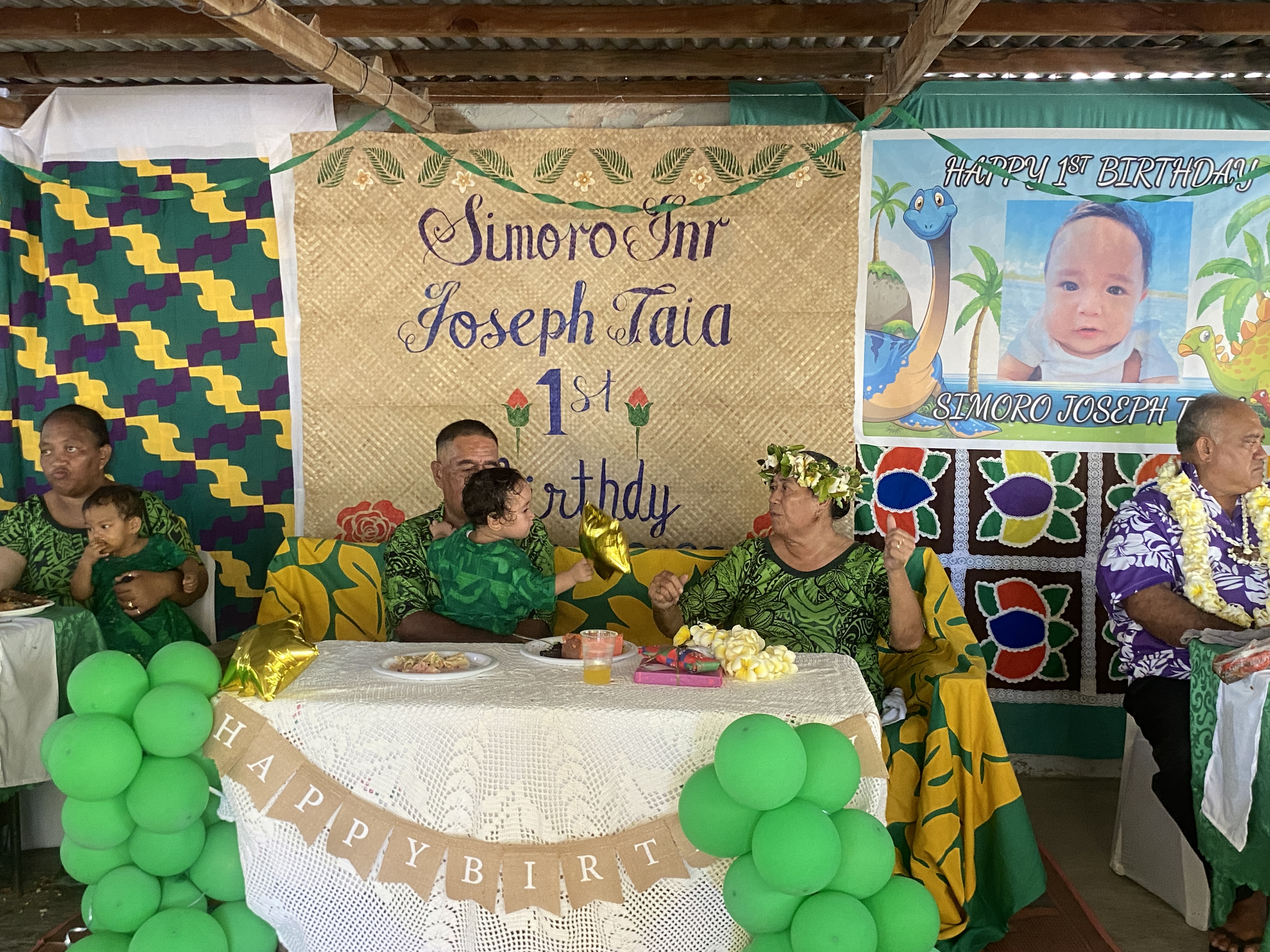
The birthday boy with his grandparents
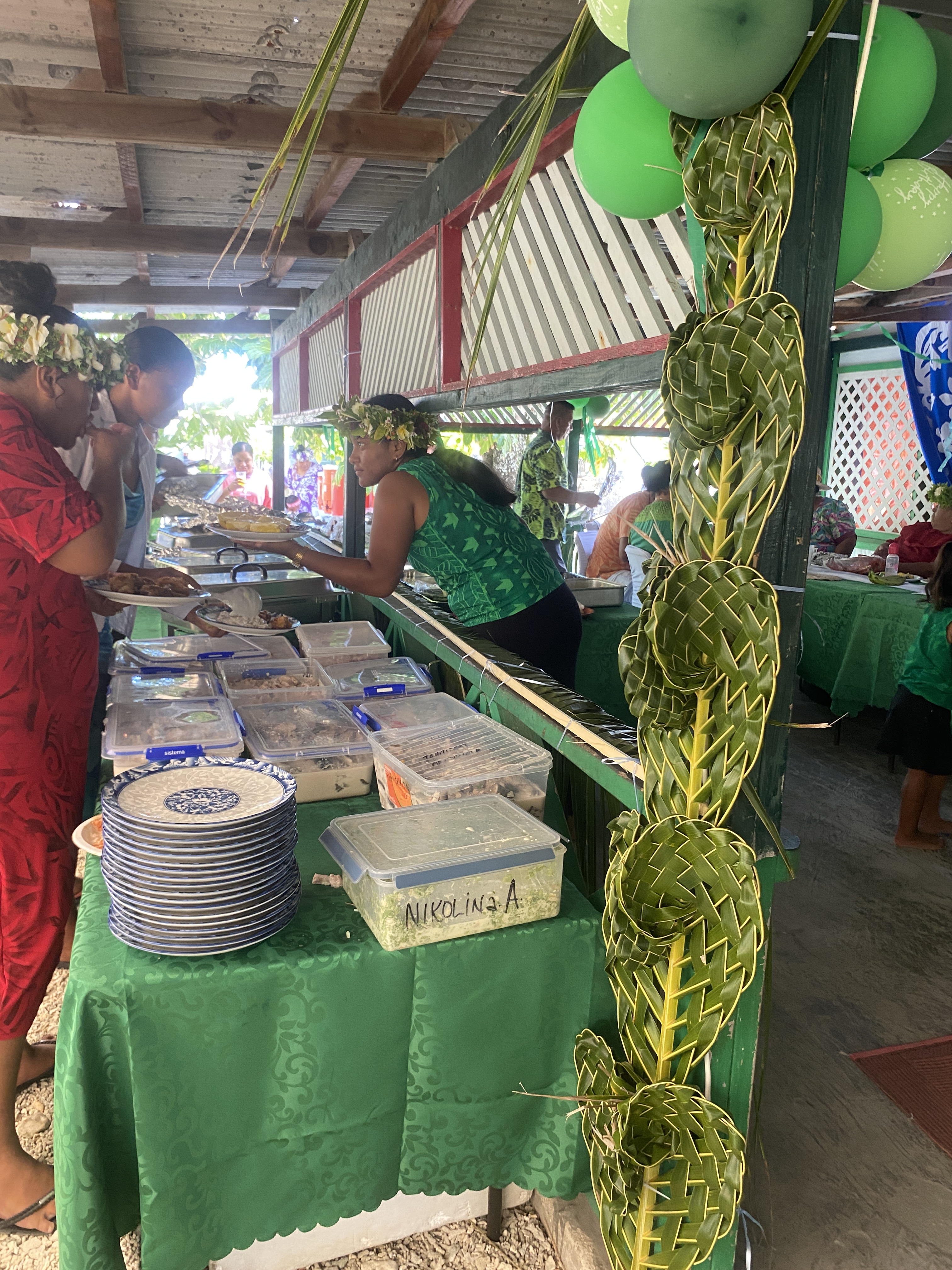
One of three loaded food tables. The whole area was beautifully decorated with woven leaves and flowers.
In between these celebrations, we went for walks around the island, snorkelled, swam, and hung out with Kura chatting about island life and watching her make her beautiful hats and other woven items.
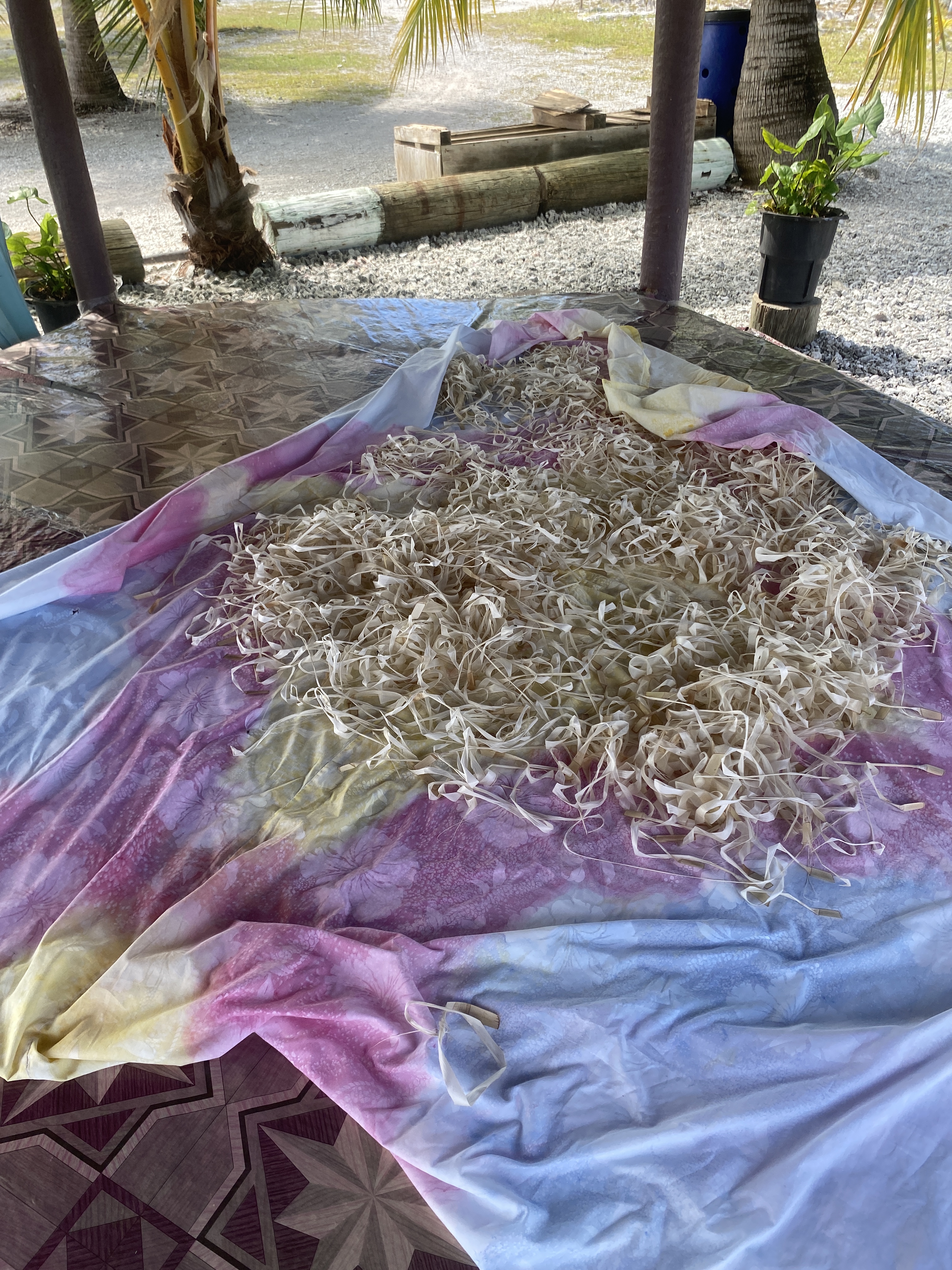
Coconut palm leaf pieces drying after having been boiled in lime juice to bleach them

Kura at work – here she was weaving some decoration on a large carved wooden key for her nephew’s 21st birthday
We went to church on both Sundays to show some respect for the importance of religion in their village. I was also keen to hear the singing, which had been so beautiful in the Pacific so far. But the style here was no match. There were no instruments at all, and it seemed that singing at fever pitch was regarded among the women as a way of currying favour with God. The more muted tones of the men’s harmonies were a welcome moderation.
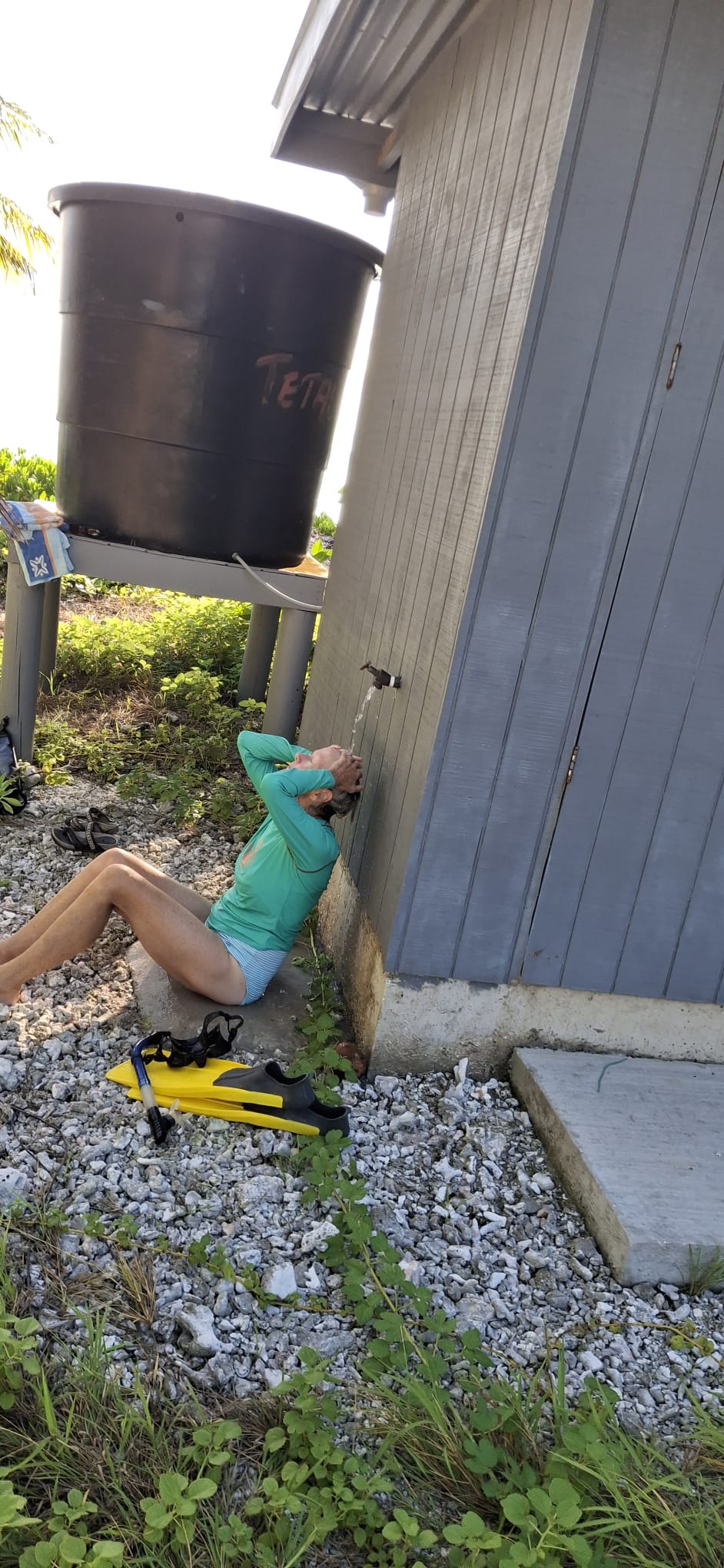
A blissful fresh water shower after snorkeling
Of course there was also sundowners with the other three boats in the anchorage. One of the other yachties, Gordie, ended up in a bit of a pickle when a coral scrape while snorkelling developed into a full blown infection in his leg and knee. Despite a course of two oral antibiotics, one of which was provided by the local hospital, he ended up having to be taken over to Omoka hospital to receive intravenous antibiotics for several days. He narrowly missed needing to be medi-vac’d out to Rarotonga.
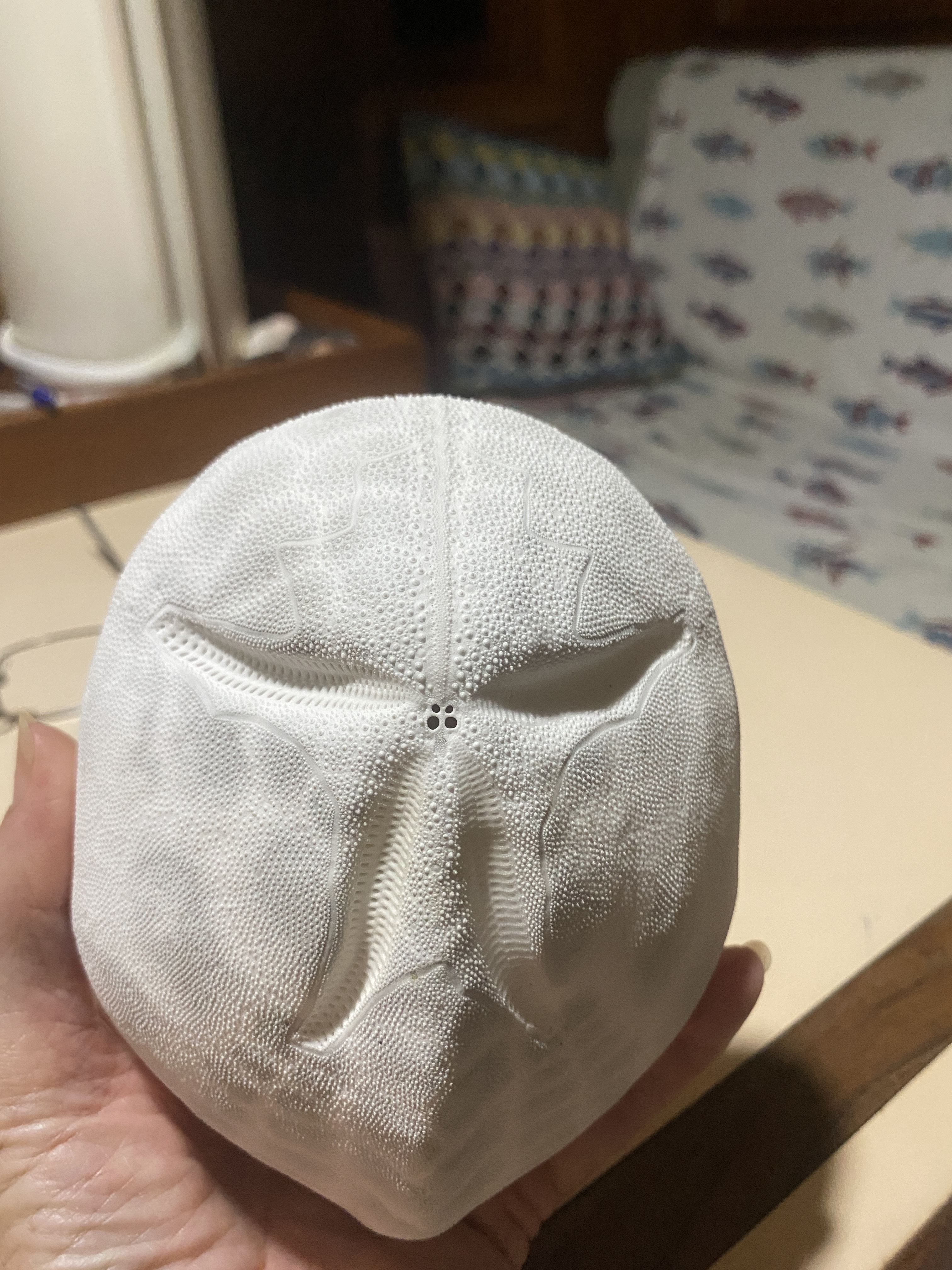
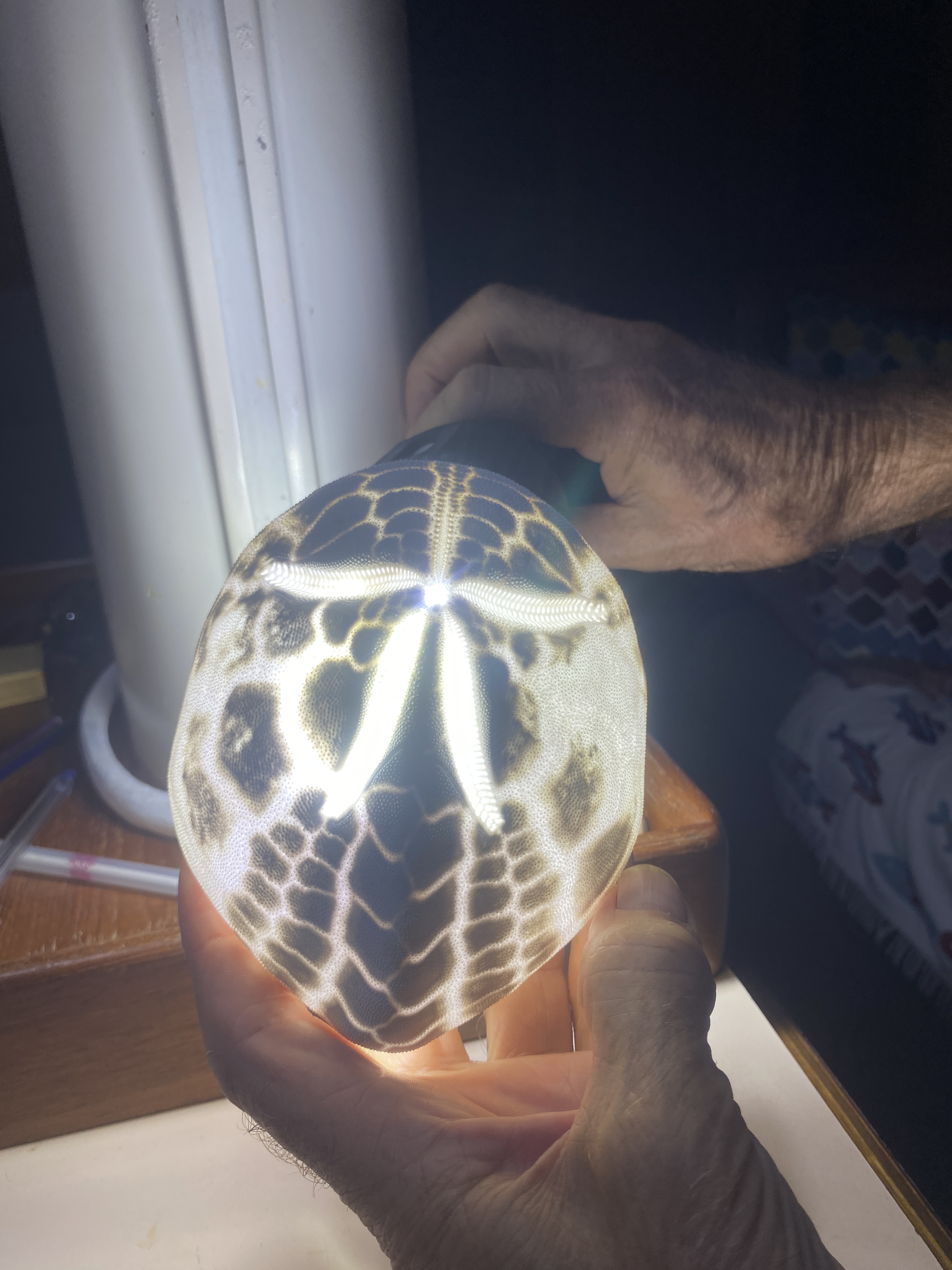
Shell of a heart urchin. These creatures have soft hair-like spines rather than spikes, and they use the ones underneath them to bury themselves down into the sand. They have specialised tube feet to gather organic particles from the sand.
Paseafique has two depth sounders, one of which stopped working a long time ago, and the second of which developed an intermittent fault over recent months. Replacing our in-hull depth sounder is not straightforward because the boat would have to come out of the water, which adds to the cost and logistics. With time on our hands, Phil, with some input from others, came up with an ingenious solution. Phil had been finding marine sonar probes washed up on a number of Pacific island beaches. We learnt that these units transmit real-time data via satellite for commercial fishing.
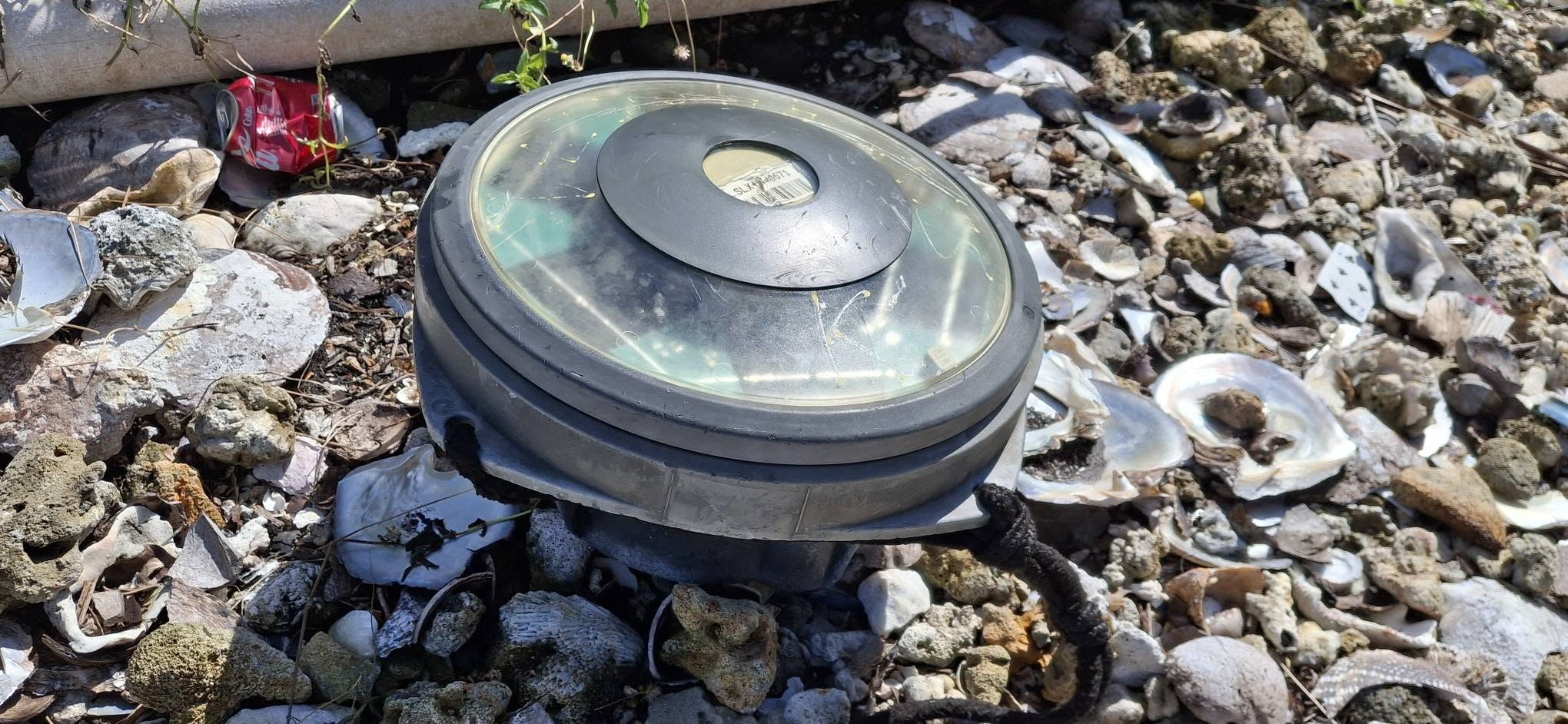
A marine sonar probe
Being a curious soul, he took one apart to find quite a deal of technology inside – circuit board, solar panels, batteries, LEDs, GPS unit, Irridium satellite unit, and a depth sounder! Manfred, another yachtie in Penrhyn at the time, advised that a depth sounder will work through the hull if you install it in a way that excludes any air between the sounder and the hull. So Phil got to work installing it in a plastic container of water, and we unexpectedly had a functional depth sounder.
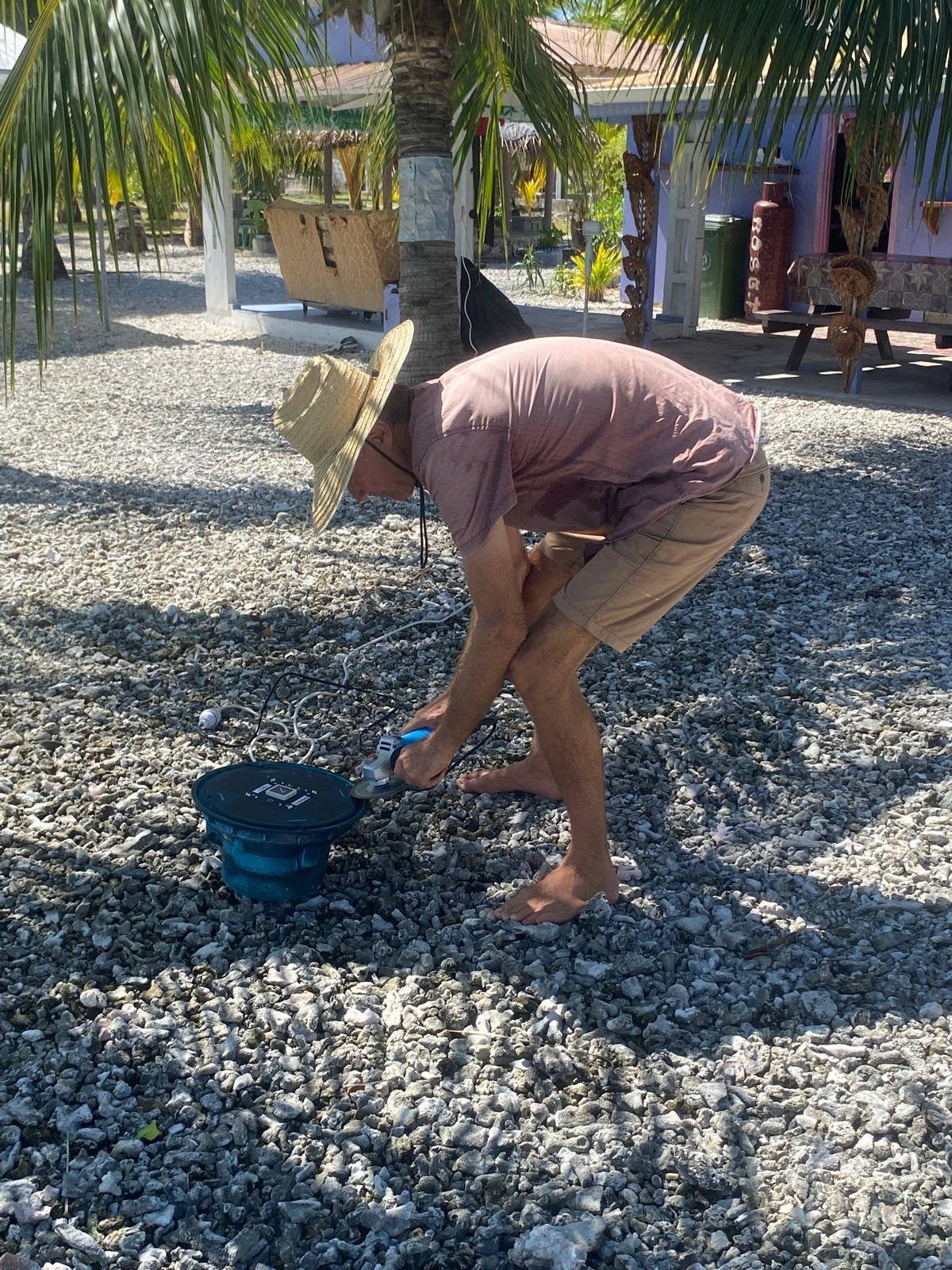
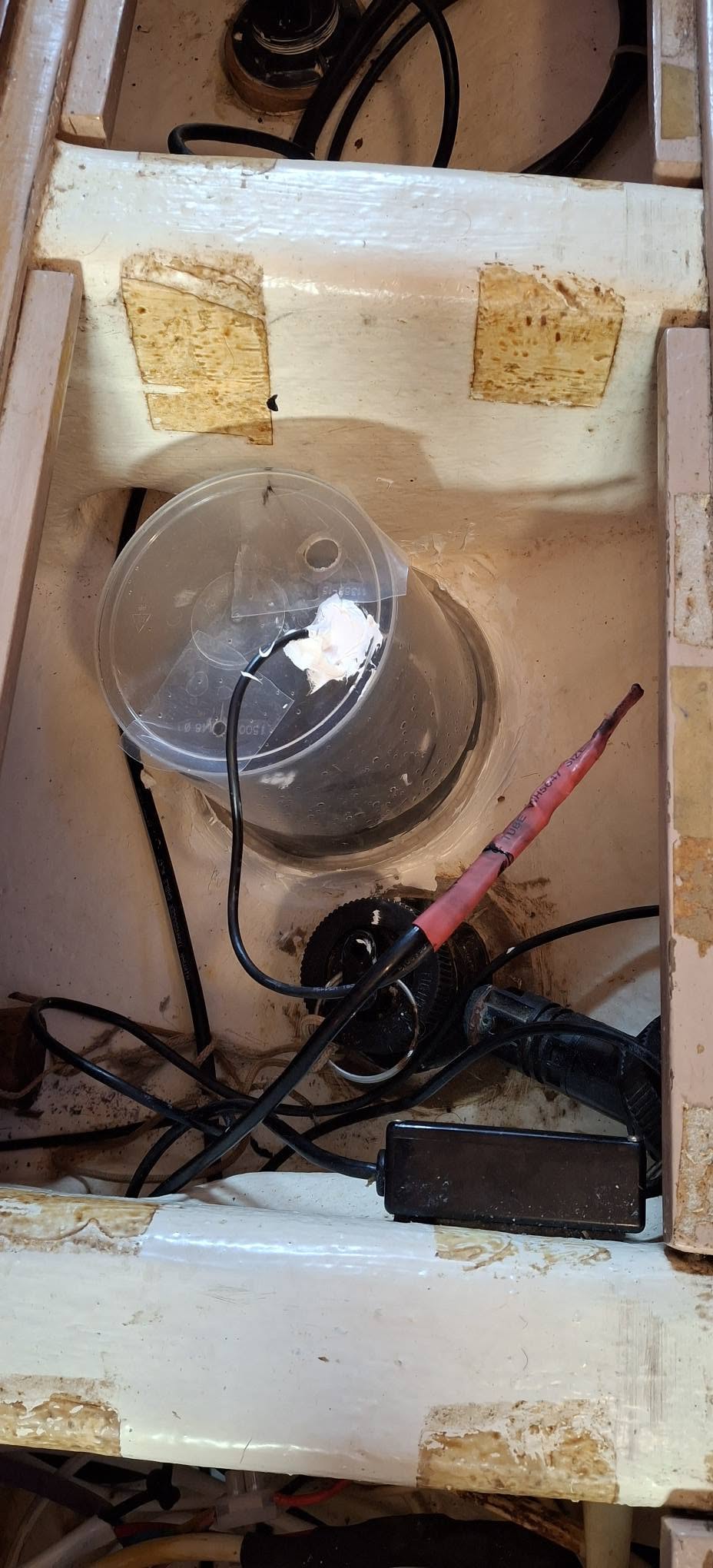
Phil in action, grinding open the probe to retrieve its depth sounder, for installation against our hull, giving us a functional depth sounder again
After two weeks in this remote paradise, we saw what we thought was a reasonable weather window for our passage to Samoa.
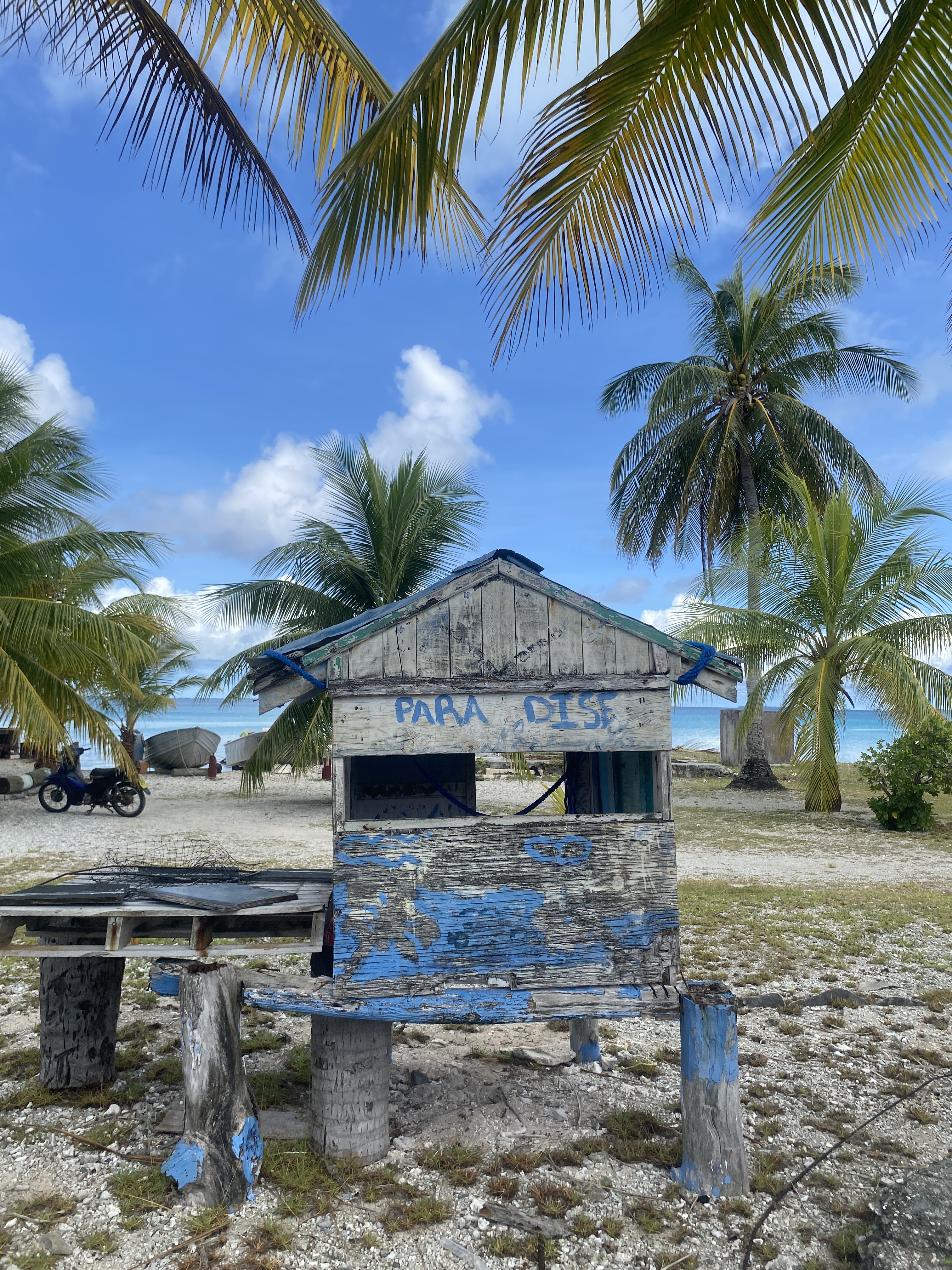
Kura says her home is paradise, and we tend to agree with her
On the morning of our departure, we went to dinghy in to say our farewells to Kura, and the outboard engine broke down – again! With no time to fix it, our New Zealand friends on Silverwind took us ashore in their dinghy. It was sad to say goodbye to Kura, this generous and gentle soul who gives so much of herself to the endless stream of cruisers who come into her life, only to leave again and mostly never return.
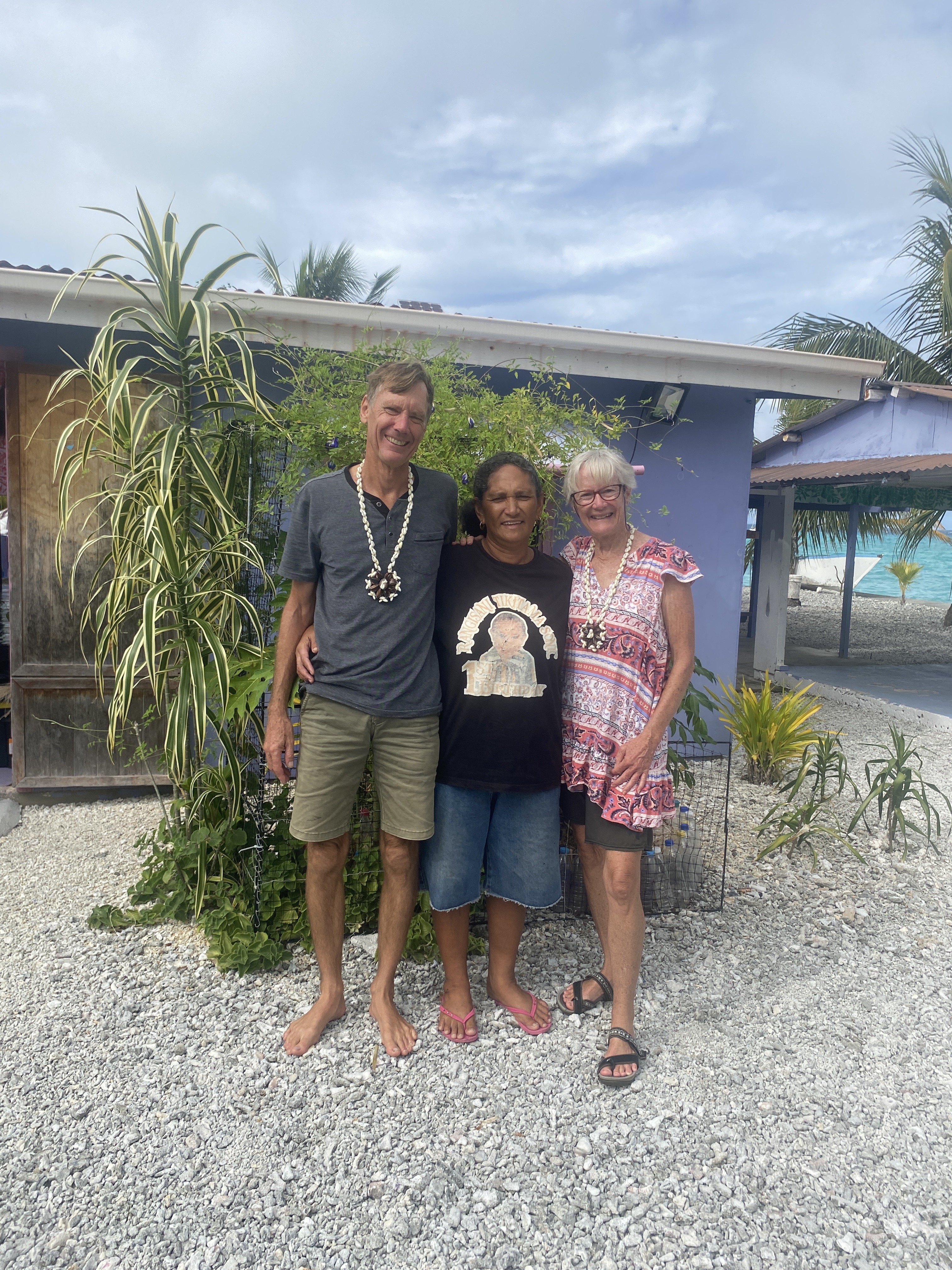
A sad farewell to Kura after she had presented us with these beautiful shell necklaces
We left Te Tautua around 10.30 on Tuesday and by midday we had cleared the pass and got the sails up. It was windy as forecast (19-25 kts) and by 7pm we had a fully reefed main. We had expected the wind to be just aft of the beam, but instead it was just forward, which is not ideal with the stronger wind we were having. A fairly wild night ensued with tons of ocean being dumped over the boat. Further, the swell and waves were conspiring to treat our hull as a punching bag, slamming frequent teeth-shattering blows to the side of the boat, and testing our nerve. We put away our large genoa and put out a small section of the stay sail – a small furling sail which we have hardly ever used. We each took a very small dose of an antihistamine to help us to get some sleep in these very noisy and rough conditions.
Next morning, we put our heads together to work out a strategy for managing the rough conditions. We decided to start with the smallest change and work our way up to heaving to – which basically means using the sails to stop the boat and just ride out the conditions until there is some improvement. We put the stay sail away altogether and just ran with the fully reefed main sail. We were surprised at what a big difference that made, significantly reducing the thumping into the waves just by slowing the boat down a little. We didn’t need to go on to employ any further measures, but conditions remained rough.
By early Thursday morning my anxiety levels were up and my mind was running through all sorts of doomsday scenarios. I decided I would feel better if I knew that someone currently in Samoa was alerted to the poor conditions we were facing and was looking out for our arrival, just in case something did go wrong. I sent a message out to the Sea Sisters What’s App group and was overwhelmed by the kind supportive messages mostly from women whom I had never met. Leonie, our friend in Melbourne, rang with moral support. I found that Bonnie Doon, an Aussie boat we had met in Tahiti, was in Samoa already and Sue kept in touch via What’s App over the next few days. With some moral support under my belt and the knowledge that Sue was watching out for our arrival, all that was left was to buckle down and get through. Fear was still a constant companion though.
The forecast showed that Thursday and into Friday morning would be the worst. The thumping waves continued, Phil apparently became sea sick, leaks started to appear, and the toilet was siphoning in more water than normal and was leaking sea water onto the floor. I plugged up the leaks in the kitchen and aft cabin hatches, and over the chart table with small towels and rags. We tried the medication least likely to produce sleepy side effects for Phil’s sea sickness, and got him onto some electrolyte fluid. Unfortunately, the packet of preserved ginger that has been Phil’s tried and true remedy had deteriorated and was not usable. We did find out later that Phil had an ear infection which might have explained the nausea and vomiting. It was a very messy night indeed with Phil unable to sleep, and then discovering that there was quite a leak in one of the aft cabin lockers which had dripped out onto the bed.
Friday brought much improved conditions, as the wind, swell and waves settled down giving us the chance to tidy up a little. There was less water being hurled over the boat, and the sun emerged. The better conditions continued on Saturday as the wind veered aft of the beam allowing us to run more with the swell and reduce the thumping that was still occurring occasionally. We were able to shake out a reef and put some head sail out. Things continued in that vein during Sunday by which time we were starting to believe that the worst was over and we would soon be in Samoa. We crossed the international date line, getting back the 24 hours we had slowly been losing since we left Australia. By 4pm Sunday afternoon, which was actually Monday afternoon, Sue on Bonnie Doon was filming us as we motored into the anchorage with a hip hooray!
But the passage had one more surprise lurking in our cabin. There had been a significant leak up there, probably through the hatch fittings, which had soaked one side of our bedding, wet the mattress, leaked through into a locker under the bed, into the bottom of Phil’s hanging locker and onto the shelves underneath that locker and out onto the floor! At least the mattress was not too wet, so we could sleep on it that night and deal with the clean up the next day.
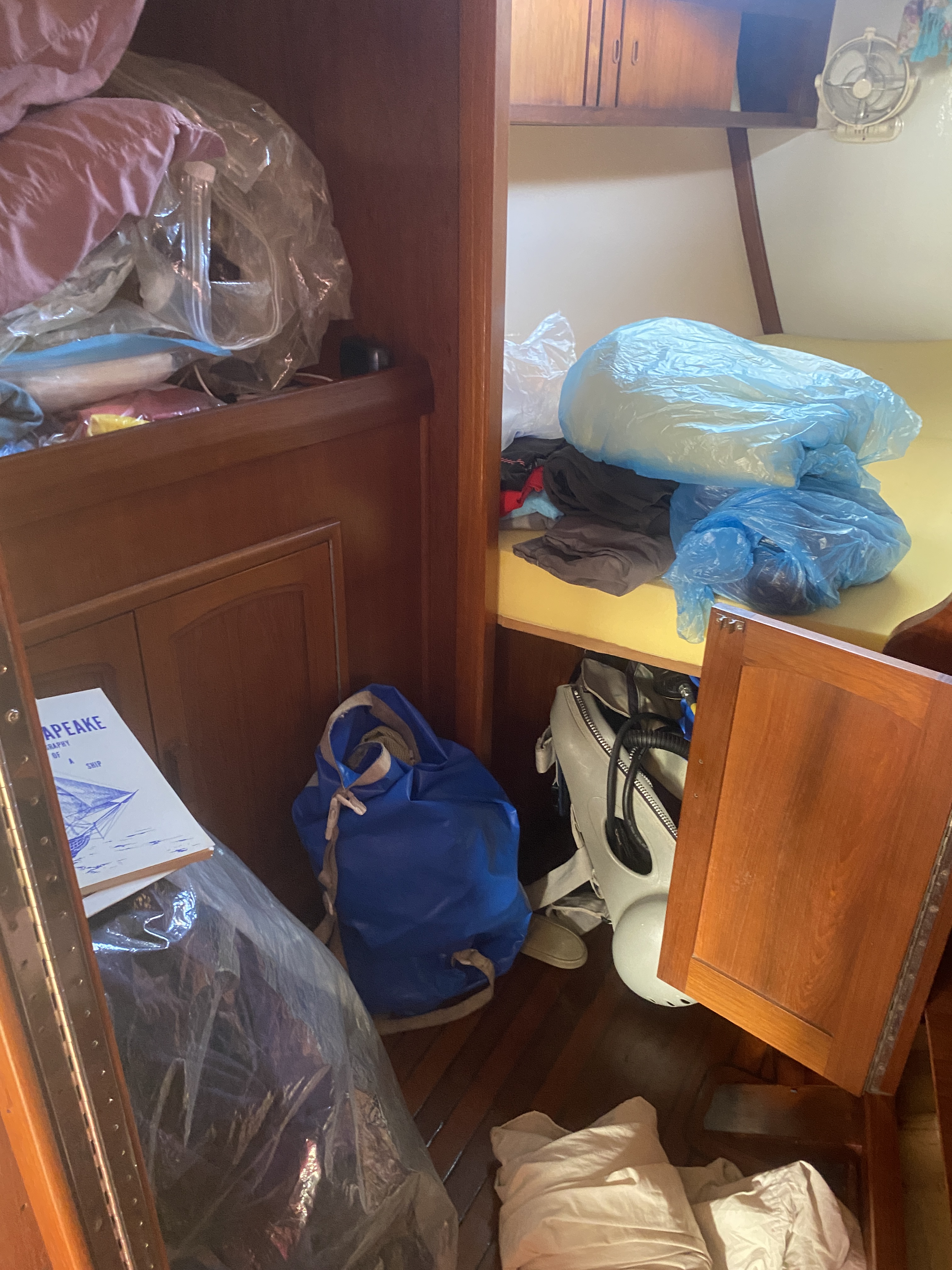
What a mess!
This passage over the largest part of the “dangerous middle” had been our worst in the 45,000 nm we have sailed. Never before have we had to slow the boat down because of the waves, use stove fiddles to keep the pots over the flame, put storm boards in the companionway, or discuss heaving to as an option, all in the one passage. We would never deliberately set out in such conditions but having done so, we and the boat past the test.
Follow our boat on NOFOREIGNLAND: https://www.noforeignland.com/boat/4748245372764160


Well, we had never heard of the dangerous middle before arriving in French Polynesia and hearing other sailors planning how to cross it! It’s good to know the strength of your boat without having to get a new one! Great to see you again 🙂
LikeLike