
April 2025
We arrived back into Shelter Bay marina where Jack and Jan from US Anthem, and Dani and Al on Let’s Go, were the remaining buddies from our group. Dani, bless her, was dockside with her pom-poms to greet us. The pom-pom greeting had become a bit of a tradition between us.

Dani giving us the pom-pom welcome
Sven on Kwilena, whom we had met in Cuba and spent some time with in a few places since then, was there with his new crew, Marina. And there were a couple of Aussie boats on our marina arm who were also in the final stages of canal preparation. Still, it felt like a different place without our whole tribe there.
So it was down to business, the first order of which was to get the broken rigging wire replaced. Before we arrived back into the marina, I had tried to book Steve the rigger to ensure that the job would be done before our transit date. His response of “Let’s see how it goes” did not fill us with hope.
We had committed to doing the line handling for Dani and Al for their canal transit and we were very excited to be doing it for them. We had established our friendship on the Moroccan land trip in 2023, and had been amazed to discover that we both had Adams designed boats AND that our Australian registration numbers were only one digit apart! Dani is a bundle of energy and optimism. One of her many projects was the establishment of the Eggs and Bacon Bay Yacht Club (EBBYC) – a club named after their soon-to-be address in Australia, but that does not physically exist. Phil and I were among the inaugural members of the club, and it has grown to become such a great group supporting each other not only morally but also with information and technical know-how. An additional and important reason for assisting Dani and Al with their transit is that we got to see up close how it all works before we had to do our own.
The story of the creation of the Panama Canal has it all – visionary personalities, intrigue, corruption, scandal, politics, the creation of a new nation, human interest and drama. Its completion required advances in medicine, financing, engineering, and labour relations each of which was significant enough to warrant recognition in its own right. It was the largest scale project ever undertaken in the world at that point and was an absolute triumph of not only engineering and technology but also of human endeavour. It required the virtual elimination of yellow fever in Panama and the control of malaria and other diseases, re-routing some of the Panama Railroad, the creation of the massive Gatun Lake and Dam, the excavation of 106 million cubic yards of dirt and stone from the Gaillard Cut, the building of the locks themselves, and the installation of their controls. In addition, a large amount of associated infrastructure, such as housing and communication facilities, had to be built. The total cost of the French and American efforts was about US$639,000,000 at the time of completion. It had also cost the lives of approximately 25,000 people, 80% of whom died during the French era (McCullough D., The Path Between The Seas, 1977 -a fascinating book by the way).
A transit from the Atlantic to Pacific involves being raised 26m in the three Gatun locks, a 5 or so hour motor across the man-made Lake Gatun and through the Gaillard Cut (formerly Culebra Cut) and then being lowered to the Pacific Ocean in the three Miraflores locks. Yachts usually go through the canal in a group of two to three vessels tied together in a “nest”. In the Gatun locks, the nested yachts go in behind a ship going through at the same time, and in the Miraflores locks, the nested yachts go in front of a ship. A yacht transit can be completed in one day, with a very early start, or two days which requires spending the night tied up to a buoy in Lake Gatun. All yachts are required to have an advisor provided by the Canal Authority (but paid for in your fees, which for the record were AUD$4750 plus $1560 refundable security deposit). Yachts also need at least four people to do the line handling plus the skipper. Meals need to be provided for the line handlers and the advisor for whom there are criteria set by the Canal Authority- meals (including breakfast) must be hot and must include protein. Bottled water must be provided. If the advisor is not happy with their food, they can order food to be brought to the boat. The owner then has to pay for the meal plus the delivery – US$750! Consequently, the transit menu is a topic of some discussion amongst the cruisers at Shelter Bay.
Dani and Al had hired one professional line handler to make up their numbers and the day before their transit they were advised it was to be done in one day. So we packed a small bag and boarded “Let’s Go”. The line handler arrived and “Let’s Go” departed the marina to spend the night out in the Flats anchorage ready for the advisor’s boarding at 4.30am the next morning. Dani was friends with the other two boats that went through with them which made the experience that much more relaxed.
It was a fantastic experience going through the Canal for the first time with good friends. We didn’t know it at the time but when going through on your own boat, you don’t get as much opportunity to just take it all in as you are busy ensuring all runs smoothly. There were a few challenges to overcome as the winch and cleat arrangement on “Let’s Go” was not ideal for the transit. Phil got the job of handling the lines up front which turned out to be quite physically demanding. The line handler was in position at the back of the boat. I was a bit superfluous but I helped Dani with the food, dishes and multiple cups of coffee.
While it’s a special moment for all cruisers exiting the Atlantic when the last lock doors open and the Pacific Ocean lies before them, it was particularly so for Dani and Al. Their world cruising had been interrupted when Al suffered a near fatal brain haemorrhage and had to have brain surgery in Barbados and then again back in Australia. But thanks to talented surgeons, Dani’s unfailing support and Al’s determination, he recovered sufficiently for them to continue cruising. Now they were on the homeward leg returning to land life in Australia. I had secretly brought my set of pom-poms aboard and gave them a thoroughly good waving on the foredeck of their boat as those doors to the Pacific Ocean opened.
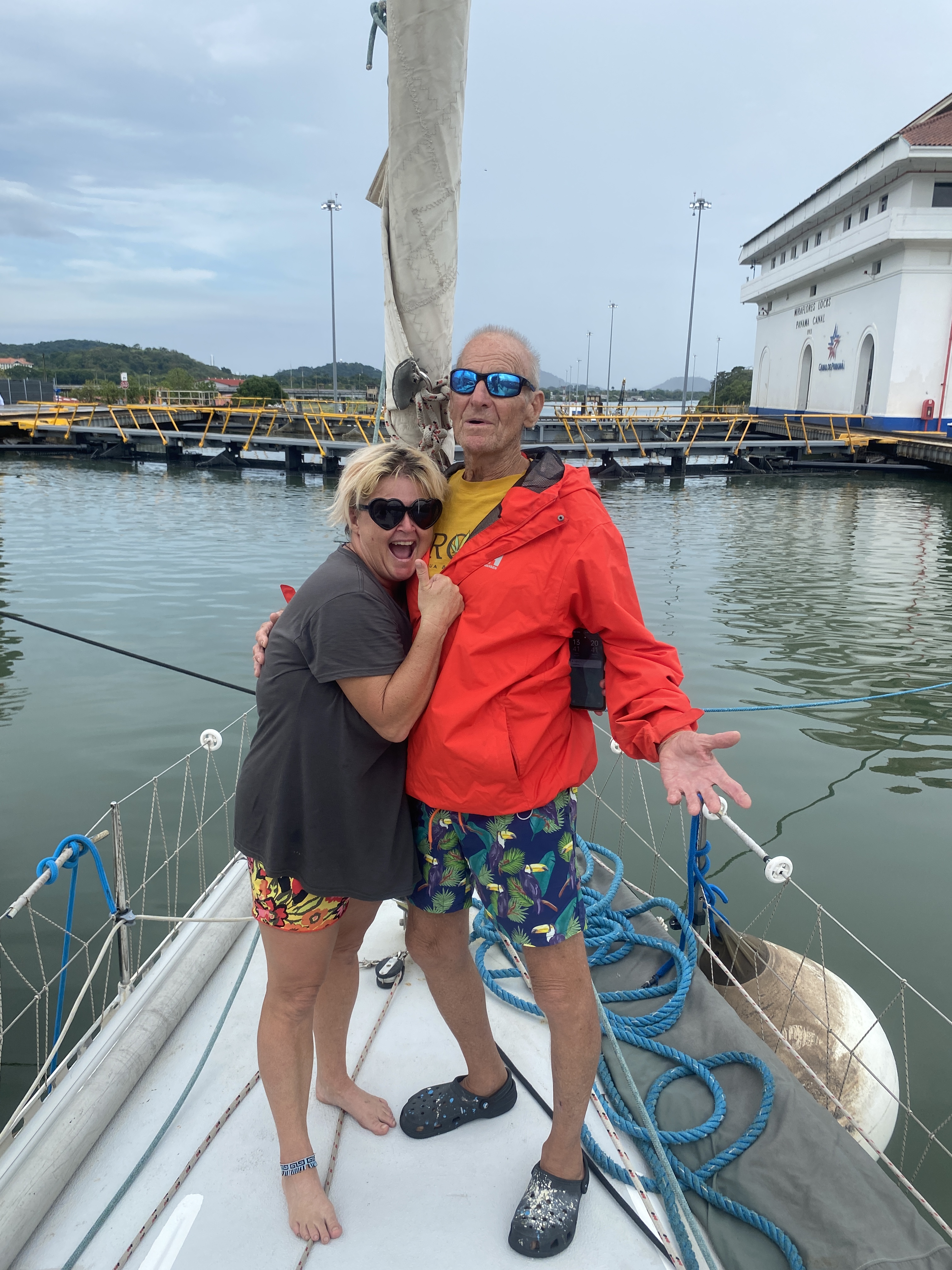

Dani and Al about to enter the Pacific Ocean after my pom-pom celebration
We said farewell to Dani and Al, who we wouldn’t see again until after we were all back in Australia, and caught a combination of bus and taxi back to Paseafique in Shelter Bay and collapsed into bed -it had been a very long day.
We now had one week to make the final preparations for our own transit and the rigging wire had still not been replaced. Steve the rigger was caught up replacing the whole standing rigging on another Aussie boat on the same marina arm as us. Fortunately they were also EBBYC members and we were able to work with them to keep the pressure on Steve to get our rigging done straight after he was finished theirs. In the meantime, Phil decided to replace the wire himself which meant all we needed Steve to do was to check it and adjust the tension. He completed the job on April 10 and our transit was booked for April 15.
Relieved to have that important boat job completed, we could focus on the final tasks. We had booked the same professional line handler that Dani and Al used after seeing him at work on their boat. He has done the most Panama Canal transits of all the line handlers -1,445! We asked our friend Jason who was around in Linton Bay to come also and now we needed just one more. We put out the word out on social media but had no takers. Then lo and behold two young American men, twin brothers, came wondering along the marina looking for a boat on which to transit. Even though we only needed one more, Kaden and Travin were a package deal, and having them on board appealed to us as parents of twins around the same age so we had our line handlers organised. Fenders and lines were arranged through the line handler to be dropped off to our boat. After stressing for weeks about the menu for the transit, I cooked up a big beef curry, and prepared as much as I could for the other meals -scrambled eggs and mushrooms with toast for breakfast, and chicken, veggie, and noodle satay for lunch.
One evening a few days before our transit we were sitting in the BBQ area having a drink with a few people when another couple approached wanting to know if we were Lesley and Phil from Paseafique. We were intrigued to know who these people were. As it turned out, their appearance fulfilled one of my hopes for our circumnavigation.
When we bought Paseafique, we decided to keep the name for two reasons -it was already on the Australian register, and we thought that just maybe one day we would run into someone who knew the boat from its previous circumnavigation. Duncan and Ariane not only knew the boat and the previous owners, they had actually sailed on her, and they had raced against the first owners. Furthermore, we had only just crossed paths. Duncan and Ariane were in the marina for a couple of days before flying out, and they only knew that Paseafique was in the marina because they saw the boat name on the bus list to go into town. Pretty cool that we met them and had them on board for a cuppa. We discovered yet another connection in that they owned a flying fifteen (a 20 foot racing boat) made by Phil’s Uncle Bill!
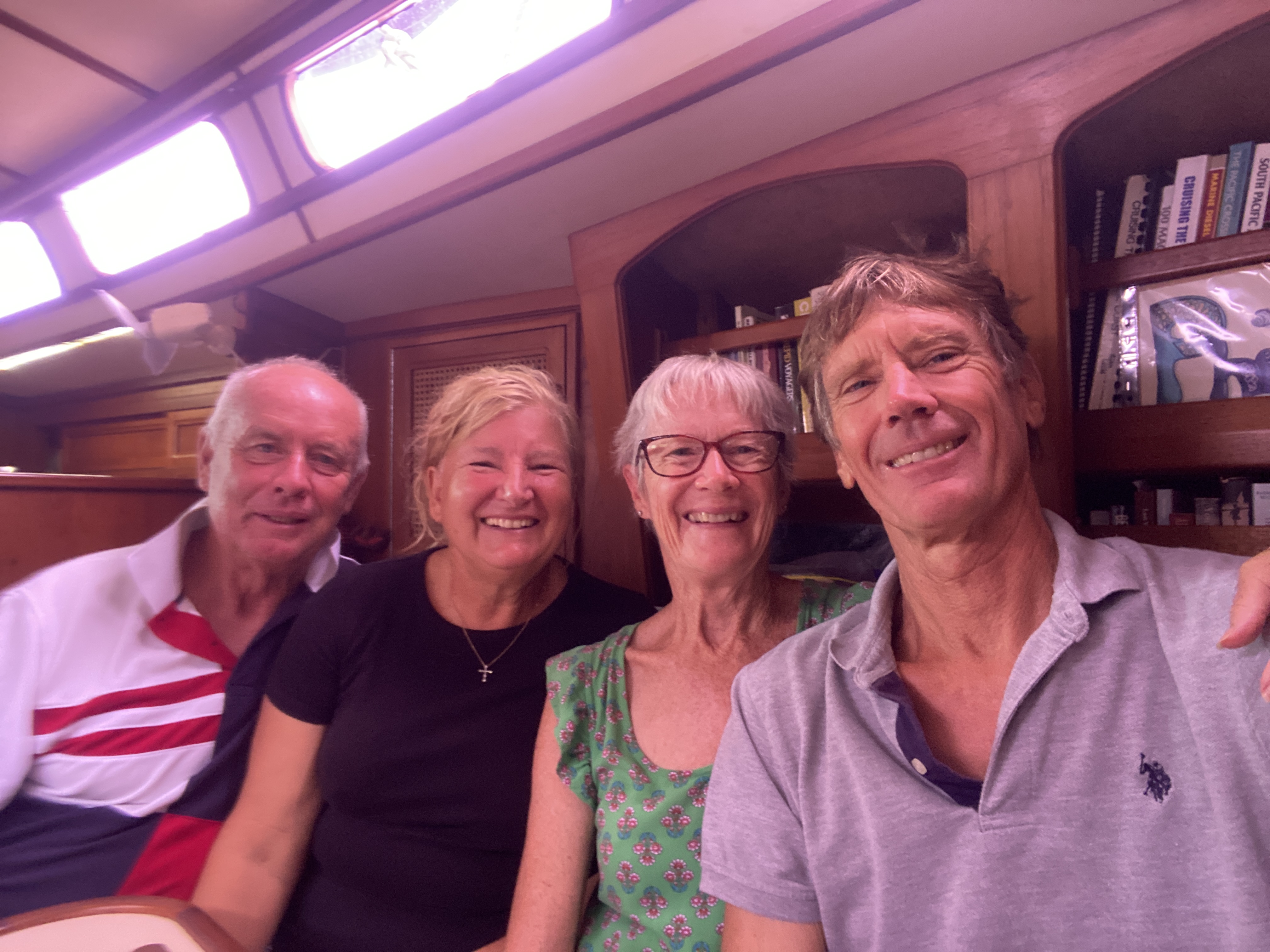
Duncan, Ariane, me, and Phil on board Paseafique
The day before our transit we had the saddest farewell of all -Jack and Jan on US Anthem left Shelter Bay to make their way back to Florida where they were going to base themselves. We had been meeting up and sailing with them on and off since Indonesia in 2015. Of all our sailing buddies, we would be separated by the greatest distance once we re-settled in Australia. The nature of our friendship will change but the shared memories of our fantastic times together will bond us forever.
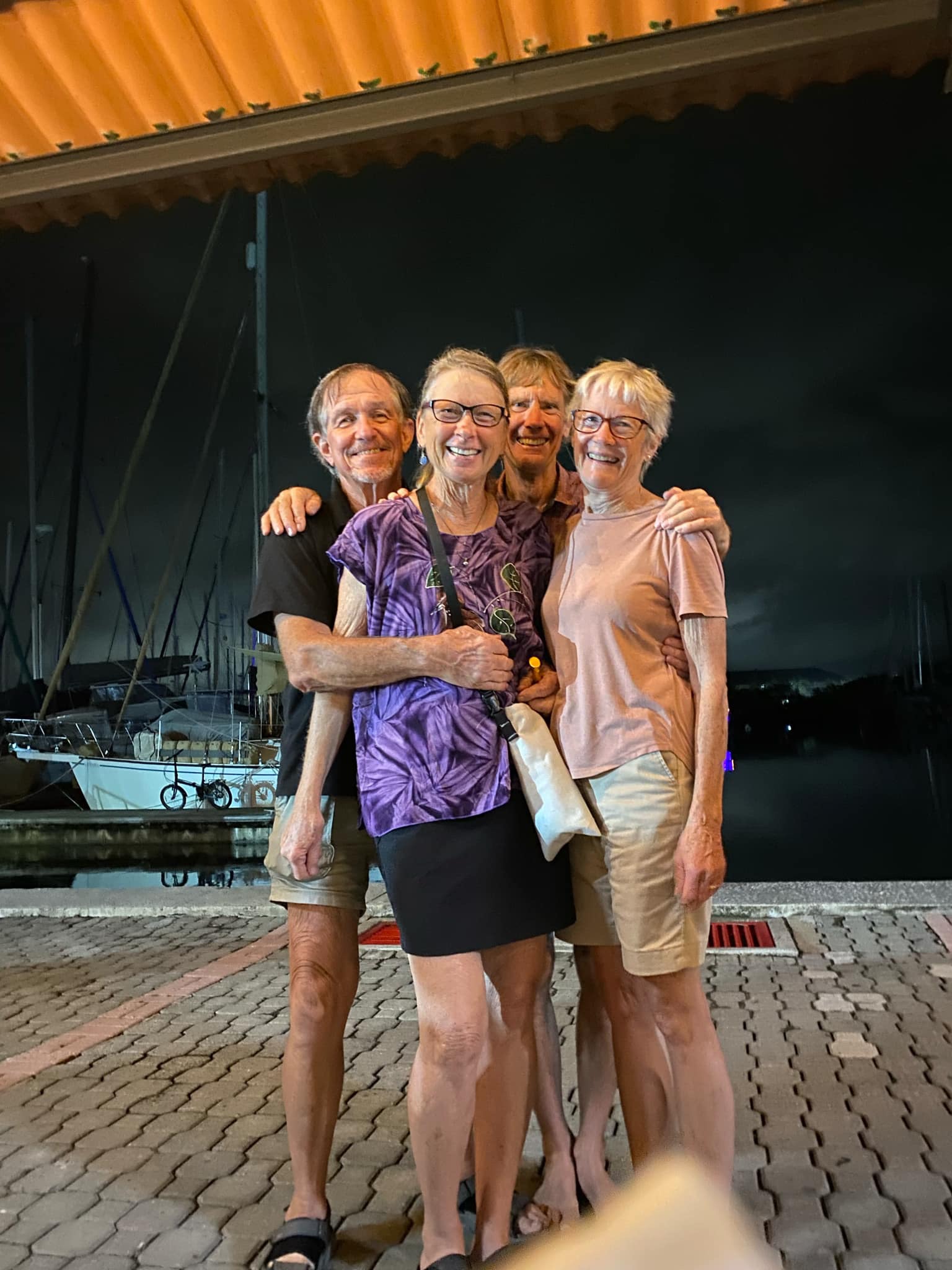

Goodbye Jack and Jan
We were hoping for a one-day canal transit but when we called the scheduler the day before to get our time, he advised that we were booked for a two-day transit. Our three line handlers arrived in the afternoon of transit day and we left the marina to wait in the Flats anchorage for our advisor to arrive by boat. There was lots of anticipation and nervous energy on board as we wondered what our configuration might be and how it was all going to work. We were so glad that we had the benefit of already having been through with Dani and Al.

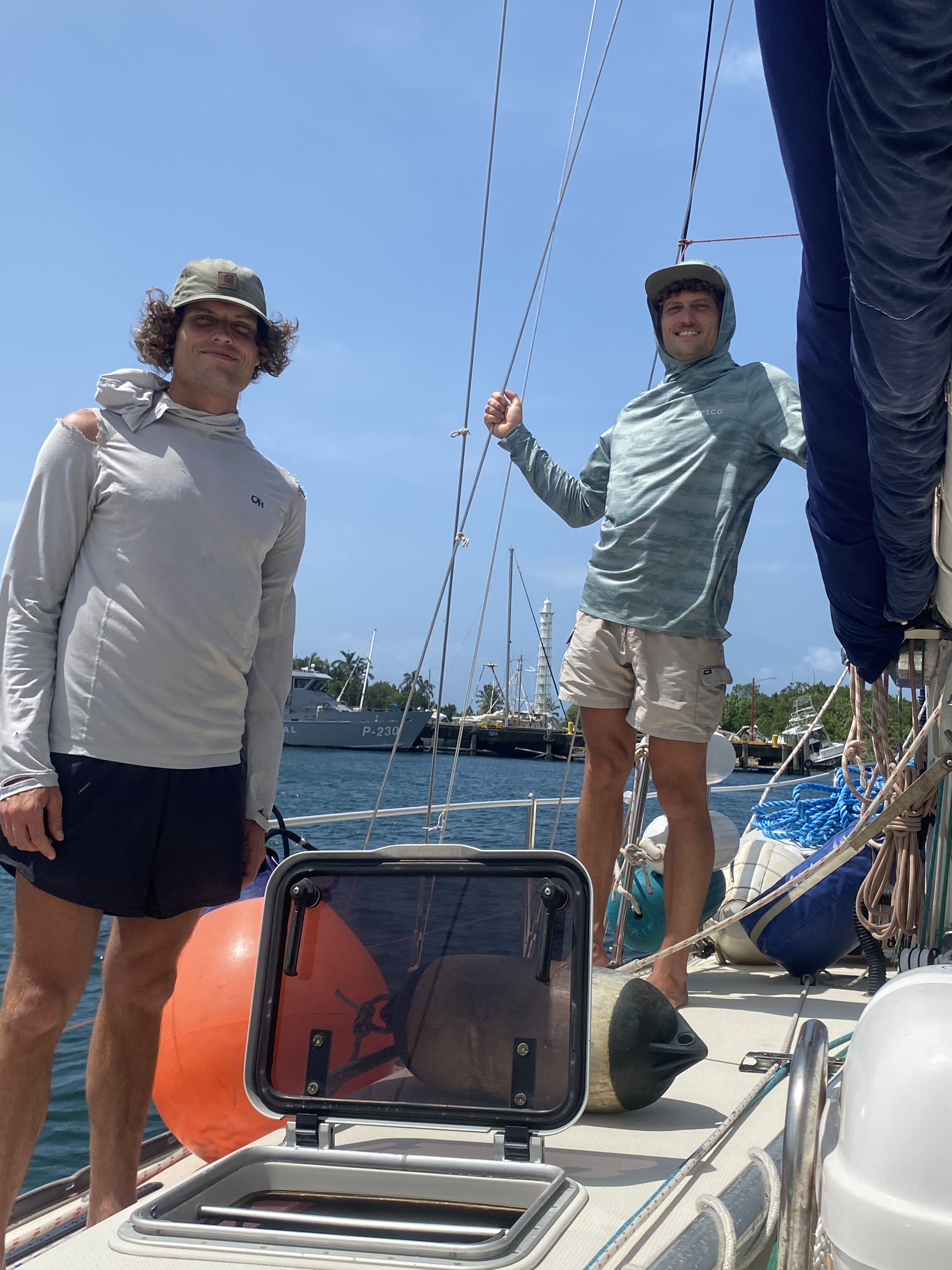
Jason on the left, and Travin and Kaden
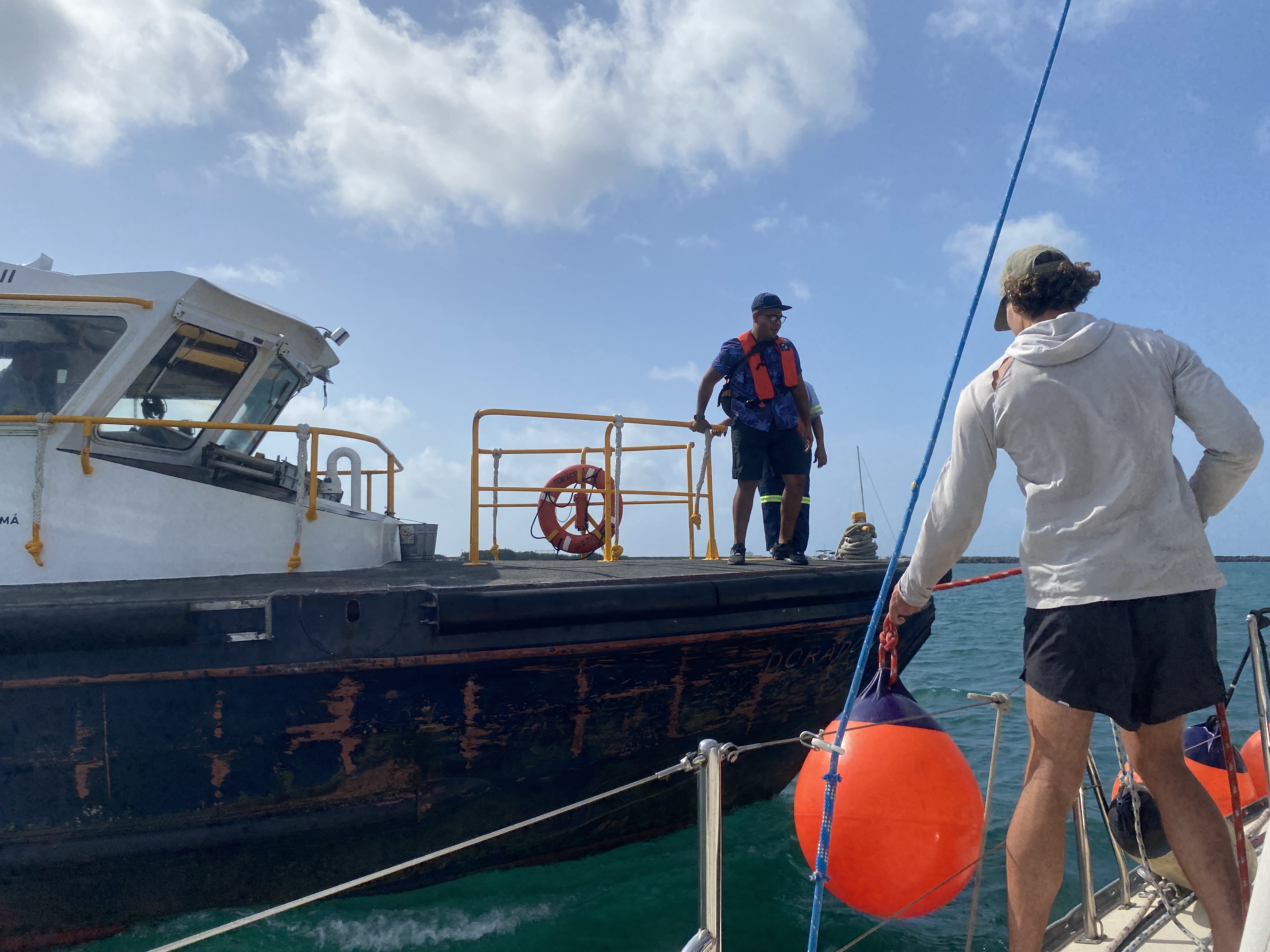
Canal Authority boat getting close enough for our advisor to step on board
The pilot boat with our advisor arrived and soon we were motoring towards the Gatun locks and were directed to make a nest with one other yacht -the catamaran “Buena Vista”, with a Japanese husband and wife team. Then it was time to enter the first lock chamber behind the ship and a large power boat tied to the wall.
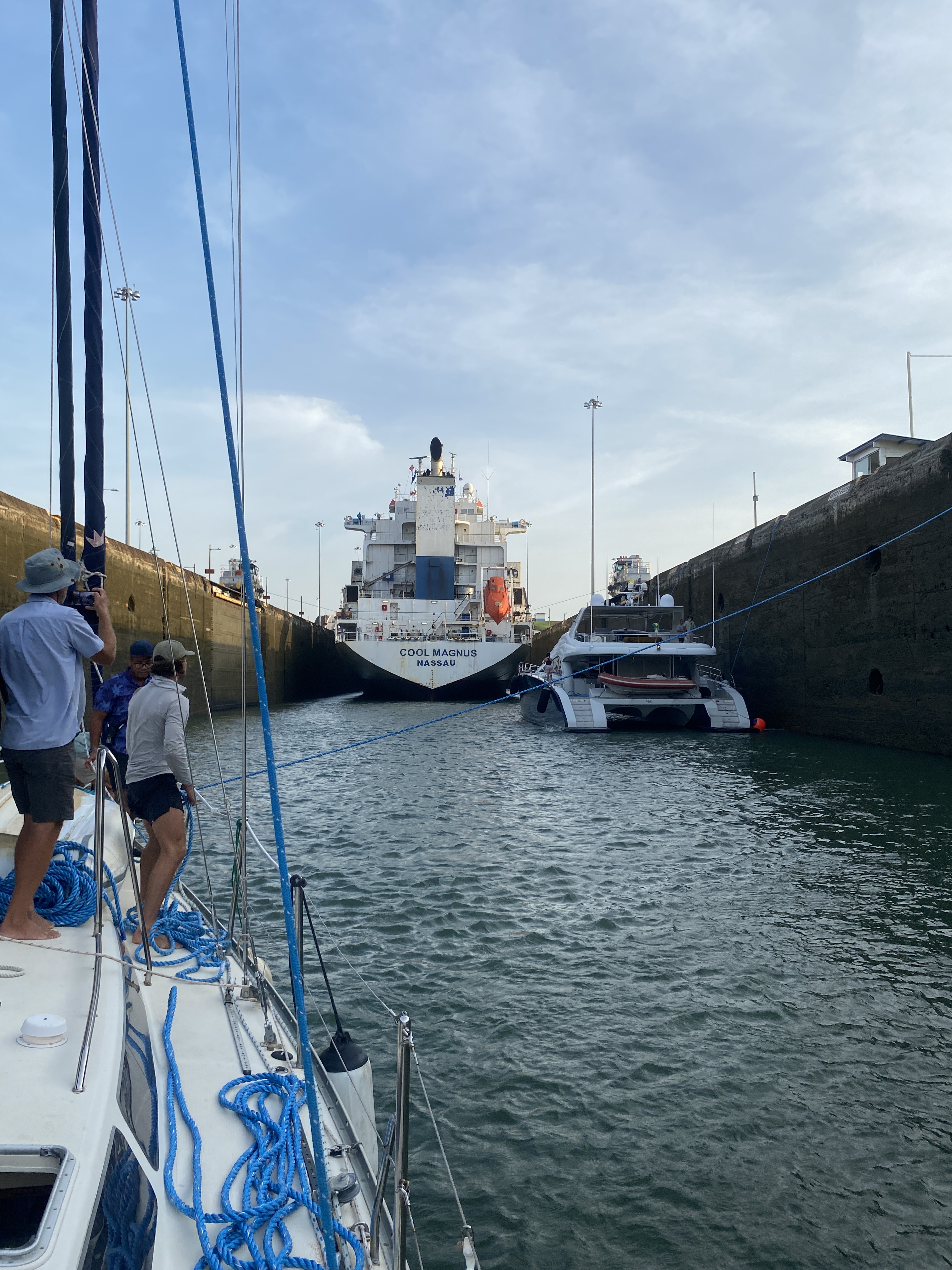
In position in the first chamber, Gatun locks
As this is happening, the shore line handlers threw two “monkey fists” to our line handler at the bow. The monkey fists are small round knots of rope to which are attached very long relatively thin lines.
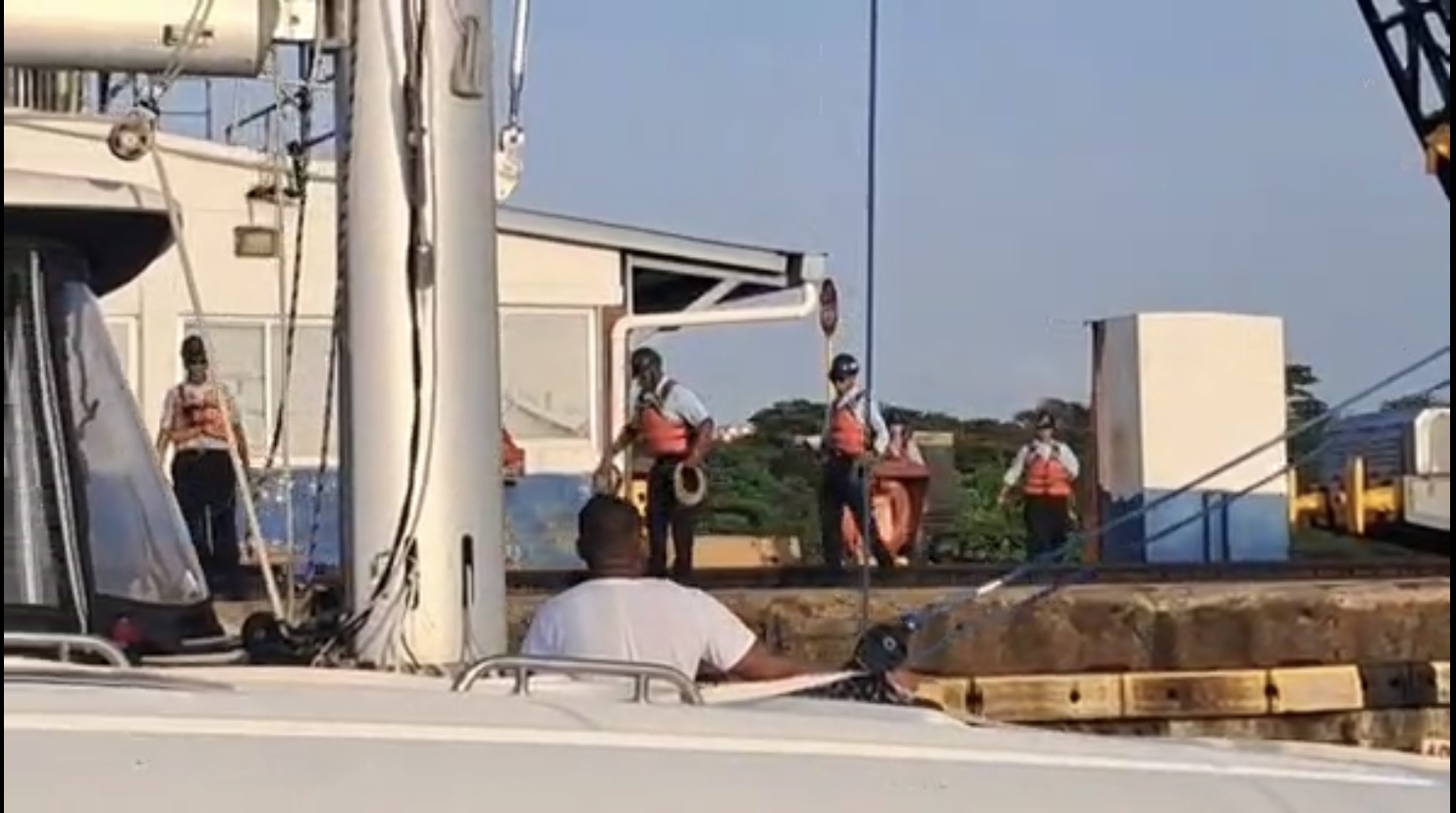
Shore line handlers getting ready to throw the lines across
These lines are then tied to our big lines at the bow and stern, and then the shore line handlers pull up our lines to the cleats on the lock wall. The process was repeated on the other side of our buddy yacht and so there were two lines on each side of the nest which are used to hold the nest steady in position in the middle of the chamber. The lock doors slowly closed on our last view of the Atlantic Ocean -spine tingles all around.

Goodbye Atlantic Ocean
The canal lock doors are amazing structures. All are 20 metres wide and seven feet thick but vary in height from 13-25 feet. During construction every rivet was inspected and the imperfect ones replaced. Each set of gates has a duplicate set in case of failure, and a good thing that is too!
As soon as the doors closed, the water started rushing and swirling into the lock, raising us up as our line handlers took up the slack on the lines so we held steady.

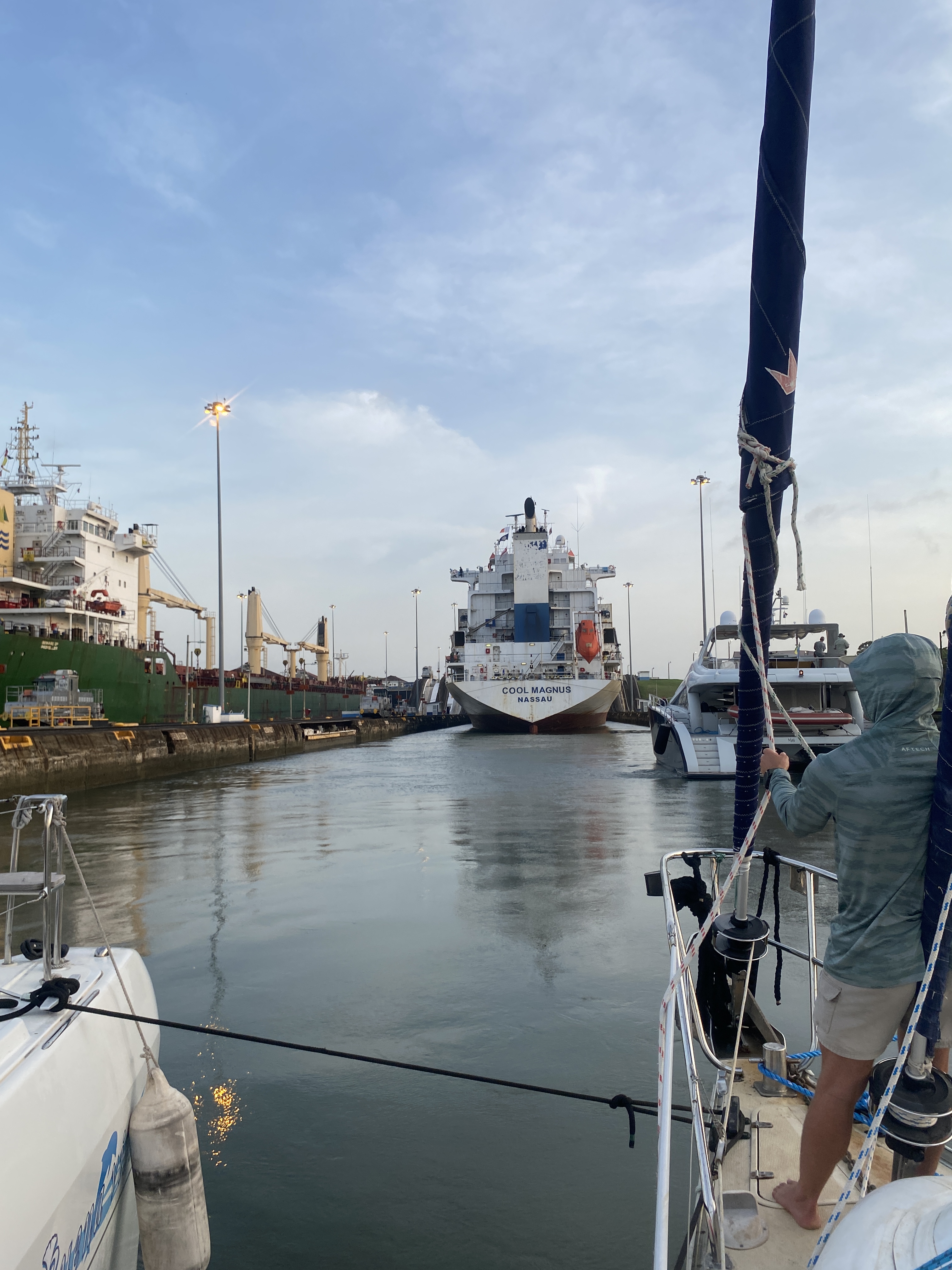
On the left, the water swirls into the lock, and on the right, water level now at the top of the chamber. Note the bow line holding us and “Buena Vista” together
Once we had reached the required height in the chamber, the doors opened and the shore line handlers then walked the lines to the next chamber as we motored along, stilled nested up to “Buena Vista”. Our nest was then secured in the next chamber and the process repeated.

As our transit commenced in the late afternoon, it was dark by the time we were completing the transit of the three Gatun lock chambers
Before too long, we were exiting the third and final chamber and motoring into Gatun Lake where we untied from Buena Vista. The beef curry was well received (phew!) as we motored to our mooring for the night. The pilot boat picked up the advisor and we settled down for a somewhat restless night.

Travin, our advisor, our professional line handler and Phil securing us to the mooring in Gatun Lake
Up bright (well maybe not so bright) and early, I got the breakfast underway while we waited for the next advisor to arrive. The first part of day 2 was a straight forward 5-hour motor across the lake (no sailing allowed) to the final set of locks at Miraflores. We were pretty excited to see our friend Sven on “Kwilena” on the horizon behind us. He had started the transit early that morning and we were really hoping that we would be nesting together for the Miraflores locks but alas that was not the case.
Things did not go as smoothly as the first day. As we approached the first chamber, we again formed a nest with “Buena Vista”, with a big power boat on the other side of them. All the line handlers did their thing and we were secured in the first chamber. Then in comes the ship being towed up close and personal right behind us! This time the water drained out of the lock and so the line handlers on the boats need to be alert and let the lines out, otherwise there is a risk of being left dangling from the wall!
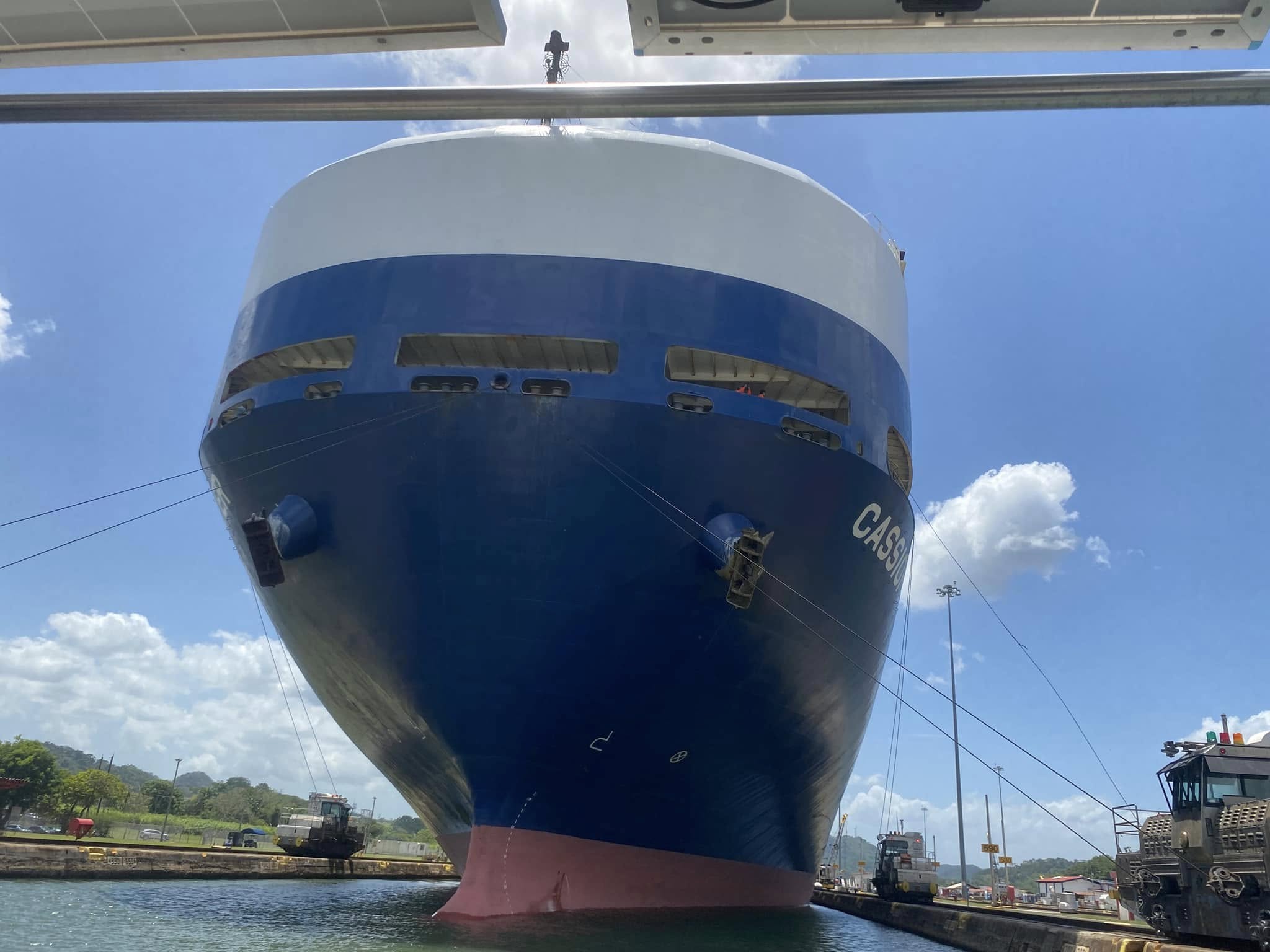
Normally being this close to a ship would be cause for alarm!
So far so good. After exiting the first chamber, the advisors decided that we needed to reconfigure the nest to put the big power boat in the middle. This power boat was waaayyyy bigger than us so it was quite a distance from our deck up to theirs. There seemed to be a lot of confusion amongst the advisors and local line handlers on Paseafique and the big cat while this nest was being made with a lot of raised Spanish voices. Things got sorted and everything settled down. But our professional line handler, had made an error (despite his many transits!) tying off one of our lines resulting in a huge amount of force on one of our winches while the nest of three boats was motoring up to the second chamber. We were very lucky that the winch was not pulled out of the deck. Fortunately one of the other lines slipped a little and dissipated some of the force. We actually know of a boat who went through after us that had a cleat pulled out of her deck so there’s plenty of scope for things to go wrong. Lunch was a rather hurried affair while we motored towards the second chamber.
Somewhat relieved, we entered the second chamber, the ship came into position behind us once again and the water level fell.

Getting into position in the Miraflores lock chamber. You can just see us next to the wall, power boat in the middle, and the catamaran “Buena Vista” on the other side. Photo from Canal cameras, sent to us by our good friend Theresa who was watching from Turkey.
The power boat had to use their engines to keep the nest from drifting to one side -our side. We got a closer view of the lock wall than we would have preferred. The doors opened and we moved into the third and final chamber. Emotions were swirling along with the water as it drained out and lowered us to the level of the Pacific Ocean. The last set of doors opened and Paseafique kissed the Pacific for the first time in close to ten years.


The Pacific Ocean waiting for us, and the last set of doors opening
The whole Pacific Ocean lay before us – waiting for us to explore and enjoy the delights of the many atolls and tropical islands. And beyond that was Australia – home. We had conflicted feelings about being in the Pacific. Phil was sad that the last section of our journey was about to begin and he would soon complete his teenage goal of cruising the world. He really did not want it all to end. On the other hand, I was excited to be getting closer to Australia, even if it takes a few years to get the boat back there, as it meant we could again adopt a six months on and six months off cruising pattern, allowing more time with family and friends in Australia.
We could only contemplate the moment briefly as it was all action stations untying from the power cat, and getting the lines and fenders ready for pick up. The advisor was picked up by the Canal Authority pilot boat, while the three line handlers and the fenders and lines were picked up by a local boat. We got the anchor down and finally we could relax and de-brief with Jason over a few drinks. It was lovely to have had a friend on board to share this once in a lifetime experience.
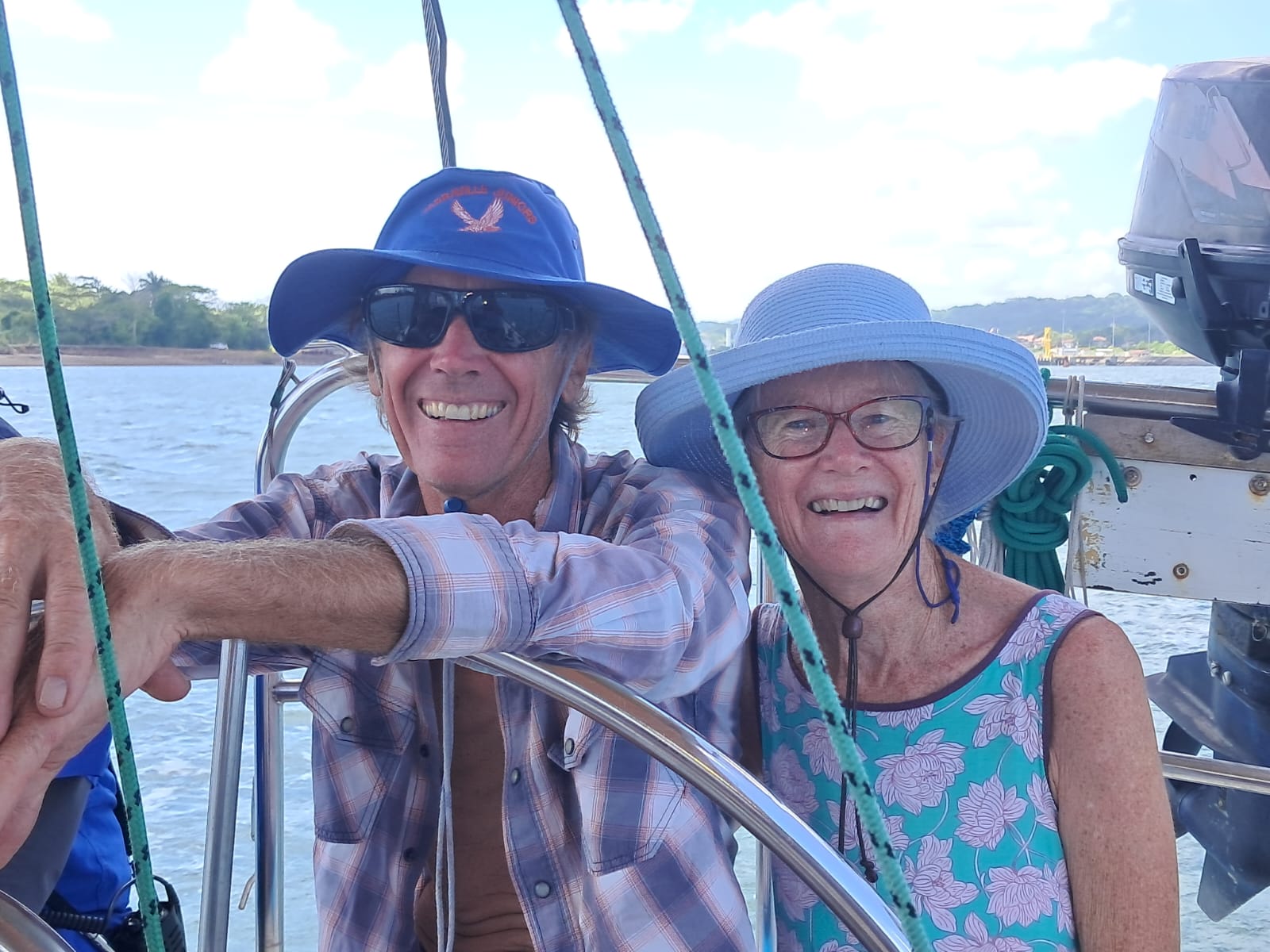
Relieved to have the transit over.
 paseafique
congratulations Lesley and Phil amazing achievement, well done, great blog!
LikeLike
Thanks Ines
LikeLike
Wow what a process Lesley & Phil. Really interesting chapter in your adventures!Safe Pacific travels. Have loads of fun…Xxx Lyn
Yahoo Mail: Search, organise, conquer
LikeLike
Thanks Lyn. Going through the canal was indeed a very interesting process!
LikeLike