November 2023
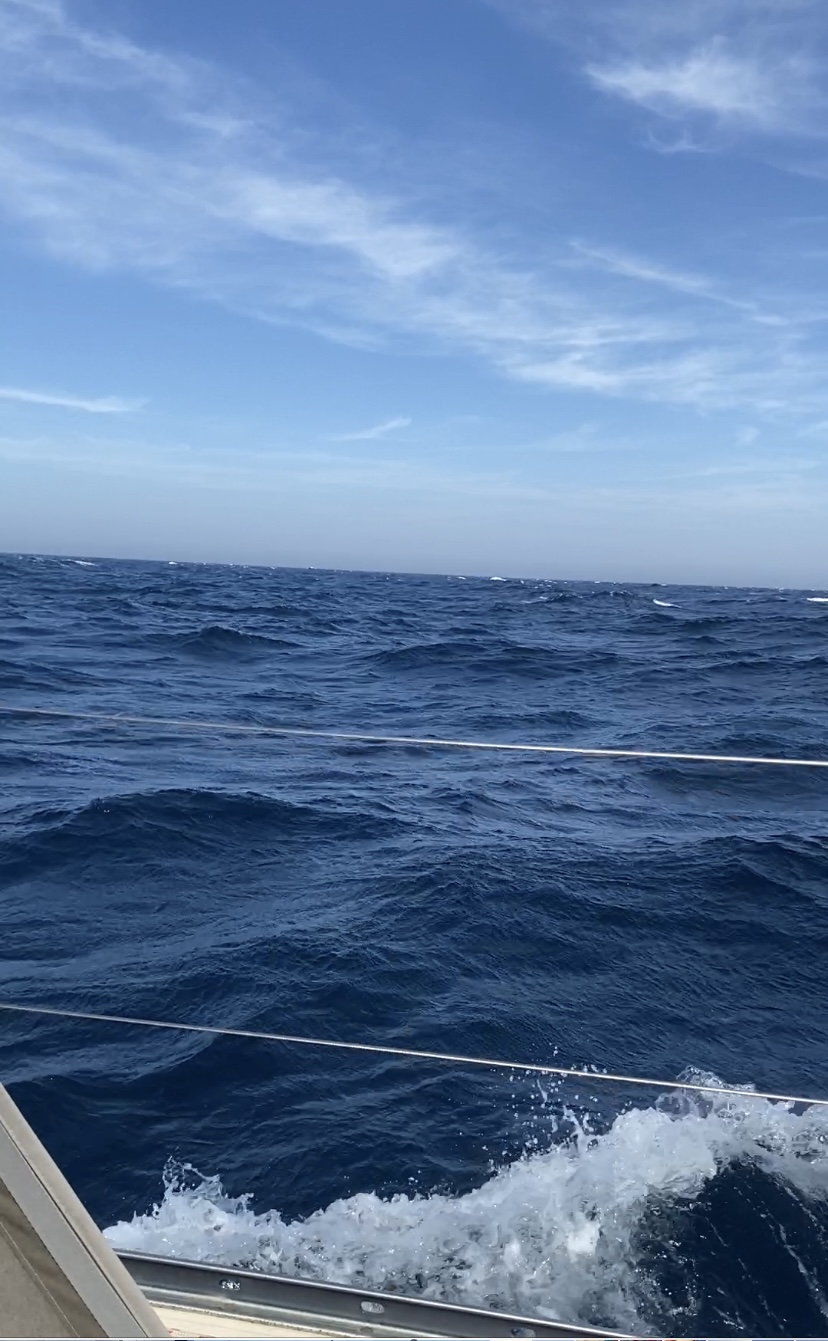
It’s the evening of our first day on passage from the Canary Islands south to Cape Verdes and if I was writing this rather than typing it, the text might not be so legible as my hands are a bit shaky. We had left on the end of a bit of a blow with the wind behind us, knowing the first 24 hours would be the windiest. We needed at least 4 days of good wind to get to the Cape Verdes, a small group of islands lying off the west coast of Africa near Senegal. The day started off reasonably well but as the wind picked up so too did the waves and we found ourselves easily in the biggest seas we have experienced. The following seas were about 3-4M and in addition there was a side on swell rocking the boat which made it challenging to move around and do things, let alone sleep!
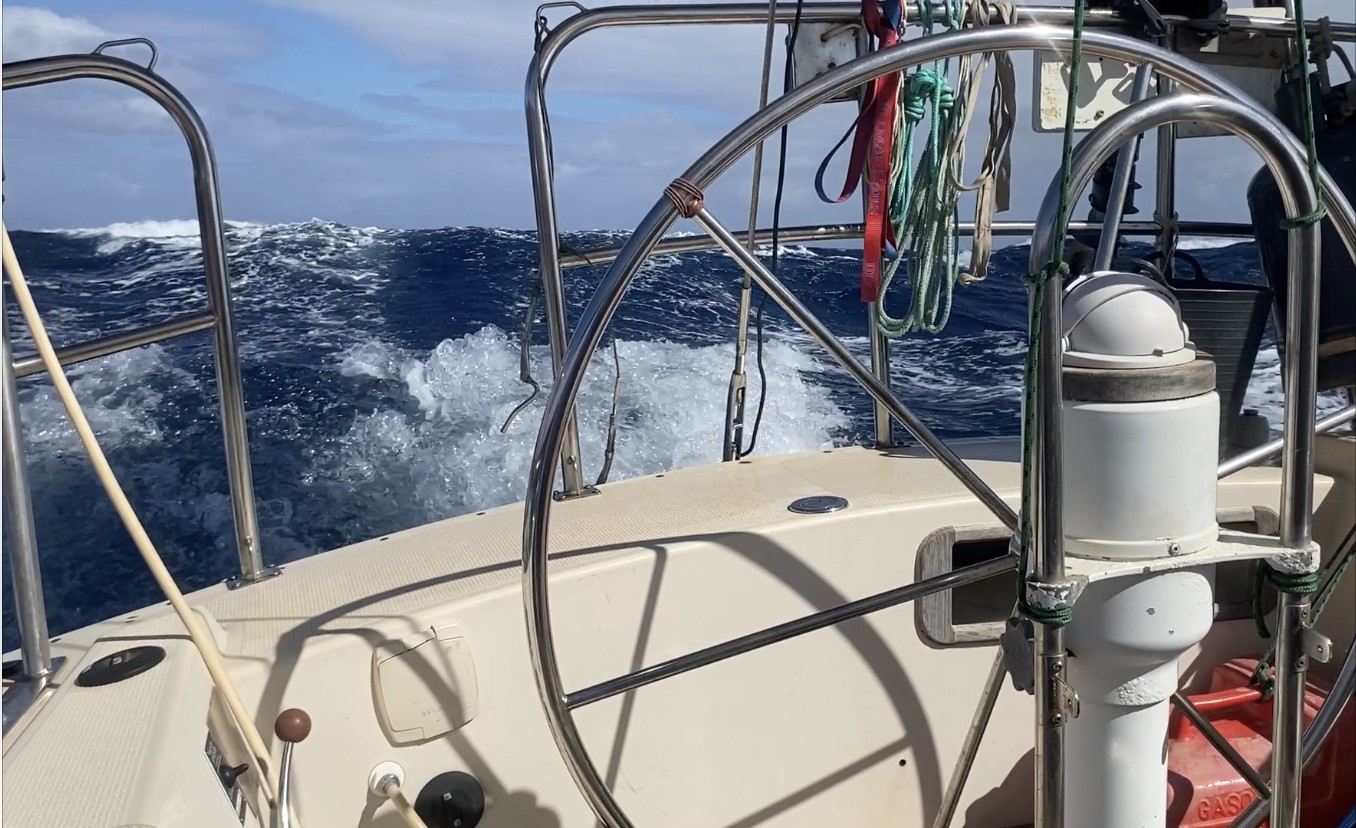
We actually got pooped by one of those following waves. Luckily we already had our storm sheets up to protect the companionway so we only got a few splashes down below. We further battened down the hatches by putting the storm boards in the companionway. We had already started with one reef in the main but we put the second reef in (made the mainsail shorter), and furled some of the headsail (made it smaller) and kept things under control. We were getting exactly the weather that had been predicted and were not expecting it to get any worse. Even so, I was edgy most of the night, more because of my thoughts about what could happen rather than what was actually happening. Phil was kind and stood more than his share of the overnight watches so I could rest and recover my nerve.

Everything always looks better in the morning and on the second day conditions were actually better. The wind and seas abated somewhat but the annoying side swell was still with us making Phil feel a bit off colour and miserable. Still, we scooted along averaging 8 knots for most of the day.
The second night was less demanding and we actually managed good sleep and the watches were fairly restful. The sails didn’t need much attention and there was absolutely no traffic. In fact, we hadn’t physically seen another vessel since we left Santa Cruz, just one on the AIS that passed us 5 nm away.
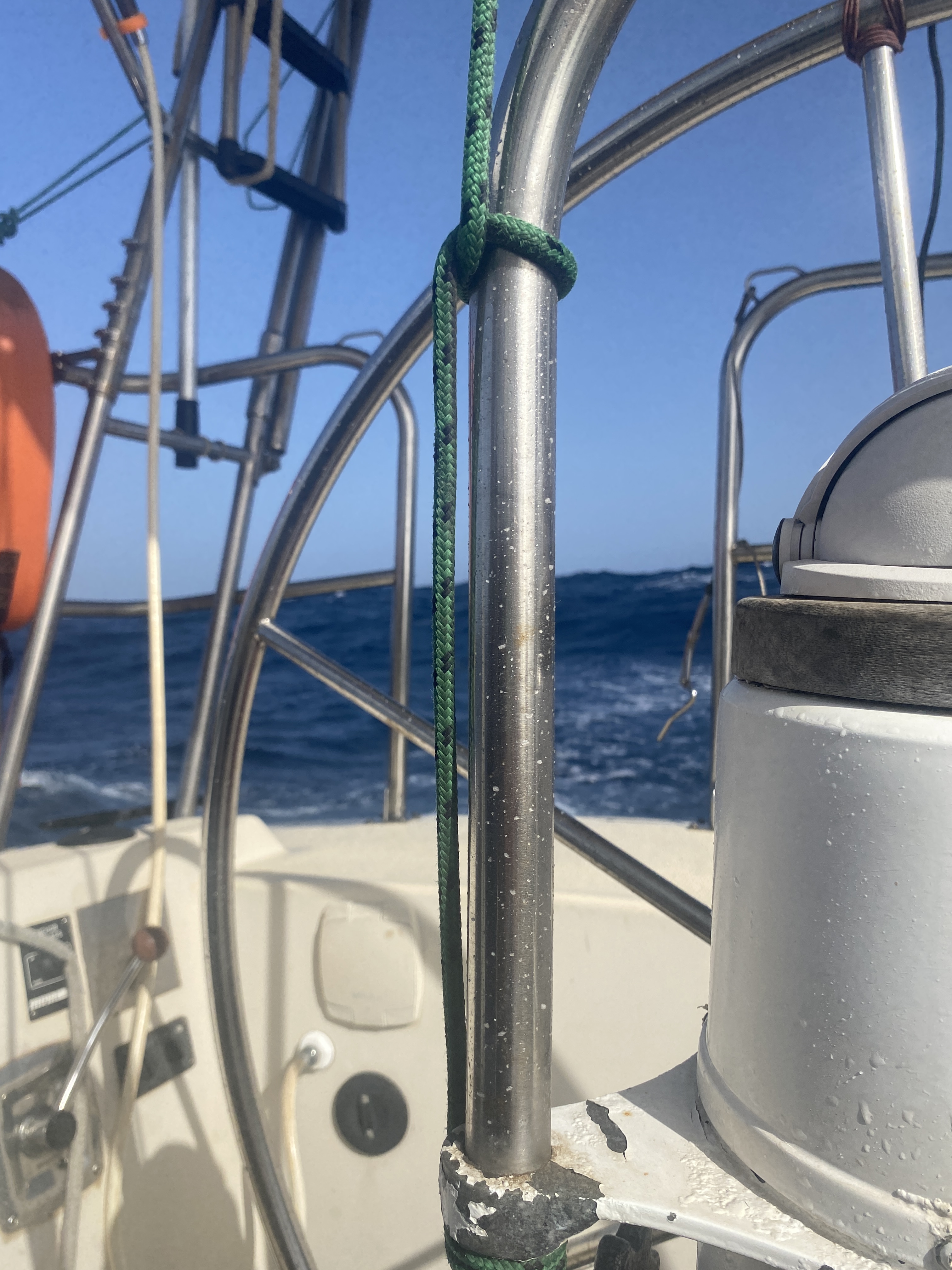
The third day passed uneventfully with us gradually putting more sail out as the wind dropped off -again as forecast. Conditions were very comfortable -small swell and good wind behind us saw the miles to our destination ticking down. I’ve just had a look at the blog for the passage to the Canary Islands, and I also reported there that the third day was uneventful. Must be something about day 3. Mind you two data points don’t make a trend.
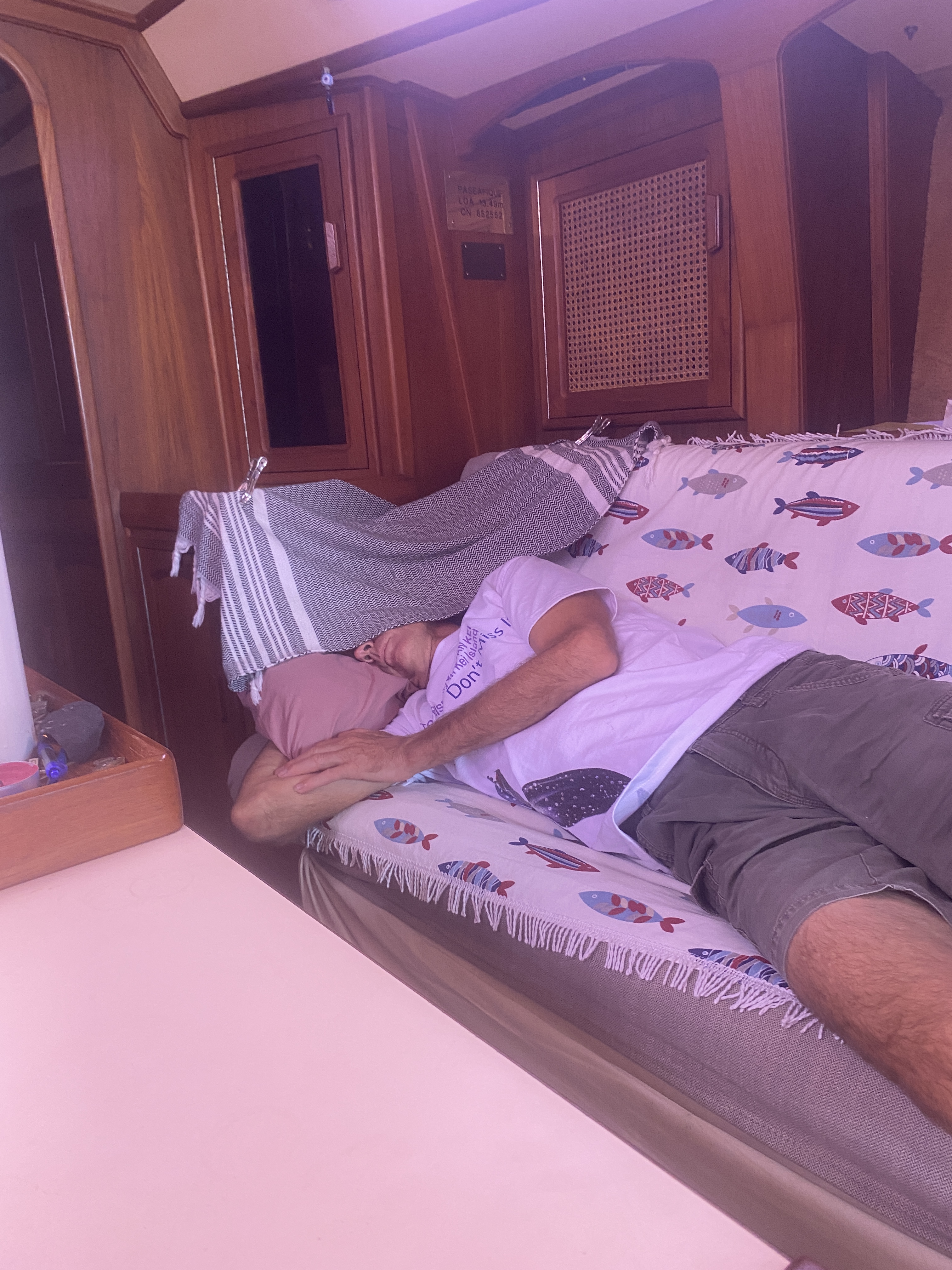
As I was trying to settle down to sleep that night, there was a new noise in the aft cabin. New noises can sometimes be a signal that something needs attention or fixing but mostly noise in a boat on passage is a major item to be managed -well at least from the point of view of someone who can’t stand even a dripping tap during the night on land. There are lots of different noises on a boat under way some of which you just have to learn to live with like the water rushing past the hull, the crackle of the radio, or the autohelm mechanism as it drives the wheel. But there are a whole host of other noises which can sometimes be suppressed depending on the source. This includes pulleys banging on the deck, crockery clanging in the locker and, on our boat, the woodwork creaking. After the first couple of days in rough seas, we thought we had pretty much got on top of the rattles and creaks so I was pretty cranky (I was tired) to discover another noise just as I had got settled in the bunk for my night sleep. Was it a new kind of woodwork creak? No, it was more of a flapping. I had a passing thought that it might be a fish but dismissed that idea in favour of the storm sheets in the cockpit which we had partially unzipped to allow more air flow, and were likely flapping around in the cockpit above me. I struggled crossly out of the bunk and asked Phil to zip them up. Was that better? Well yes, almost. There was still a bit of flap flap but it soon stopped.
As an aside, in case any of you are wondering why I don’t just use ear plugs -I’ve tried believe me. I’ve bought any number of different types, including ones specifically designed for smaller ears. I just can’t tolerate them in my ears and they don’t seem to make much difference to the sound.
The next morning we were on deck adjusting the sails to maximise our speed now that the wind had dropped off, and guess what? There on the deck was a poor dead flying fish. In some parts of the world, flying fish sandwiches are a fixture on the menu. We could have had one for breakfast but I was too quick to throw it overboard. No doubt some other creature would have eaten it for breakfast.

As we sat enjoying the late afternoon of the fourth day, we were disturbed by a noise that definitely belongs in the bad category -an alarm from the chart plotter signalling that there was a problem with the autohelm! One of the most dreaded break downs of blue water cruisers. No-one relishes the prospect of hand steering for hours or days on end. At that point we had another 24 hours before we would reach landfall in the Cape Verdes. We got organised for Phil to check out the problem -he steered while I cleared the way to the back of the boat where he would need to go for access and then I took over the steering while he climbed in the back. Thank goodness conditions were settled-the seas were mild and the wind was consistent so steering was relatively straightforward and Phil wasn’t being tossed around down below. After a tense 10 mins or so, Phil popped his head up with the very welcome news that the issue was fixable: three of the bolts holding the base of the autohelm to the hull had loosened and fallen out, and the fourth one had broken. Thirty minutes later, the repair was completed and we were two very relieved sailors.
During our last night at sea on this passage, I was able to get reacquainted with night time ocean magic. We were floating along on calm seas with a very consistent wind on our aft quarter. There were no clouds so the full array of stars were twinkling away above us. Sparkles of bioluminescence appeared beside us as Paseafique’s hull stirred up the water. The smallest sliver of a crescent moon had risen just above the horizon. And with the first blush of dawn light, the magic faded as the last day on passage began.
I said it was the last night at sea, but it wasn’t quite. We knew that the last day would be the slowest with the lightest wind, and we had initially anticipated arriving around 9 pm or so. Once we got around to the west coast of Sal, our destination island, and turned south towards the anchorage, we had current against us and that slowed us right down. We eventually gave up sailing and motored the rest of the way, with the revs up to push against the current. We got into the Palmeria anchorage around 11pm. Thank goodness our friends Jack and Jan on US Anthem were there and they guided us in, as there are a lot of unlit buoys, fishing boats and old unused vessels in the harbour. We had made it, sailing 812 nm in almost 5 days with an average boat speed of 7.2 kts – the boat went still and quiet and we went to bed.

 paseafique
Really enjoying these detailed accounts. I’m sure you’ll enjoy looking back at them in years to come. xx
LikeLike
Glad you are enjoying them. When I look back at the earlier ones, it’s amazing how much I’ve forgotten until I read it and that jogs the memory
LikeLike
Well done you two. Safe and sound after such a sailing experience. Thanks again for the colourful and informative log.
LikeLike
Thanks John and Jenny
LikeLike
Your posts are something I really look forward to Lesley and Phil, thank you for this instalment, you are presently on your big crossing, I trust you will have an easy time of it but also that it is still an adventure! Tons of love from Darwin mob!
Elizabeth Copeman
LikeLike