
June/July 2022
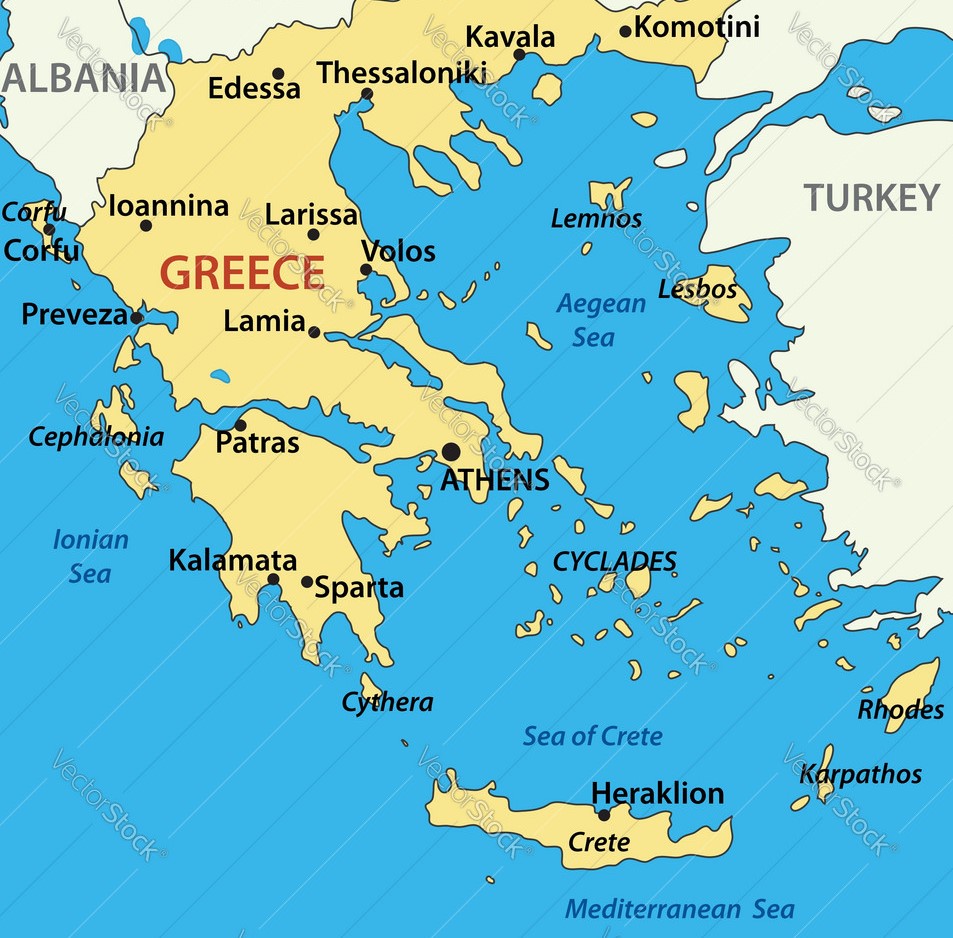
Peloponnisos is a rugged part of Greece, the shores of which are mostly dominated by steep rugged and bare mountains that run almost right down to the water. According to our cruising guide, the people who have lived here over the centuries have been as tough as the landscape. The Spartans, the supreme ancient warrior race, lived here, as did the Maniotes who lived in clans that spent a lot of time fighting with each other. While the rest of the Peloponnisos was at different points controlled by Rome and the Ottomans, the Maniotes remained fiercely independent.
This large peninsula separates the Aegean from Europe and was an important part of the trade route that linked the exotic wealth of the Indian Ocean to Europe. Consequently, it is not surprising to find some rather impressive forts and castles along its coast. There are about 5 of these, and we visited 3 of them clustered on the third and most western “finger” (Koroni, Methoni, and Pylos), each one a bit different, and each one very impressive and interesting.
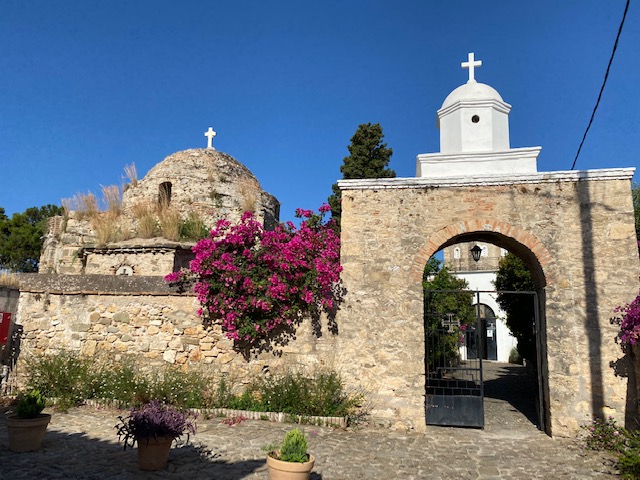
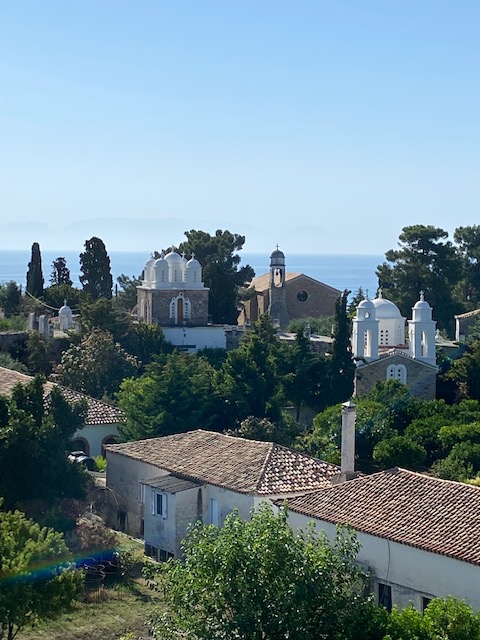
Koroni Castle, on the east side of the “finger” end, became a powerful maritime fortress under the Venetians, who occupied it for two periods (1205-1500; 1685-1715). The Ottomans occupied it also for two periods (1500-1685; 1715-1821), and left their mark with a mosque and baths. It was surrendered to French forces after the Greek War of Independence but was eventually controlled by the liberated Greeks in 1828. During World War II, it was a base for the Italian and German troops. There are in fact a few families that still actually live inside the fort grounds, which are quite lovely. In addition, the Monastery of Timios Prodromos was founded inside the fort in 1920. We were able to go inside the Monastery grounds where we found a calm feeling as we wandered through the gardens tended by the nuns, and enjoyed the views over the ocean.


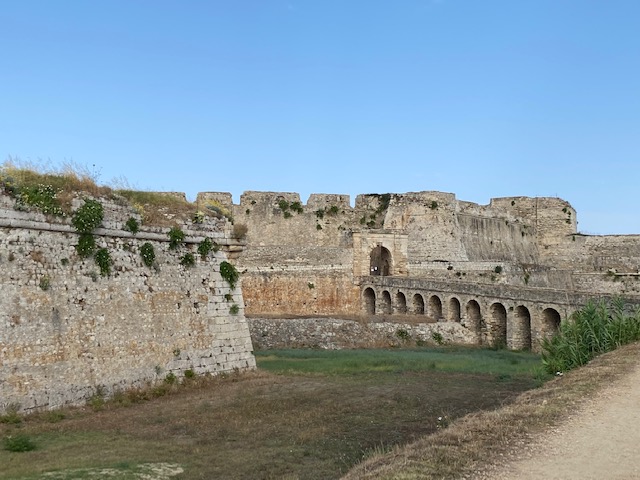
Similarly, Methoni Castle, on the west side of the “finger” end, developed into a significant commercial centre under the Venetians (1206-1500), after which it was occupied by the Ottomans and remained part of their empire for most of the next 300 years. The Venetians managed to wrestle it back from the Ottomans from 1685-1715. Koroni and Methoni were known as the two eyes of Venice. There is not a lot left to see inside the extensive castle grounds, but the fort wall is truly magnificent and is a clear navigational landmark from some miles away.




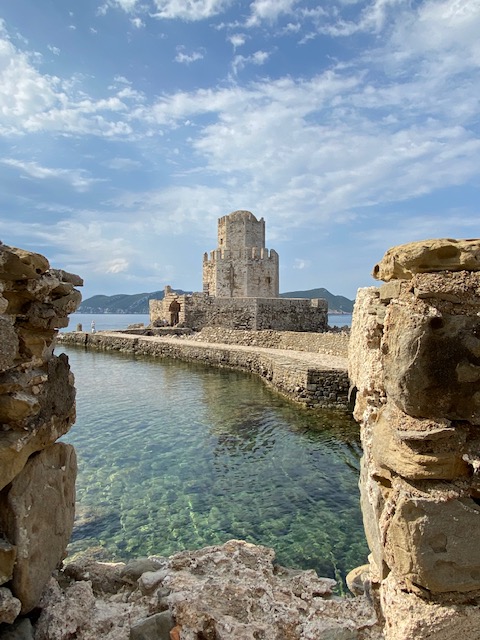
Pylos Castle is on the western side of the third finger. Actually there are two castles – one old and one “new”. They are situated near Navarino Bay which is quite large and is protected from the sea by a long thin island – Sphacteria, and a tiny little one – Pylos Island. This is simply a gorgeous area with some interesting history as well – exactly the combination that we enjoy. Navarino Bay is where the Battle of Navarino was fought in 1827 during the Greek War of Independence (1821 to 1832). It was the last naval battle fought entirely with sailing ships. The Allies fighting for Greece included the British, French and Russians and the opposing side comprised the Turks and Egyptians. The British actually entered the harbour with the band playing on deck supposedly to signal that they didn’t really want a fight but shots were fired on them so away they went blasting their guns. It was a resounding victory for Greece and her allies. Incidentally, this is not the story or the location for the movie “The Guns of Navarone”.
We anchored at the northern end of the bay and had an exhilarating and varied walk which took us up to the old castle from where we had a spectacular view of Voidokilla Bay – a simply stunning semi-circular bay with a narrow opening. The return took us down a billy goat track to the Cave of Nestor, and further down to Voidokilla Bay for a walk along the beach and then through the sand dunes back to our dinghies.


We moved to the southern end of the bay to anchor near Pylos town for a couple of days which gave us the opportunity for an early morning dinghy expedition to Pylos Island. This is one of those magical experiences that will stay with us for a long time. There were many nooks and crannies to explore as we motored gently around the island, the sunlight shone through archways onto the clear water, and birds swirled everywhere.


We found the walking track to the top and we rewarded with spectacular views and a prime seat to watch the birds darting around the cliff tops. Just lovely. We stopped for a look on Sphacteria Island and found a memorial associated with the Battle of Navarone nestled in a quiet spot amongst the pine trees.


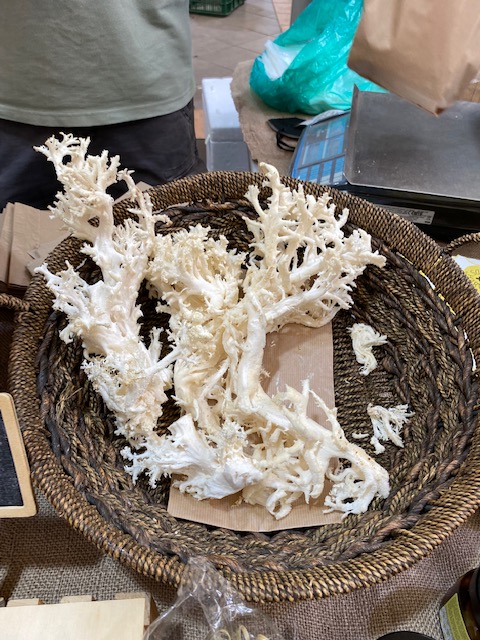
We had a brief stop at the friendly city of Kalamata – sounds familiar? Yes, famous for Kalamata olives which are my favourite. The food market here was just excellent. In addition to a good selection of fresh fish and meat, we also found fragrant fresh herbs, and some very interesting mushrooms. Not magic mushrooms, but preserved mushrooms. Some had been preserved in lemon which were delicious, and some had been preserved in a sweet light syrup which apparently are fabulous with ice cream! Imagine having mushrooms with ice cream!


Our last landfall on our voyage around the Peloponnisos was at Katacolon, and from here we did a day trip to Olympia- another absolute highlight. It was thrilling to be at the actual site where the Olympic Games started and it proved to be another absorbing and fascinating trip back in time. We saw so many parallels in the rituals of those first games with our modern games today – a procession which started a few days before the games and the arrival of which signalled their start, the high honours accorded to the champions when they returned to their home cities, and penalties (in the form of a fine) for cheating – yes even then! In fact, the money from the fines was used to erect statues of Zeus, which bore inscriptions of the offenders’ names and the rule which they broke. Fines were commonly issued for bribery (of other athletes and referees), ignoring instructions of officials, and being late.
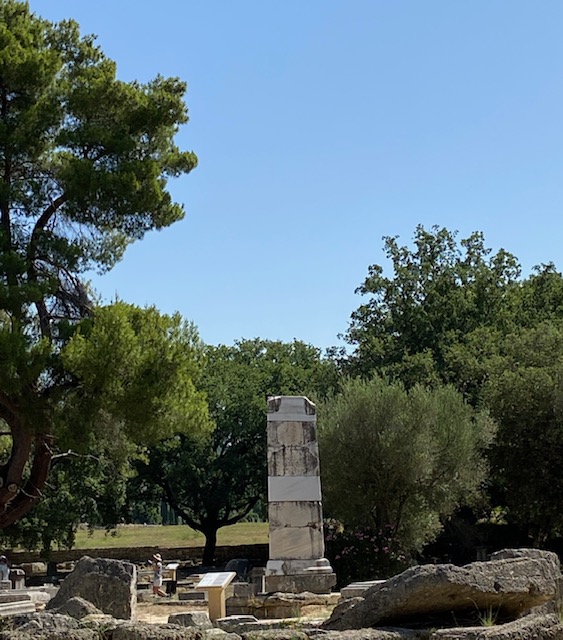
The site at Olympia was inhabited around the 3rd millennium BC and a sanctuary dedicated to Zeus began to appear around the 10th century BC. Institutionalised games started in the 8th century BC, although ad hoc games were held at the site before that. The ancient games were abolished by the Christian Roman Emperor Theodosius in 393 AD because they were seen as a pagan ritual honouring “false” gods. There is not much left above ground height but the area is well shaded and the signs very informative so we spent a few hours wandering around it, breathing in the history, before we made our way into the museums for some relief from the heat.

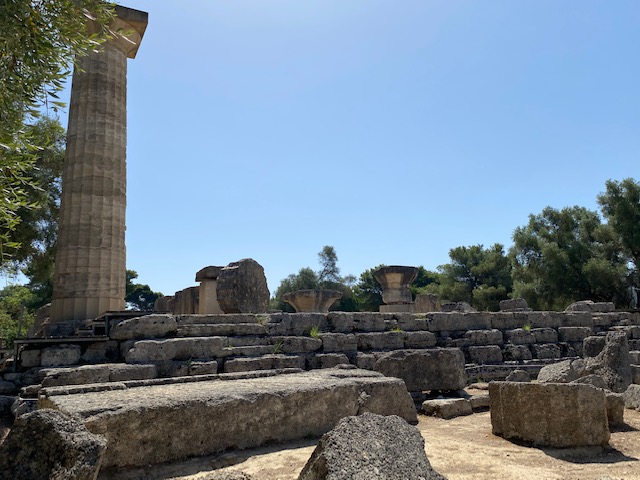
The Temple to Zeus housed a massive ivory and gold statue of Zeus that must have been just magnificent, which I guess was fitting for a god who was considered the father of the gods and humans. The statue took 8 years to build in a workshop on the site and was considered one of the seven wonders of the ancient world. The pediments on the exterior of the temple were decorated with massive marble sculptures of battles. Unfortunately, it was destroyed by a fire.


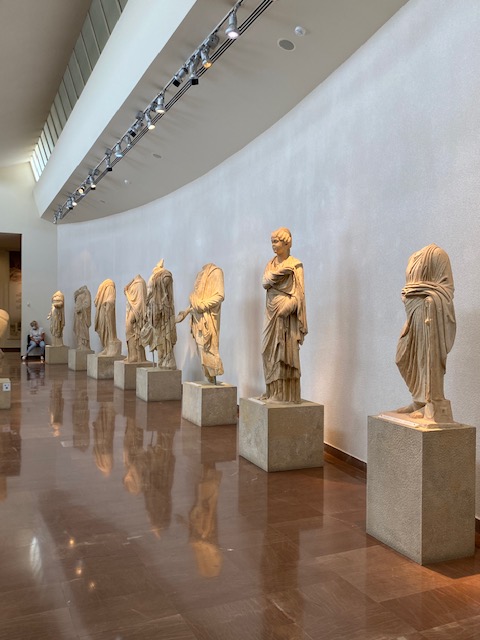
Nearby the Temple of Zeus was a statue of Nike, the goddess of victory. The statue, which is now in one of the museums at Olympia, was an offering from the folks who beat the Spartans (supposedly unbeatable warriors) in a war around 421 BC. It would have been a dominating structure as it is 2m high and was on a pedestal 8.8M high. Nike’s presence at the site was therefore more of a military symbol than a sporting one.

Walking out onto the actual athletic stadium was such a thrill. Phil and I did a run of course but we were quickly stopped by an official, not because we dared to run on the stadium but because Phil didn’t have any shoes on! Quite bizzare given that the ancient athletes were bare footed. There was no seating except for the judges. It seems that the only restriction on spectators was that no women were allowed with the penalty for doing so being death. Other than that, rich or poor, anonymous or famous, poets and singers, and even slaves were free to attend. One woman, the mother of an athlete, defied the rule and attended disguised as a man. She was found out when her clothes slipped off but was pardoned because she was the daughter, wife and mother of Olympic champions -even back then it was who you know that counted.

As Ancient Greece was in a constant state of war, a truce was declared for each of the games. Special officials travelled in groups of 3 to all Greek cities to announce the beginning of the truce and the date for the games. The Sacred Truce was housed at the Olympic site in the Temple of Hera. It is in front of this temple that the Olympic torch is now lit using rays from the sun. It is not lit from an eternal flame as I thought. There was an everlasting fire in another building at the altar of Hestia. This flame symbolised the common hearth of all Greeks – quite a nice symbol I think.

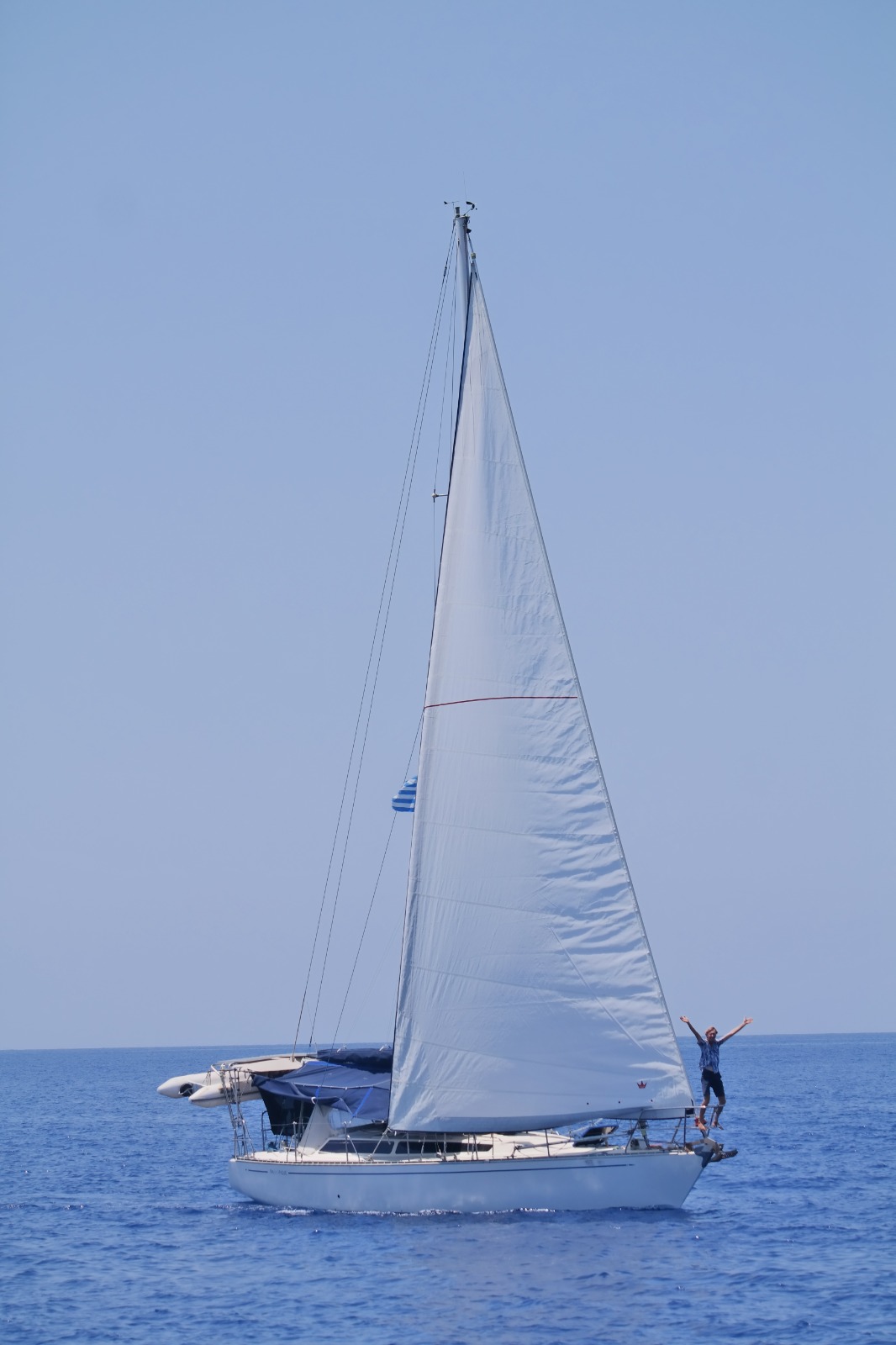
Many cruisers heading west from the Aegean miss Peloponnisos by passing through the Corinth Canal, which cuts through the isthmus which joins this large peninsula to the rest of mainland Greece, and traversing the Gulf of Corinth into the Ionian Sea. Although it was a little challenging to sail the long way around, we were very glad that we did. We were looking forward to the relative shelter offered by the famous cruising ground between the Ionian Islands and mainland Greece.


A fantastic and beautiful record of your journey, sights, sounds and people! Loved the whimsical photo and the herb seller; however all of it is terrific.
Weather kind to you too!
Xxx Much love Lyn
LikeLiked by 1 person
You write beautifully. Thanks for the tips!
LikeLike