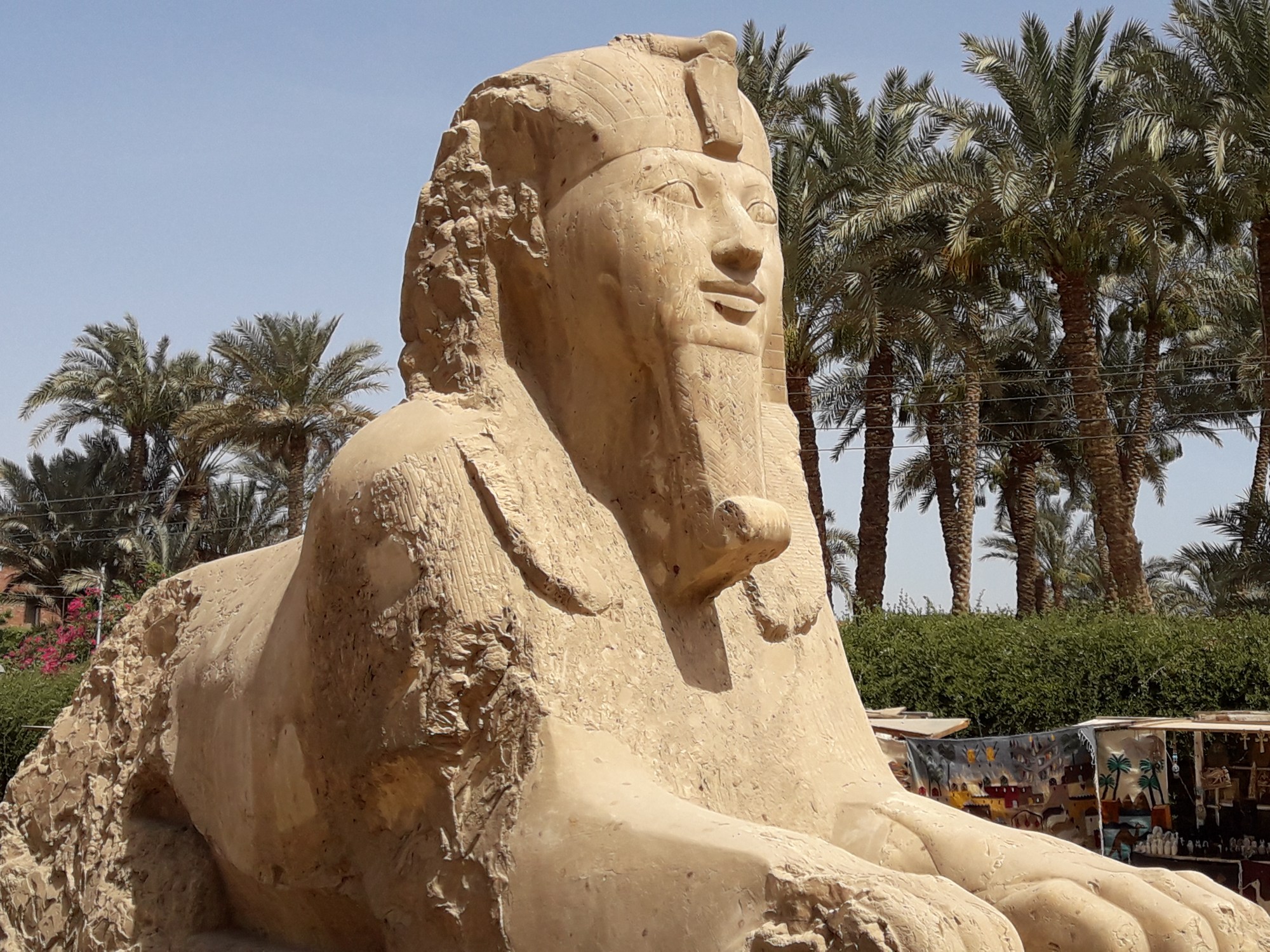
Where do we start? The history here is absolutely fascinating – well to us it was, and we met some wonderful people, but the way some Egyptians treat visitors to their country does not do them a lot of favours, and left us glad to leave the country after a month.
With much anticipation of a re-union after some seven months apart, Lesley flew into Port Ghalib a resort town on the southern Red Sea coast of Egypt. Meanwhile Phil, on board Paseafique, was bashing his way north from Sudan against the prevailing northerly wind. Lesley had a few days to check out the area and stake out a good vantage point from which to watch for Paseafique making her way up to the harbour entrance. As Phil did not yet have an Egyptian sim card, we were incommunicado once Lesley had left Australia, so on the day she estimated he would arrive, she duly went to take up position in the morning only to get a text message from the agent to say that Phil had arrived!!! And yes, sure enough there was Paseafique over the other side of the harbour tied up to the customs dock. A mad scramble to get over there quickly ensued and before long, Phil and Lesley were able to kiss and talk through the gate of the customs area, until the policeman on guard decided he have given Phil enough leeway and sent him back to the boat. Several hours later, Paseafique was tied up out the front of the hotel where Lesley had been staying, and we were happy campers again.


Paseafique through the bars at the customs dock, Port Ghalib; Happy campers
With Paseafique secure at the Port Ghalib dock, we organised an all-inclusive trip to Luxor through the hotel. On arrival in Luxor, we met our guide, Hussein, and were soon on our way to the Valley of the Kings and Temple of Hatsheput. Hussein turned out to be a very good guide, as he had quite good English and an infectious enthusiasm for Egyptian history. We heard the stories of a number of ancient Egyptian pharaohs and also the convoluted way in which Hatsheput became the first female pharaoh of Egypt. The tombs that we visited were just magnificent, as was Hatsheput’s Temple. It was extremely hot out there in the rocky valley, and we were well and truly ready to head back into Luxor for a late lunch. As it was Ramadan, Hussein was not able to even drink water! We really felt for him, given all the talking he was doing standing out in the hot sun.
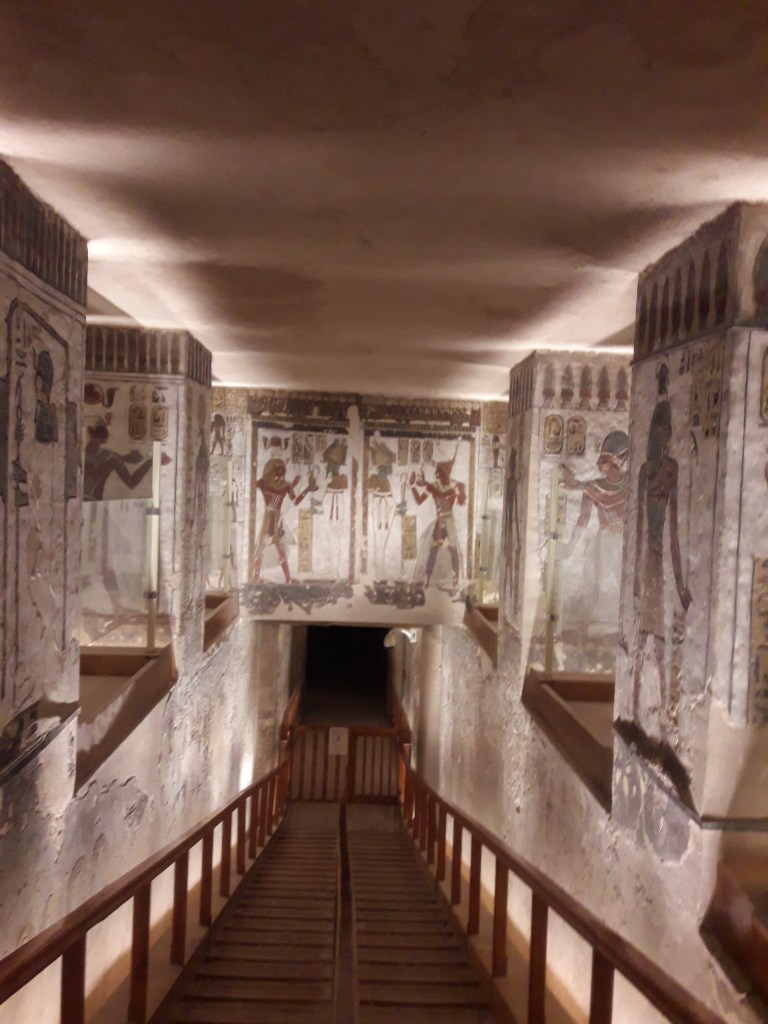

Can’t remember whose tomb this was- but it was magnificent!


A few close ups- lots (and lots!) of repeated hieroglyphs – Lesley couldn’t get her head around how much work it would have been until she found out that they did use a type of stencil. Still presumably each one had to be painted separately. Just mind blowing!

Hatcheput’s Temple, Valley of the Kings
Next morning, we visited Karnak Temple in Luxor, a most impressive ancient temple complex covering 100 hectares. Construction of Karnak started about 4000 years ago and continued up until the Romans took control of Egypt. Each Egyptian ruler left their own mark, so parts of the complex have been pulled down and remodelled, or new sections were added over about 2000 years. We were very glad that we had Hussein, as it made our visit much more interesting and informative, given the relative lack of signage. After lunch, we visited the Luxor Museum, a small but very good museum with a well curated display.


Entrance to Karnak Temple; evidence of building methods- the mud built a ramp so they could move the stone blocks up the ramp into position

Some of the massive pillars holding up the large blocks of stone for the roof
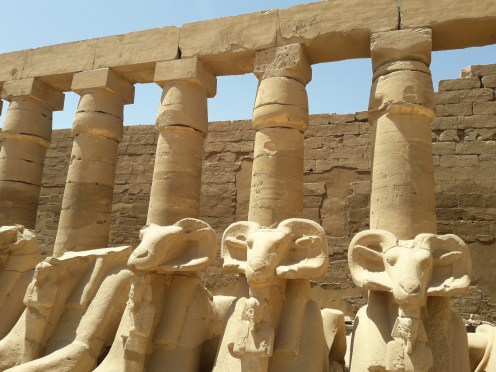
Another section of Karnak
We had both our evening meals in Luxor with Hussein, and learnt a little about the rituals of Ramadan.
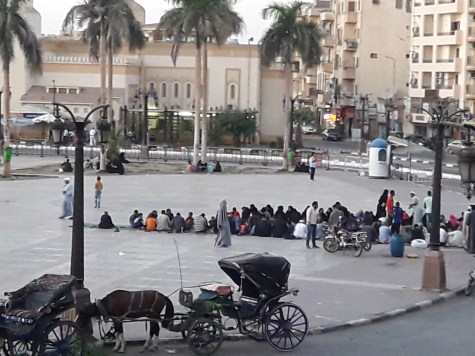
This is a common scene in towns during Ramadan – poorer people waiting for their evening Ramadan meal being provided for them by the wealthy citizens

Hussein was a happy man after the evening meal, and then tea and shisha pipe
After dinner on our final evening, we visited the Luxor Temple which was very atmospheric.


As we were with Hussein for most of our time in Luxor, we were mostly spared the constant pestering by hawkers wanting to sell, sell, sell. We did have to run the gauntlet in a few places, so Lesley put into practice some advice her friend Sue had given her – head high, eyes front, and just keep saying no thanks like a mantra.
Back at Port Ghalib, we made our preparations for the leg north to Port Tawfiq at the southern end of the Suez Canal. We expected that this would be a “grin and bear it” passage against mostly northerly winds, and that’s pretty much what we got. We spent a couple of nights at some nice little anchorages around where the Red Sea forks into the Gulfs of Suez and Aqaba. Umm Usk (an atoll) in particular was beautiful with some excellent snorkelling.


Desert landscapes on the way up the Red Sea and Gulf of Suez
From there, we had a couple of quiet days, for one of which we had a lovely southerly breeze which we really made the most of. After that, we had to contend with the northerlies again, until we were tied up at a slightly dodgy jetty at Port Tawfiq. We were dismayed though when our agent, Captain Heebi, informed us that the small vessel office for the Suez Canal would be closed for a week after the following Sunday (it was Tuesday when we arrived) due to the end of Ramadan festivities. We had already booked accommodation for a visit to Cairo for four nights from the Thursday. The closure meant that we would be stuck in Port Tawfiq for six more nights when we returned from Cairo – stuck being the operative word as there is not much there. We had been in constant e-mail contact with Heebi for a few weeks before we arrived in Port Tawfiq, and we just couldn’t understand why he waited until we got there before he told us about the closure, which presumably must be planned in advance. Anyway, there was nothing we could do about the situation, so we packed our bags, locked up the boat, and off we went on the bus to Cairo. We found our way to our centrally located Air bnb via the fairly efficient subway system, and settled in.
We quickly discovered that the Egyptians are the best salespeople going. They are excellent at striking up friendly conversation and can be ever so charming, all the while angling to get you to buy something from them. We were out for a walk on our first evening there, and before too long, a couple of guys who were crossing the road at the same time as us, struck up a conversation. One of them professed to be an Australian (showed us his passport), back in Cairo because of a death in the family. The other was a local, and his best friend. After a bit of chat as we walked along, they invited us to share their evening meal (it was still Ramadan) with them and their friends. We thought this would be a great opportunity to experience something of regular life in Egypt and before long we were seated at a table in the street with a group of Egyptian men. There were similar groupings around tables set up in this street, all eagerly waiting until sundown before they could start eating. We had a very nice meal, and then were offered a cup of tea – and come inside to enjoy the tea. Well, “inside” turned out to be a perfume shop. One of the guys who ran the shop, Kalim, was chatting to us in a conversational way as he served the tea, about the shop being in his family for a few generations etc. Then it was “let me show you some of our perfumes” and then came the sales pitch. Unbeknown to Phil, Lesley had decided to leave her perfumes at home in Australia (in an attempt to lighten her luggage and stay within the limits), thinking that she would buy some in Egypt. So we did actually end up buying some perfume from Kalim the charmer, as a “present” for Lesley whose birthday it was in a couple of days. Our two friends had sat around in the shop while all this was happening and as we had asked about the tourist information centre earlier, one of them volunteered to take us to one after we had completed our purchase. There was much handshaking as we left and an open invitation to join them for dinner any evening, as we were “part of the family now”.
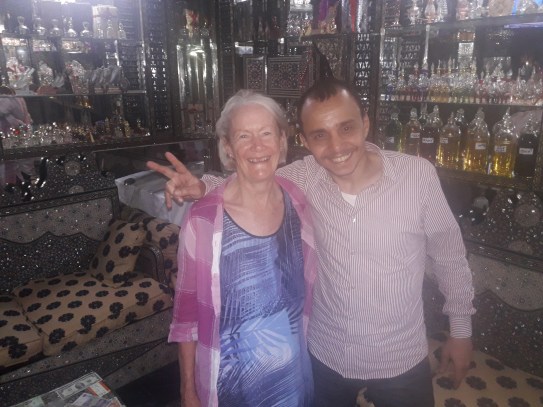 Lesley with Kalim in his perfume shop
The tourist information centre turned out to be just a local travel and tour agency (probably “all in the family”), but it did seem to have some kind of government accreditation – mind you that might not necessarily mean anything. The guys there were very helpful and had good value tours so we booked one for the pyramids, which included two other sites, and also a dinner cruise on the Nile for our last night in Egypt and for Lesley’s birthday.
We met our driver at the travel agency early the next morning, and set off for our day viewing ancient ruins. First stop was Memphis, the site of the first capital of Egypt. There is not much left there to see apart from an impressive large statue, so it was a quick stop, and then onto Saqqarah. This area was a vast ancient burial ground featuring a step pyramid and many tombs, and is Egypt’s largest archeological site. There was even an underground complex of 24 very large sarcophagi in which sacred bulls were entombed. We spent an absolutely fascinating few hours there and were very grateful that we had our driver to take us to the different areas in his air-conditioned car. We wouldn’t have seen anywhere near as much if we had been walking. We were besieged again, this time with animal handlers wanting us to take a ride on their camels, horses and donkeys. One of the guys with a beautiful Arabian horse tried his best to sweet talk Lesley into a ride with him, and when that failed, wanted Phil to take a photo of him with “your princess” but of course, only if Phil paid him for posing. He rode off with a scowl when we refused. Even with the air-conditioned car, it was incredibly hot walking around the site, and after a few hours we were fading fast, so onto our last stop for the day – the pyramids at Giza.
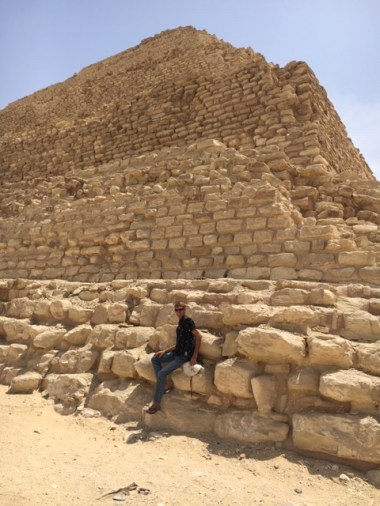 Phil at the Step Pyramid


Paintings inside one of the tombs depicting the slaughter of an (unlucky) bull


The lucky bulls were the ones selected for worship (one at a time) as they ended up as mummies in this large underground complex of sarcophagi
The Giza pyramids are truly a magnificent sight, standing in the middle of the desert. Unfortunately, the shine was taken off our visit there by confusion about where to buy the ticket for entry into the Great Pyramid, causing us to be traipsing around in the late afternoon heat from one gate to another to find the ticket booth. Things were further soured when we finally got our ticket and found out we only had another hour until the whole site closed for the day – an earlier than normal closure because it was still Ramadan. So we hot footed it (literally) back to the Great Pyramid and crawled up the steep “walkway” inside, into a relatively small, and very stuffy, room which was completely unadorned. It seemed a bit of an anti-climax compared to the tombs we had seen in Luxor and Saqqarah, but here we were in the middle of a 4,000 year-old building that had been the tallest man-made structure for thousands of years. Back out into the daylight, we quickly got a look at the second and third pyramids, and also the great sphinx, while making our way back to the gate before closing time. It was a huge day and probably too much to be attempting even in the early summer. However, the visit to Saqqarah will remain as a highlight, and we would not have been able to get there if we had not taken the tour. While you can get to the Giza pyramids by train from Cairo, which had been our original plan, Saqqarah requires a car.

 The Great Pyramid of Giza, also know as the Pyramid of Khufu – the entrance is the small black hole to the left of the camels in the upper photo. Lesley next to the entrance, relieved to be out of that hot and pokey space
We spent the best part of another day in Cairo at the Egyptian Museum – another totally fascinating day. Highlights in the museum included the Royal Mummy Room and also the Tutankhamun exhibits. There are 11 mummies in the Mummy Room very well displayed in temperature controlled glass boxes. It’s a veritable who’s who in Egyptian Pharos and other notable VIPs including Ramses I, II and III, Queen Hatsheput, and Tuthmosis III. It was absolutely awe inspiring to be able to stand right next to these people and look at their faces – if only they could talk! It was thrilling to be able to see the mummies of the people whose stories we had heard so much about from our guide in Luxor. While it was fabulous to see them, we did feel that to some extent they should have been left in their tombs, which is where they and their families believed that they needed to be so that they could pass into the afterlife. We had seen some, but not all, of the Tutankhamum exhibits in Melbourne a few years ago, but it was great to see them again and marvel at the beauty of some of the pieces. We were also interested to see in the museum that the Egyptian people had dice (for games), fish hooks, glassware, the earliest prosthetics (a wooden toe in this instance), toys, and even boomerangs for hunting.
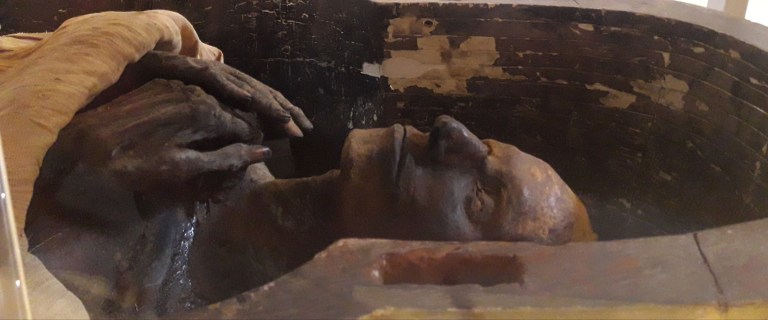 No photos allowed in the Royal Mummy Room, but this is not a royal mummy

The stencils that the ancient Egyptians used to do all those hieroglyphics


Some of the treasures from the Tutankhamon display


The canopic jars used to store Tutankhamon’s organs. The jars were then put into the elaborate box on the right.
While the outing to Saqqhara and Giza that we booked through the tour company was pretty good, the dinner cruise on the Nile turned out to be a bit of a fizzer. We were picked up about 7pm and taken to the boarding place (once the driver found the right one!), where there was not a boat in sight. A phone call to our tour operator re-assured us that the boat would be there, and eventually it did turn up but by the time the load of passengers were disembarked and we got going, it was getting close to 9pm. We were a source of intense interest from the Egyptian crowd who were disembarking and many of them wanted photos with us. Dinner was served immediately we got underway and was a buffet of fairly ordinary food which we shared with a large Indian group who were on tour together. The evening was so corny that we laughed our way through it and the night was saved by some excellent Egyptian dancing performed by a troupe in fabulous costumes.


Nile dinner cruise and dancing
Back on board Paseafique once again, we set about the usual preparations for the next part of our journey – through the Suez Canal and across to Cyprus. The transit of the canal was relatively straight forward as there are no locks and only about half a metre difference in the sea level between the Red and Mediterranean Seas. We got underway about 11 am, with one other yacht, Mutley, doing the transit at the same time. By 6pm that evening we were both tied up at the Ismailia “Yacht Club”, the half-way point, for the night. We were off again just after 4.30am the next morning, and by 11.30 am we were clear of the canal entrance and sailing in the Mediterranean!


Our two pilots for the canal transit: the first guy on the left asked for a gift (as well as the USD$20 tip); the second guy on the right gave us a small gift each!

Well, the canal does go through the desert after all!
 But there is some interesting infrastructure – this is a pivoting floating bridge that is deployed to allow road traffic to cross the canal

The ships go north in the morning and south in the afternoon – here is the some of the afternoon convoy

And they do pass close by!
 paseafique
Hi, very good.
LikeLike
This is so mind-blowingly different than our Caribbean Islands (or should I say ‘suburbs of Florida’) experience that I am sitting aboard Amandla mouth agape and green with envy …even if some locals need a lesson in hospitality
LikeLiked by 1 person