
We arrived in Diego Suarez, on the north east coast of Madagascar, after a fairly gruelling day of travel from Crater Bay on Nosy Be where we had left the boat. Our plan was to explore Diego, and to use it as a base to visit two national parks, Parc Nationale Montagne D’Ambre, and Reserve Speciale Ankarana. However once we had experienced road travel in Madagascar, we decided to do the return trip over two days, instead of one, and stop over night at the little village near the main entrance to Ankarana. Our Norweigan friends, Knut and Kristen, had told us that they found Diego a bit boring and recommended no more than three days there. Well, after our first morning exploring the city, we decided that they were right, and in fact three days would be generous. There is definitely interesting history there but the tourist brochure for the city walks was all in French which makes it less accessible to us. We found a tour company (Evasion Sans Frontiere) and arranged for a day trip to Montagne D’Ambre for the next day. In fact, they were very helpful and linked us up with another couple who also wanted to do this day trip so that the cost for the vehicle, driver, and guide was split between us. We had a pleasant enough day, but would not say this was a must see destination. Montagne D’Ambre is a rainforest so we had a nice walk through it, stopping to admire the waterfall along the way.

Our guide had a special interest in chameleons which gave a good focus for the day. She found us three different species. The first she actually spotted on a tree branch as we were driving along on our way to the park, and she got the driver to stop so we could have a closer look at it.

Aren’t these creatures amazing? I love their feet, and the hilarious way they rock back and forth trying to make you think they are part of the tree blowing in the wind
The second one was the second smallest chameleon in the world and she had to carefully poke around in the leaf litter at the base of lots of trees before she found one for us.

The teeny tiny chameleon
The third one was extremely well camouflaged on the branches of bushes with very dense foliage. It is most unlikely that we would have found any of these without our guide, and it was something quite different for us to see.

You might need some clues to find this one: its head is right at the bottom, tail at the top and it has white markings on it to match the lichen on the branch
With some trepidation, we set off early the next day for the 96 km taxi-brusse ride to the village of Mahamasina, at the entrance to the Ankarana Reserve. It was the same scene at the taxi-brusse station in Diego, with a bevy of ticket touts descending on us even before we had got out of the tuk tuk that had brought us from the hotel. This time, though, there actually was a ticket booth, so we marched over to it, determinedly holding onto our luggage, and got our tickets. Then it was a matter of waiting until all seats had been sold and we were off. It was every bit as uncomfortable as the trip to Diego had been, and even more so for me as I did not get to sit in the front seat at all this time around. We were seated in the row behind the driver, where there is a small parcel rack. At one point, I had a woman sitting directly opposite me on the parcel rack, with her legs apart and my right knee pushed right up into her groin – way too up close and personal for me! But there was no choice but to grin and bear it. Fortunately, she was only taking a relatively short trip, and no-one else was put there. After about 4-5 hours, we arrived at Mahamasina and checked into the guest house (Chez Laurant). As soon as we had arrived, a guide from the national park office introduced himself (Simon) and filled us in on the different walks we could do. We arranged for him to take us on the 5 hour walk the next day. We were pleasantly surprised to find that we didn’t pay the guide directly, but at the park office where we also paid the entrance fee. Both the guide and entrance fees were fixed and displayed in the park office. Accommodation at the guest house was quite basic – no hot water, and power only from 6-10pm, but the dinner was very good.


Chez Laurent
We set off with Simon at 7.30am the next morning for the walk through the east side of Ankarana. Almost straight away, I spotted a chameleon crossing the path not far in front of us. We got a really good look at him as he made his way up into a tree. According to Simon, it is rare to see a chameleon in this park, so we started our day by feeling lucky.
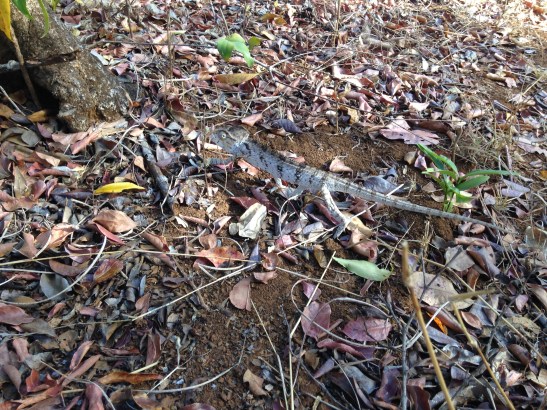
Chameleon crossing the path, pretty well camouflaged in the leaf litter
We walked for a while through pretty woodland, and Simon pointed out a variety of plants and explained their uses. Quite a number had some medicinal properties. Birds were active in the dappled sunlight and again Simon impressed us with his knowledge of the different species and their habits. He spoke very good English which made all the difference to our experience.


The walk through the woodland- we saw lots of these tangles some of which were very extensive
Soon we came to the lost rivers – three large rivers that empty into a giant sink hole, and then disappear underground. At this time of year, the rivers are completely dry, so we were able to see this area very well. Simon told us that when it rains, you simply cannot be anywhere near the junction of the rivers, as there is just too much water and it’s dangerous. Even sometimes when it rains in the mountains, but not in the area around the sink hole, you could be easily caught out by a huge torrent of water suddenly rushing down the dry river beds. This area has very interesting geology and Phil was in heaven. It was truly amazing.

The river bed of one of the three lost rivers is at the top of this photo
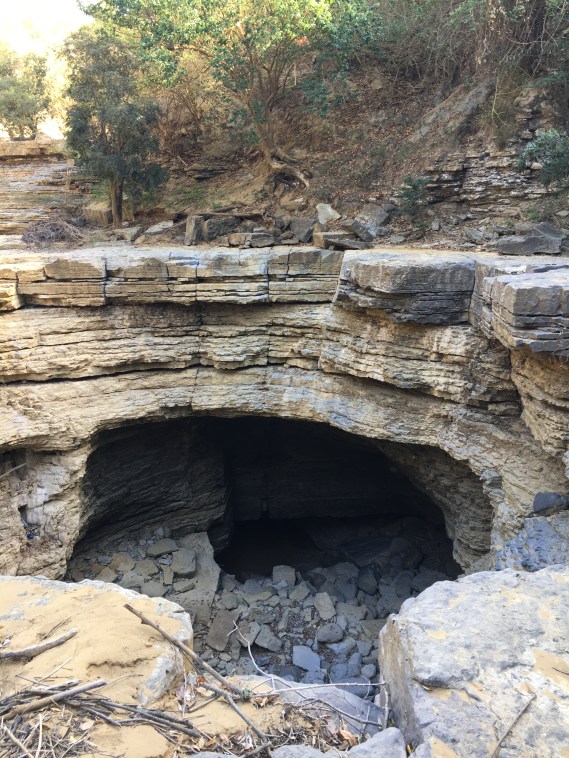
Close up of the sink hole

The photo illustrates just how big the sink hole is!
Leaving the lost rivers, we continued on through the woodland and came across a group of crowned lemur, again on their way from one side of the track to the other through the overhanging trees. A couple of them came some way down the tree trunks, possibly hoping for some bananas even though it is prohibited to feed them in the reserve. I was totally captivated. They were so gorgeous. Another lucky sighting according to Simon (maybe everybody who does this walk is lucky!).
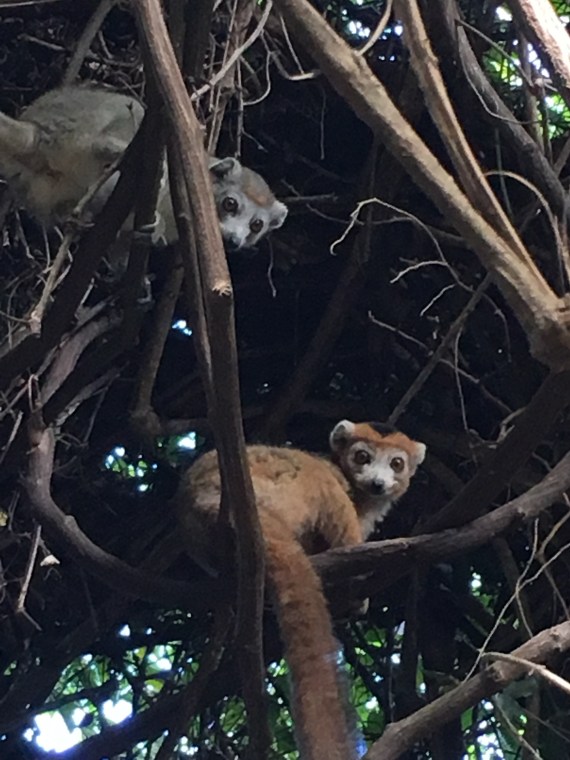
Crowned lemur (grey is female, brown is male). Aren’t they just the cutest things?
Our luck with the lemurs continued when Simon found a couple of sportive lemurs. These are very small nocturnal creatures (about 700 g) that sleep wedged into hollows in tree trunk – with their eyes open! Apparently, they have no eyelids.

The nocturnal sportive lemur
Eventually we arrived at the edge of the tsingy – very hard spiky pinnacles of limestone. Now this is something really different. A very weird landscape which looks like to could be another planet. The few plants that were dotted through the field were quite unusual.
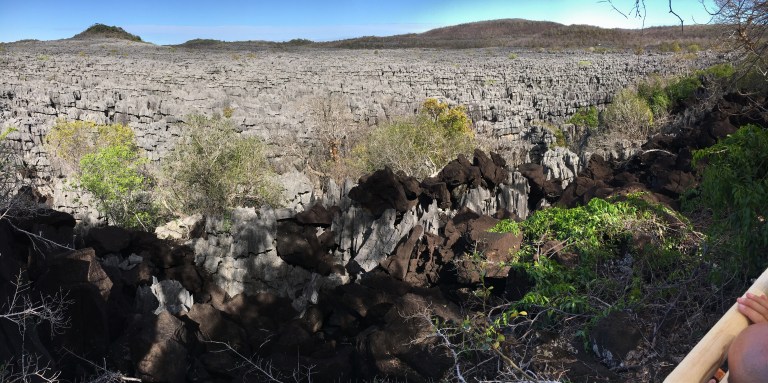
Grey limestone tsingy almost as far as you can see. The black rock in the foreground is volcanic
After admiring the view, we set off and followed Simon across the tsingy to a suspension bridge that crossed to a lookout and rest area. Metsingy (not sure if I have the spelling correct) means to walk on tip toes in Malagassy. Simon told us that an early European explorer wanted a special word to describe these formations as they were so unusual. He settled on “tsingy” which on its own has no actual meaning in Malagassy.


See just how sharp that tsingy is! One person at a time on the suspension bridge
After a short rest, we crossed back over the bridge and the field of tsingy, and returned through the woodland, learning more about the wildlife along the way. By this stage, we were very glad we had started out relatively early as Simon had suggested, as it was quite hot.


Top left is a leaf bug and her babies (the white things on the branch). Top right is chameleon eggs. Bottom photo is self explanatory
Once back at the guest house, we collapsed onto the bed to recover sufficiently for lunch. I was really pooped as Simon did set a fairly brisk pace. We whiled away the afternoon, reading and taking a short walk around the small village. Simon had informed us that the guesthouse could make a booking for us on the taxi-brusse, which was a relief as we were concerned that we might have trouble getting a seat, given how crowded it usually is. The down side to having a booking is that the pick up time is 4.30am! As far as we could ascertain from the guy at the guest house, that is the only service that goes all the way to Ankify (where the ferry terminal is), and on which one can book a seat. We had another satisfying dinner, got everything in readiness for the morning (torch at the ready as no power), set an alarm, and turned in for an early night.
We woke up the next morning, not to the alarm but to knocking on the door! Yikes! We were informed that the taxi-brusse was 5 kilometres away. We leapt out of bed thinking we had overslept but not so. Our pick up was slightly early. With bleary eyes, and accompanied by the guest house guy (pretty good service we thought), we made our way to the road side where the taxi-brusse soon appeared. There was another couple also catching the same service, and it turned out to be the people with whom we shared the day trip to Montagne D’Ambre. The four of us were squished into our seats, luggage strapped to the top, and we were waved off by the guest house guy. Our touring friends live on Nosy Be (same place we were going) and had been on holiday – the woman was Swiss and the guy was Malagassy and both had limited English so conversation was light on.
It was amusing to see all the locals on the taxi-brusse rugged up against the early morning “cold”. Jumpers, beanies, and even blankets were the order of the day. Admittedly it was a little cool, but we clearly have not acclimatised to the Madagascan winter. We bumped and ground our way along the decrepit road, stopping for letting off and taking on passengers, with everybody shuffling a few millimetres to change position at least marginally and gaining some comfort for about 10 minutes before the new position became uncomfortable.
Upon arrival at the ferry terminal, we again had the ticket touts descend on us, but this time we simply followed our friends (who could speak both Malagassy and French) through the process of buying our tickets. Before too much longer, we were back at Crater Bay where we found all in order on the good ship Paseafique. As we were a bit wiser about how the travel system works, we paid half as much for the taxi-brusse and ferry on the return trip (AUD$50 all up) as we did getting to Diego in the first place.
If you read the previous blog about the marathon trip to get to Diego Suarez, you will recall that we found it one of our worst travel days ever. Taking the return trip over two days was a much better option and I would recommend 4-6 hours in a taxi-brusse in Madagascar as an upper limit per trip. Ankarana was clearly the highlight for us, and if we had our time again we would not bother going to Diego or Montagne D’Ambre. We are not sorry we did the trip though (now that it’s over – ha ha), as it was a unique travel experience and we did get to see more of Madagascar, and its fascinating creatures, than would have otherwise been possible.

 paseafique
Thanks for the news. What a treat to see the chameleons and lemurs! All’s well here.
Love Alison xx
LikeLiked by 1 person
That sinkhole, the Tsingy, the suspension bridge and the chameleons almost make it worth it to take a road trip from Hell.
LikeLiked by 1 person
Fascinating wild life. Love the lemurs 💕
LikeLiked by 1 person