
Who would think that travelling on a highway would be an experience worthy of a blog? We recently travelled some 200 km on the N5 highway in Madagascar, and even though we had read about the perils of road travel here, we were still astonished by the conditions.
After managing to secure a mooring for Paseafique at Crater Bay, Nosy Be, we set off for a few days of exploring the northern part of Madagascar. Our plan was to take a taxi-brousse (or bush taxi, as they are known here) from Ankify on the west coast of Madagascar to Diego Suarez on the east coast, a journey of about 260 kms. We planned to see a bit of Diego, previously a Portuguese port, and visit two national parks, and be back to Paseafique in a week.
But first we had to get from Crater Bay to Hell-ville to catch the ferry from Nosy Be across to Ankify on the mainland – not straight forward as you don’t just ring the local taxi service, and there is no Uber, and it is a bit of a walk up to the road where you could hail one. Luckily while we were having drinks at the Crater Bay yacht club the night before we were due to leave, Phil managed to arrange a taxi to collect us at 9am the next morning, so we were all set.
The next morning, the taxi delivered us to the harbour at Hell-ville, and immediately we were besieged by about 6 local guys grabbing our luggage, talking loudly in French, and wanting to sell us tickets for the ferry. We baulked at the 60,000 Ariary they wanted to charge us (about AUD25) and so they dropped the price to 50,000. We weren’t entirely sure about these guys but we went along with it. Once they are in charge of your luggage, you are at a bit of a disadvantage. We found out later that we should have trusted our instincts. So we got down to the ferry dock, and got onto the indicated speed boat to await departure- ferries and buses depart when full here, rather than run to a schedule. We knew that the last taxi-brousse from Ankify would depart by 12 MD (as it was a Sunday), so we were nervously willing more passengers to get onto our boat every time someone approached. Eventually, all seats were taken and we zoomed off for the 30 minute ride to Ankify.
Upon disembarkation at Ankify, I marched off determinedly to find a ticket office for the taxi-brousse, rather than buy tickets from one of the guys who again besieged us, while Phil got our luggage off the ferry and followed. He collected his own little entourage and had a funny anecdote to tell me later. One of the guys kept pestering him to buy tickets and Phil told him that he was just looking for his wife. So the guy started pointing to various local women asking “Is this one your wife? What about this one?”. As Phil is a middle aged white man, this guy automatically assumed that he would have a young Malagassy woman as his wife. It’s a common sight here – the older French men with a young local wife.
Anyway, after ignoring the raucous pleas of our entourage, we found what we thought was a ticket office, only to be told in halting English by the guy sitting in there that there is no ticket office at Ankify and we should buy our ticket from one of the guys who had been following us. So after resisting this guy all the way from the dock, he told us in basic English, that we had to buy two tickets – one for him to take us to Ambanja (a town 22 km away), and then another for the taxi-brousse from there to Diego. It seemed that we had missed the last direct taxi-brousse. So we bought two tickets for a total of 95,000 Ariary each (AUD$40), and followed our guy and his mates to his car- a vehicle that would only be fit for a paddock bomb or the wreckers in Australia. It had no door linings, one door which would not open, no floor covering, crooked steering wheel, and worn out seats. We all piled in and a short while later we arrived in Ambanja. While we waited uncertainly on the road side, our guy made a number of animated phone calls. By this stage, we were confused as to what was happening. We were expecting that he would drop us at a station and we would get the taxi-brousse from there. Eventually a crowded mini-van pulled up, and the driver got out and proceeded to have a very animated conversation with our guy and his mates. A short time later, a second crowded min-van pulled up. Two passengers were dispatched from the first mini-van, and were installed in the second mini-van, which then drove off. Now we were instructed to get into the two empty places in the first mini-van. I was placed in the front, with the driver and one other passenger. I found out later when I was moved further back in the van just how lucky I was to have been in the relative comfort of that front seat for at least half the trip. Phil was placed in the second row, thankfully next to the window. Our luggage was strapped to the reinforced roof, along with all the other bags.
Notice I said we were put into places rather than seats? The Madagascan taxi-brousse take the expression “jam-packed” to a whole other level. The van was designed for 15 people and it was carrying 26! Each row in the van normally seats three people, but four to five are squeezed in.


These photos give a sense of the seating arrangements – note five people in the back row, three in the left panel and two in the right
Further, the row immediately behind the driver, usually has a narrow bench which would normally take a few parcels. This space is obviously too precious to waste and so a couple of passengers usually find themselves placed there.

Parcel rack seat: at one point there was actually a person sitting on top of the red and white material; one of my knees on the left, and the knee of the person next to me on the right
Small people who are going a short distance sometimes have to stand crouched in whatever spot is possible, and ultimately, the co-driver who assists with getting people on and off, and getting their luggage off the roof, can always ride on the back bumper bar, giving up his seat to a paying passenger. Fortunately, there were no chickens or goats to accommodate as well.
So once again we were off, this time bound for Diego Suarez along the N5 highway. This road is best described as a series of assorted craters and potholes loosely joined by pieces of bitumen. Consequently, the drivers do a lot of swerving to miss the worst of the bumps (often onto the other side of the road), and also drive on the gravel shoulders a lot as this is actually smoother than the road itself.


A national highway!
There were a number of bridges to cross, most of which were one way. Some of them had collapsed and not been repaired, so there was an off road bypass across the dry river bed. Some of the bridges consisted of horizontal girders, with metal ramps going across the girders. The ramps were all just wide enough for the tyres, requiring a fair degree of accuracy on the driver’s part.

Slowly does it – I actually closed my eyes going over this bridge
The driver we had on the way to Deigo had a rather unnerving method of dealing with the road conditions. He would drive full pelt right up to a rough section or a vehicle he wanted to overtake and then jam on the brakes and swerve sharply. All of this made for a very rough ride, which was even more uncomfortable by the seating arrangements in the van, and the very loud music played by the driver through poor quality vibrating speakers.
We proceeded at mostly a very slow pace overall. Along the way, there was lots of stopping. Obviously, we stopped for passengers embarking and dis-embarking, but sometimes this was within a few 100 metres! It was during one of these stops that Phil noticed something black falling from the roof, only to discover that it was one of our bags. What good luck that was. With all the people squeezed in, you can imagine what it took to let someone from a back row off the van. No problem- they just climb out the back window! The driver had no compunction in stopping for various errands – he bought a large bunch of bananas here, a sack of oranges there, and some snacks in a few places. He stopped to talk to people. He stopped to have his dinner, but did not tell the passengers, so we were all still sitting on the bus wondering where he had gone. Eventually Phil and I got off to investigate and found him sitting at a road side stall eating a meal!
Then there was the stopping for the police road blocks, and there were about 10 of these during our trip. On the surface, these stops are to check the driver’s licence and car registration papers, and to collect any tax that might be due on the transport of charcoal (used everywhere for cooking). However, the police are also extracting bribes from the drivers. It is all very discrete, with the money being placed inside the driver’s documentation folder when he hands it over for checking. I was concerned that the police might try to also extract something from Phil and me, as foreigners but it didn’t happen.
There were stops for the calls of nature. The men all relieved themselves on the side of the road (out in the country, not in the villages) during the course of the day. I did wonder how the women were to be accommodated, and was left to ponder this until just after dark when there was a hubbub in the van and the driver pulled over. All the women charged out of the van, and squatted on the side of the road in the dark, although they did get caught in the light of oncoming traffic. By the way, Phil and I did not join in this group activity, preferring to limit our fluids and wait until we got to our hotel.
There was also another type of call of nature. At one point during the journey, a guy who was probably a fishmonger got on and was seated next to Phil. No prizes for guessing how Phil worked out his occupation. He was pretty shabbily dressed also, with blood on his clothes. Luckily, Phil was still next to the window, so it was just bearable. It would not have been so bearable if Phil had not managed to yell loudly enough to get the driver to stop when it was obvious that the fishmonger was vomiting. He just made it off the van in time. Poor Phil then had the worry that this was not the end of it, however, he made it through without another episode.
Despite the frequent stops, there was no stop for the passengers to have a meal. Some people did buy snacks from vendors through the van windows. Phil and I managed a quick bite to eat when we discovered the driver having his dinner.
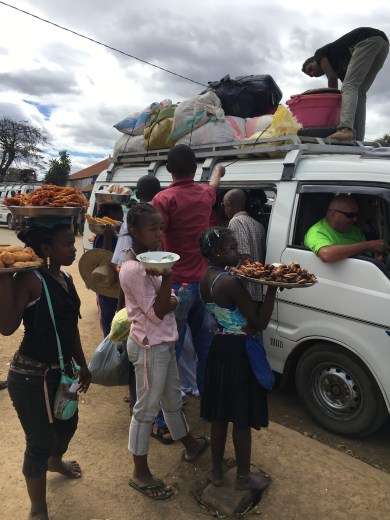
Food vendors crowd around our van
Jammed into the mini-van with a bunch of non-English speakers, there was nothing else for it but to observe the passing scenes. The highway is used by a lot of different types of vehicle: cars, mini-vans, 4-wheel drives, trucks (half of which were broken down mostly with flat tyres), bicycles, motorbikes, men pulling carts, and zebu (the local species of cattle) pulling carts. In addition, there were lots of people walking along the roadside, and animals crossing the road -small herds of zebu, pigs, ducks, and chickens with their chicks scurrying after them.
Being on the road for such a long time and passing through many villages where life is predominantly lived in the open, gave me the chance to watch the rhythm of their day. We had set out from Ambanja not long after 12 MD, and so I saw lots of family groups sitting at rough wooden tables eating lunch that had been cooked on their charcoal fires. There had clearly been lots of washing done in the morning as the countryside was littered with colourful clothes spread out to dry, often on top of long grass next to a river.
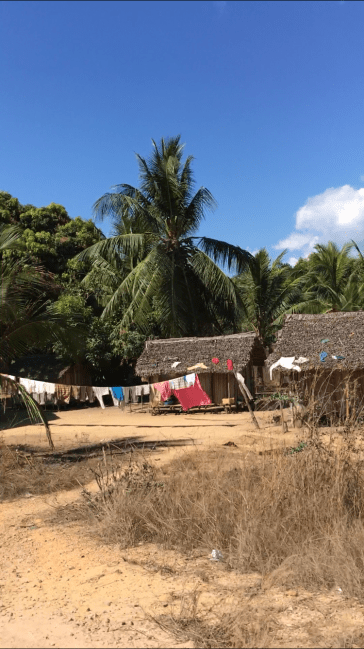
Washing was clearly a major activity as we saw lots of it
During the afternoon, people were resting or sitting around talking. The women and girls would sometimes be braiding each other’s hair. Mothers would be breast feeding their babies in the afternoon shade. Children were running and playing, as children do everywhere. Some children were working though. We noticed quite a few young boys out on the road side with a shovel, filling in some of the potholes with dirt. As we drove by, they would hold their hands out looking for a payment – sort of pay as you go road maintenance. Clearly, there was not much maintenance being done by the authorities.
In the late afternoon, people (men and women) were taking their daily bath in rivers, often quite close to the roadside. As night began to fall, the pedestrian traffic seemed to increase as more people were walking between villages, perhaps after having been to visit someone in a nearby village for the day. Some were carrying things such as dead ducks, or piles of wood. Small fires began to appear as the preparation of the evening meal got under way. As it got darker, it also got cooler so people were getting into warmer clothing and gathering around the fires.
By this stage, there had been some shuffling of the seating arrangements and Phil and I were seated together. We discovered that we had both been worrying that our ticket tout might not have actually paid this driver, which would mean that the driver would be looking for another fare from us when we arrived in Diego. We did have a receipt for having paid the fare, but we were unsure whether the driver would recognise the receipt, and in any case, if the fare had not been paid to him, he would be wanting it from us, receipt or not. We were obviously tiring of the travel, and started checking our estimated arrival time on Google maps. Each time we did we checked, the arrival time got later and later! Finally, we reached the outskirts of Diego and eventually the driver stopped. We guessed this was the final stop when everyone else piled out of the mini-van, and retrieved their dusty luggage which was waiting on the side of the road. The driver didn’t bat an eyelid when we picked up our luggage and walked off, so we guessed that our ticket tout had indeed paid the fare.
Fortunately, we were not far from our accommodation, so we hailed a passing tuk tuk. The driver didn’t really know where our guest house was, so we directed him using Google maps and got him to let us off when we reached the pin on the map. However, this was grossly inaccurate and after getting directions from a helpful English speaker, we walked the last 500 metres to the guest house, where we rushed into the toilet, and gratefully accepted a cold beer and a decent meal. It had taken close to 9 excruciating hours to do the 237 kms in the taxi-brousse, and the whole trip from the yacht club took 12 hours. Stretching out on the bed that night after a lovely shower never felt so good.
 It is the dry season, but the countryside we passed through was extremely dry and fairly barren
 paseafique
What a memorable trip! It made for a great read. I hope the trip back is more comfortable, but that doesn’t seem likely.
Sorry I missed your call the other day – would have loved to talk.
Thinking of you.
Alison xx
LikeLiked by 1 person
Great story at least! We had a less intense version of that mini-bus trip in Laos.
LikeLike
Haha. Yes we had a mini bus trip in Laos too but it was nothing in comparison to this!
LikeLike
I’m mohamed kaleel irs very good as I see everything now from here have a nice journey of the life and all the best from God and my greetings and my wife Banu too.
LikeLike
What an adventure you are enjoying on the high seas and land. As sailors, we should know nothing goes to plan!!! Have enjoyed all of your blogs. Happy and safe travels. Look forward to the next exciting instalment.
LikeLike
In spite of Fabio’s stories, I was still a bit determined to do some land travel her …but your odyssey was even worse (is that possible) and I think I will just enjoy the next six weeks afloat. I can’t believe you all took the RN5 and lived to talk about it. That road is legendary in a land of legendary roads!
LikeLike