Day 1 Thursday April 26th 2018
After two months of swinging at anchor in Sri Lanka, Paseafique sprang into life again at first light and we were making our way out of the Trincomalee Harbour, feeling sad to be leaving and full of anticipation about the passage ahead to Gan at the southern end of the Maldives. It is 850nm from Trincomalee to Gan for which we were anticipating light winds against us (rather than all cruisers’ preference of wind behind us), and unfavourable current for some of the trip. We were the last boat to leave the anchorage, and we had been listening to the experience of our friends already underway – they were all bemoaning the current, not just down the east coast of Sri Lanka, but also an east setting current through the Maldives, making it difficult to sail west to get there.
The first day started out quietly enough with little wind and the new motor humming away until about 2.30pm when the afternoon wind arrived and we could sail. Things became a bit boisterous as the wind increased to 16-18 knots on the nose, the swell started to increase, and we had current against us. We were both feeling a bit nauseous, unusual for me unless in rougher conditions, and so we nibbled our way through some ginger nut biscuits and crystallised ginger. The boat was leaning, for goodness sake! And we were tacking! I had got a bit soft over the last two months. Late in the day, we discovered that some of the stitching along the seam towards the top of the mainsail had given way, leaving it gaping. We had decided to anchor for the night in any case, so we dropped the sails and the anchor, had dinner, showered and gratefully crawled into bed. We had sailed (and motored) 90 nm, but our distance made good was a little less at 84 nm.
![IMG_4534[1]](https://paseafique.blog/wp-content/uploads/2018/05/img_45341.jpg?w=414&h=553)
Disappointing for this to happen when we had had the mainsail seams professionally restitched a few years ago
Day 2 Friday April 27th
Feeling refreshed, we got underway early by motor, and settled in to repairing the mainsail. Phil’s “stitch-it-all” that he bought many years ago really came into its own. It’s sort of like a manual sewing machine. You push the needle through the fabric, pull back slightly to make a loop, and then the person on the other side threads the thread through the loop, and you pull the needle back through and repeat, and repeat, and repeat, and repeat – well you get the picture. It took us most of the morning to effect the repair of the 1.5m seam, including breaks to rest our contorted bodies. Phil also replaced a broken shackle on the main sheet.
The wind came in around 11.30 am, just as we had finished the repairs, and so we sailed for the afternoon. Conditions were much kinder than our first day- the winds were still on the nose but lighter and there was less current against us and less swell. We still had to tack though. Our nausea had settled and we were much happier campers. The east coast of Sri Lanka is very pretty so we had some lovely scenery for the day. As evening approached, the moon rose and the gentle wind continued, in fact swinging around onto our beam, so we had a lovely patch of quiet moonlit sailing. When the wind died out, we anchored again for the night. We had sailed (and motored) 78 nm, with our distance made good being 73 nm.
![IMG_4559[1]](https://paseafique.blog/wp-content/uploads/2018/05/img_45591.jpg?w=473&h=355)
We don’t have fancy photographic gear but this shot gives you the idea of how lovely it it to be sailing at night with a waxing moon
Day 3 Saturday April 28th
We motored for a large proportion of the daylight hours today. Our mood brightened up when Phil spotted a pod of three whales some distance away from the boat. We were hoping they might come closer but they had other plans, and crossed across the front of us and then disappeared. Our tropical fruit is all starting to ripen so we will be having fruit salad for the next few days! The wind came in about midnight and so Phil had a glorious 5 hours sailing until I got up in the early morning. In the 24 hours to 6am we had covered 137 nm and motored for 61% of that time.
Day 4 Sunday April 29th
We had a very good sailing day today and were able to make a fair bit of progress westward, which was our strategy for this part of the passage. The night was gorgeous, with great wind, good seas, and a full moon. However, the night also brought a change in wind direction, and so we ended up heading a lot more north than we would have liked. I enjoyed a lovely hour or so in the early morning with the full moon setting on one side, and the sun rising on the other. Worth being awake for. In the 24 hours to 6am we had covered 134nm and motored for close to 6 hours. We now have about 500nm as the crow flies to our destination- about half way.
![IMG_4565[1]](https://i0.wp.com/paseafique.blog/wp-content/uploads/2018/05/img_45651.jpg?w=380&h=507&ssl=1 "IMG_4565[1]")
![IMG_4567[1]](https://i0.wp.com/paseafique.blog/wp-content/uploads/2018/05/img_45671.jpg?w=380&h=507&ssl=1 "IMG_4567[1]")
The moon setting on one side and the sun rising on the other
Day 5 Monday April 30th
An uneventful but pleasant day. The wind became mostly westerly so that is probably the end of pushing westward. Nonetheless, we sailed all day and night in quite pleasant conditions. The evening again was gorgeous, and we both got very good sleeps. Phil tried to wake me at 4am but I was not very rouseable so he left me, and had a snooze in the cockpit. He managed to wake me at 5.30am, and then he slept until 9.30am- one of his latest morning sleeps. We covered 123 nm in the 24 hours to 6am and no motoring at all.
![IMG_4571[1]](https://paseafique.blog/wp-content/uploads/2018/05/img_45711.jpg?w=563&h=422)
We had hoped to get a lot further west before we had to turn south, but you can only sail the wind you get
Day 6 Tuesday May 1st
The day started out with a continuation of yesterday’s pleasant conditions. Not so pleasant, however, inside the boat when I investigated the smell I had noticed coming from our cool storage and found that all 4 cabbages had started rotting from the stalk – unpleasant smelly mush. Now, every source I had consulted about fresh food provisioning for long trips highly recommended cabbages, noting that they last “forever”. I had followed the instructions and wrapped each one in paper towel but to no avail. We had bought them at a market, but perhaps they were not the freshest to start with. I salvaged about 1 cabbage worth and the remainder went to feed the fishes.
![IMG_4570[1]](https://paseafique.blog/wp-content/uploads/2018/05/img_45701.jpg?w=459&h=612)
Yuk, yuk,yuk
By mid-afternoon, conditions outside were becoming unpleasant also. The wind was up about 15-20 knots but also the swell had increased, which brought slapping waves to our hull. We (Phil) put a reef in the main and furled in some of the headsail which made things a bit more comfortable.
Several days ago, when consulting the auto-pilot manual on another matter, we discovered that it has a wind vane mode. In the usual mode, the autopilot follows a set compass heading, altering the steering when the wind or waves knock the boat off that set heading. Very handy as it means that no-one has to stand at the wheel steering the boat. However, the person on watch still has to adjust the sails and the set course on the autopilot depending on changes in the wind direction. When sailing up wind, there can be a lot of adjusting to be done, especially when you need to stay high into the wind to make your destination. In contrast, when in wind vane mode, the autopilot maintains the boat on a set angle to the wind. So in this mode, the boat will be changing course to maintain the set wind angle. Hey presto, no more adjusting sails or course. The person on watch still has to make sure that any resulting change in course is safe (not too much of a worry when out in the open ocean), and check if any tacking is required to make the destination. The autopilot in wind vane mode has an alarm which is triggered when the boat changes course by more than 30 degrees. What an absolute revolution for this particular passage. Once you have decided on the required wind angle and set up the wind vane mode, you are miraculously freed up, and much less mental energy is required (especially on my part) to keep the boat sailing nicely. We had the wind vane mode operating from the late afternoon and all night, and what a huge difference it made for the night watches! We have not been in a position to use this kind of capability before. Our old autopilot did not have that function, nor was our old wind instrument accurate enough, and the data from these instruments were not integrated. It’s great to have the benefit of new technology as various bits of kit need to be replaced. Still it was an unpleasant night with waves thumping the boat.
Despite the stronger wind, we had our slowest 24 hours covering 114 nm, reflecting the effect of wind direction being against us, and also the waves slowing the boat. 292nm in a direct line to go to our destination.
Day 7 Wednesday May 2nd
A very uncomfortable day, with the wind and waves continuing to conspire to impede our progress. Added to that, we now also have an east setting current pushing us sideways, making it even more difficult to get further west. We are starting to experience a few more squalls, most of which are fairly short lived. However in the afternoon we had a longer one (45 mins or so) that brought rain as well as wind. Phil had seen it coming, and we put a second reef in the main (for the non-sailors, this means we let down some of the mainsail so we had less sail area). The wind only got to 30 knots so it was not too severe. The problem was that one of the lazy jacks, which hold up the sides of the mainsail bag, came off the mainsail bag (stitching broke) and so the mainsail was hanging down (because of the reefs, there was extra sail sitting the bag). Phil tied this up to the boom, making a mental note to remember to take it off if we later took the reefs out. Once the squall went through, we did indeed need to take out the reefs and winch the mainsail all the way out again. But the mental note that Phil made about taking off the tie was nowhere to be found, and so he was winching the sail up against the force of the tie (which he couldn’t see from where he was standing), and consequently the mainsail ended up with a 30 cm tear in it down near the boom. The good news was that we can still use the sail, but needed to leave the first reef in so that the torn bit would still sit in the sail bag. It will be a nuisance if we end up in light winds and need more sail out but according to the forecasts that it unlikely.
We tidied up and dried out after the squall, and after a short period of lighter winds, the conditions reverted so that we were back to beating against wind, waves and current. However, the thumping we had yesterday has pretty much disappeared so that was better. By 6am on Thursday morning, we had sailed 119 nm in the previous 24 hours and had about 180 nm in a direct line to go. Only problem was that we could not sail in a direct line!
Day 8 Thursday May 3rd
Another uncomfortable day during which we really started to notice the effect of the east setting current. We had more squalls, which required shortening of sails, dealing with wind shifts, and then putting the sails up again once the squall had passed, all of which requires a fair bit of physical effort, especially when going to windward. We did have a quiet period during which we managed to repair the tear in the mainsail. We were getting a bit fed up by this stage – struggling to make headway in these conditions, tired of having the boat heeled over on a lean (making everything difficult including going to the toilet and sleeping), and mentally tired by the continual change in conditions associated with the squalls. I hadn’t been able to get much in the way of incoming messages through the HF in the last two days, and so that also tends to dampen our mood. It’s always nice to get a couple of messages from friends and family. By 6am Friday morning, we had sailed 89 nm in the previous 24 hours and had 145 nm in a direct line to go. This meant that we had only made good by 35 nm – so we had sailed 89nm to only get 35 nm closer to our destination!
![IMG_4583[1]](https://paseafique.blog/wp-content/uploads/2018/05/img_45831.jpg?w=507&h=380)
The straight line on the left is where we wanted to be!
Day 9 Friday May 4th
General conditions were a little better this morning. The wind had eased off a bit, and the swell had moderated. However, the wind eased off a little too much so we took the opportunity to put on the engine and push our way west against the current to try to get into a better position where we might get some protection from the current by sailing closer to one of the Maldivian atolls. By the afternoon the wind had returned so we were sailing again. Our strategy of seeking some relief from the current paid off and we felt we were making better progress. Another area of stitching on the mainsail came undone. The mainsail was old when we bought the boat, and so we had a sailmaker oversew and re-inforce some of the seams, but clearly he missed some places. Towards the late afternoon/evening, we had three squalls come through one after the other, again up to 30-36 knots. Once again, shorten sail and sit out the squall. We put the motor on for a while in between squalls to try to get ahead of the systems somewhat.
![IMG_4584[1]](https://paseafique.blog/wp-content/uploads/2018/05/img_45841.jpg?w=427&h=320)
The timing of this squally weather put our usual evening routine out. We had museli bars and apples for dinner and neither of us bothered to have a shower. Phil eventually got into bed around 8 or 8.30pm, about an hour later than usual. However, the wind kept changing and conditions were unsettled. I was not feeling very confident at all about managing the boat, particularly when it was so important to keep as close to our course as possible. So it was not too long before Phil was back on deck and he sent me to bed, where I lay miserably contemplating my shortcomings, before eventually falling into a restless sleep. Meanwhile, Phil covered both our watches, having a few catnaps in the cockpit. There were four episodes of large windshifts which required a rapid response to prevent unintended tacking. By 6am on Saturday morning, we had sailed 124 nm in the previous 24 hours to get 101nm closer to our destination, and had 44 nm in a straight line to go. A decided improvement on the previous day. We had also crossed the equator for the second time at some point before 5am, but neither of us noticed at the time! There was certainly no equatorial rituals on Paseafique for this crossing.
Day 10 Saturday 5th May
We had another challenging morning with a series of squalls, after which the wind dropped off, so we put the engine on at about 8am. By 10am conditions had settled down and Phil went to bed for a decent sleep. We had decided at that point that we were just going to keep motoring and push through the wind (which was coming directly from where we wanted to go) and current to get into Gan today. The rest of the day was uneventful, and we dropped anchor at Gan inside Addu Atoll at 3pm. We had sailed (and motored) 1055 nm over 9 days and 10 hours. We motored for 29% of that time and used approximately 140 litres of fuel. We would have had a better passage if we had left Sri Lanka earlier and headed for the northern Maldivian atolls and then spent time slowly cruising south to Gan. However, the Maldives are an expensive destination for cruisers and so we had not planned to go there at all. We had changed our minds though as we thought it would be prudent to stop there for a short time to top up with fuel and water – the last opportunity to do so for the next 5-6 weeks.
Normally, there is quite a degree of excitement associated with arriving in a new country, but the only emotion we felt was relief. We tidied up, had a snooze and some dinner, and went to bed hoping for a better day tomorrow.
![IMG_4618[1]](https://paseafique.blog/wp-content/uploads/2018/05/img_46181.jpg?w=588&h=441)
 paseafique
What an achievement Lesley & Phil! You must have been so relieved to arrive & have that well earned rest.
Lesley you amaze me with your resilience and determination, what you have achieved is incredible. Enjoy your time in the Maldives.
Lots of love to you both, Trish xxx
LikeLiked by 1 person
Thanks Trish xx
LikeLike
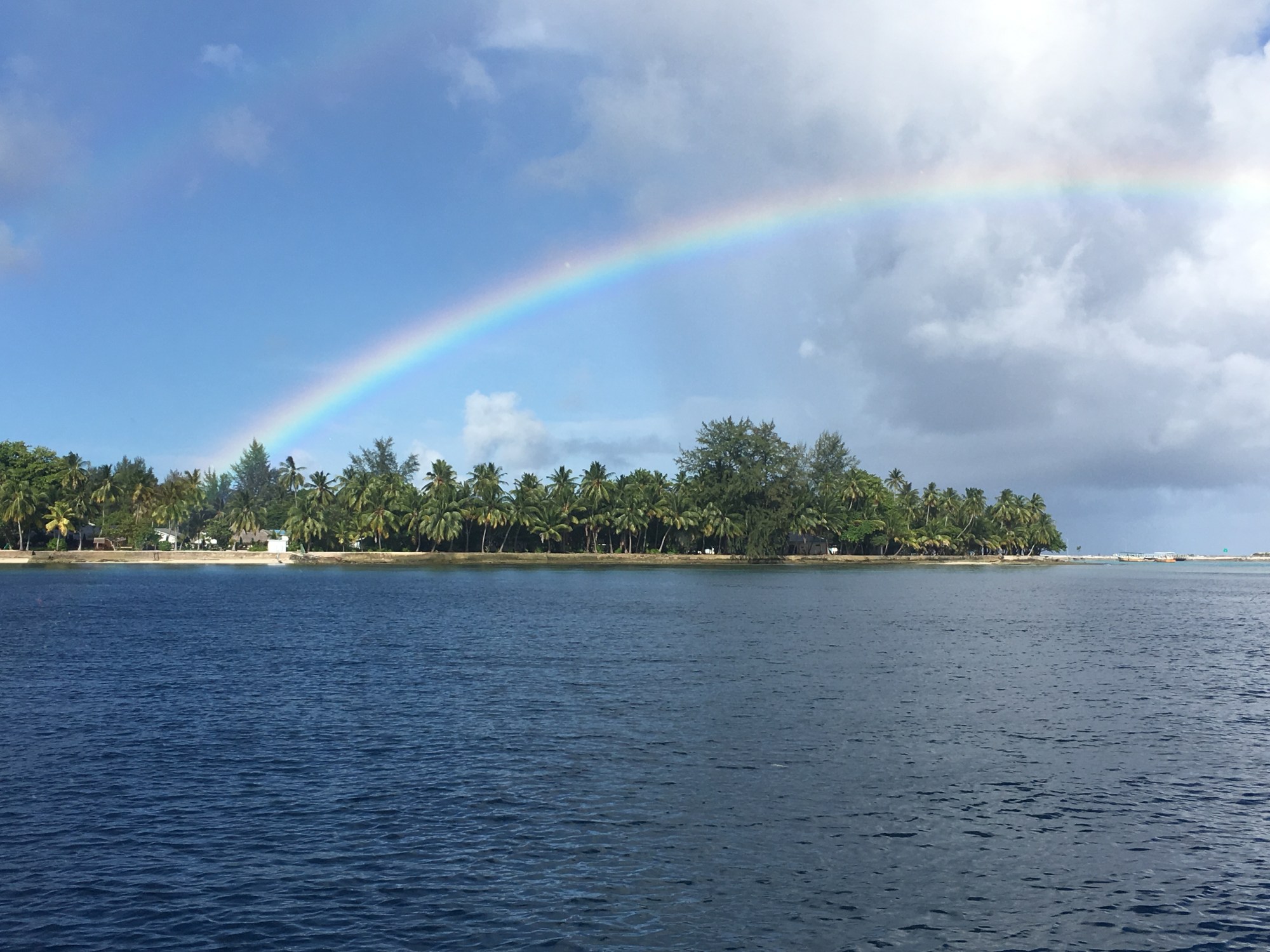
What an odyssey! I hope that rainbow in Gan is the promise for a smoother sail to Chagos. Wishing you a pleasant passage.
LikeLike