We embarked on our short 8 day trip to Sri Lanka’s ancient cities with the usual nervousness that accompanies leaving the boat. We checked and re-checked – hatches locked, sufficient anchor chain out, bilge pumps working, solar cell on to keep battery charged for the fridge and anchor light and so on. Our friends on Brick House had kindly volunteered to keep an eye on Paseafique which was re-assuring.
The main bus station in Trincomalee is typical of most Asian cities – work out what number bus you need, find it in the line-up, board and wait for departure.


Buses and trucks frequently have elaborate decorations
Soon we were on our way to Anuradhapura. According to the Lonely Planet, this city became a capital in 380 BC, and Sri Lanka was ruled from there for 1000 years. During that time the various kings stamped their mark by building Buddhist monasteries, dagobas (or stupas), temples, monuments, canals and tanks (dams or man-made lakes). After checking in to our guest house, we set off to do a few errands. It didn’t take very long before a fellow called Mahamed latched on to us and started helping me choose an umbrella and wanting to know what our plans were for while we were here. He was actually quite helpful, and he gave us a better price for a half day tour of the ruins than we had from the guest house (Melbourne Tourist Rest).
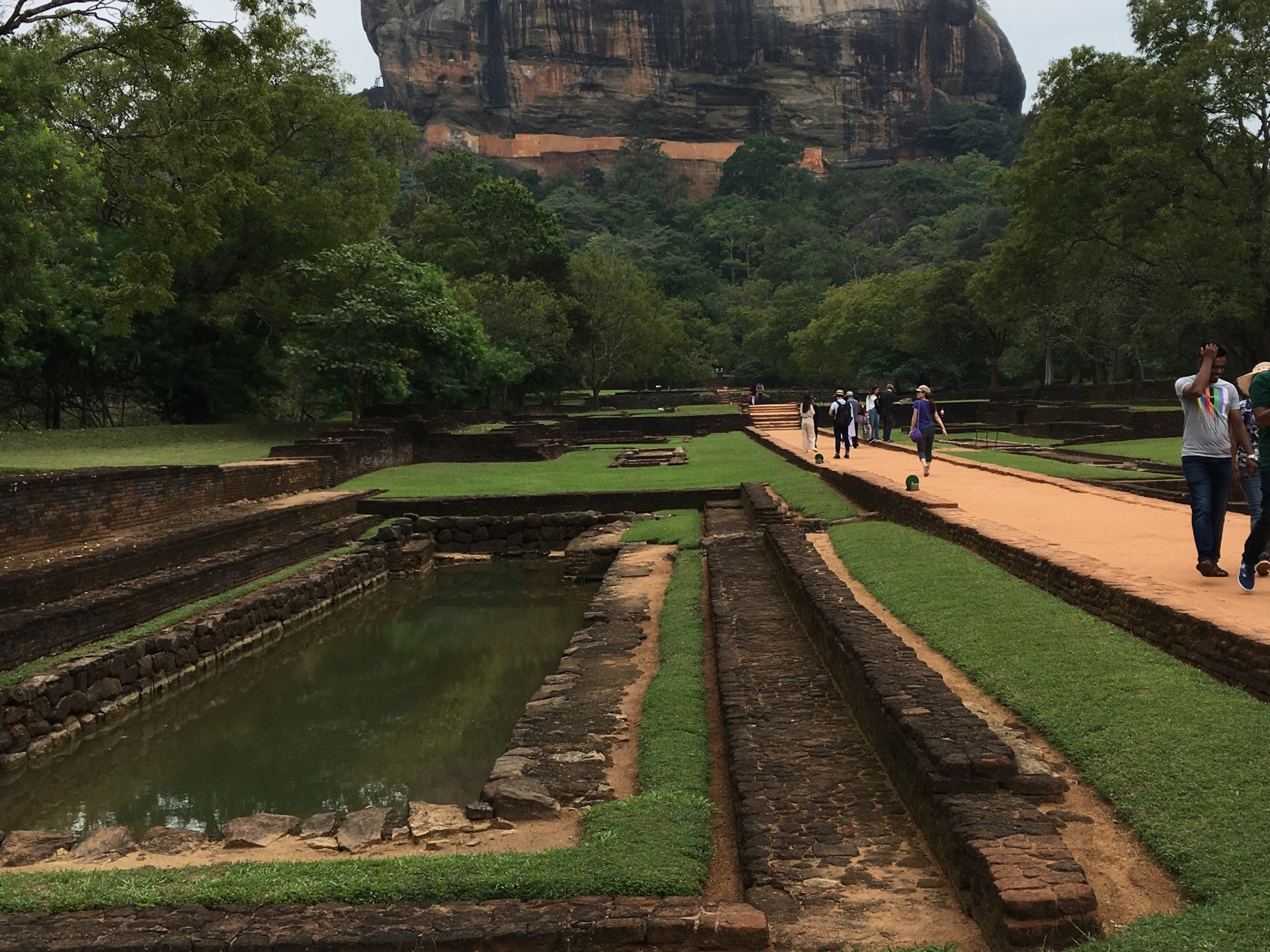
Mahamed duly picked us up at 7.30am the next morning for our 5 hour tour of the old city which is spread out over quite an area. We zipped around in his tuk tuk and saw the major sites including the Royal Pleasure Gardens:


the Sri Maha Bodhi, a tree grown from a cutting of that under which Buddha gained enlightenment in India:

the Ruvanvelisaya Dagoba, a large white dagoba “guarded” by wall holding a frieze of hundreds of elephants standing shoulder to shoulder:


the Thuparama Dagoba, the oldest in Sri Lanka and possibly the oldest in the world; the Abhayagiri Dagoba and remains of the associated monastery set in a pretty woodland area :


Knees and shoulders have to be covered!
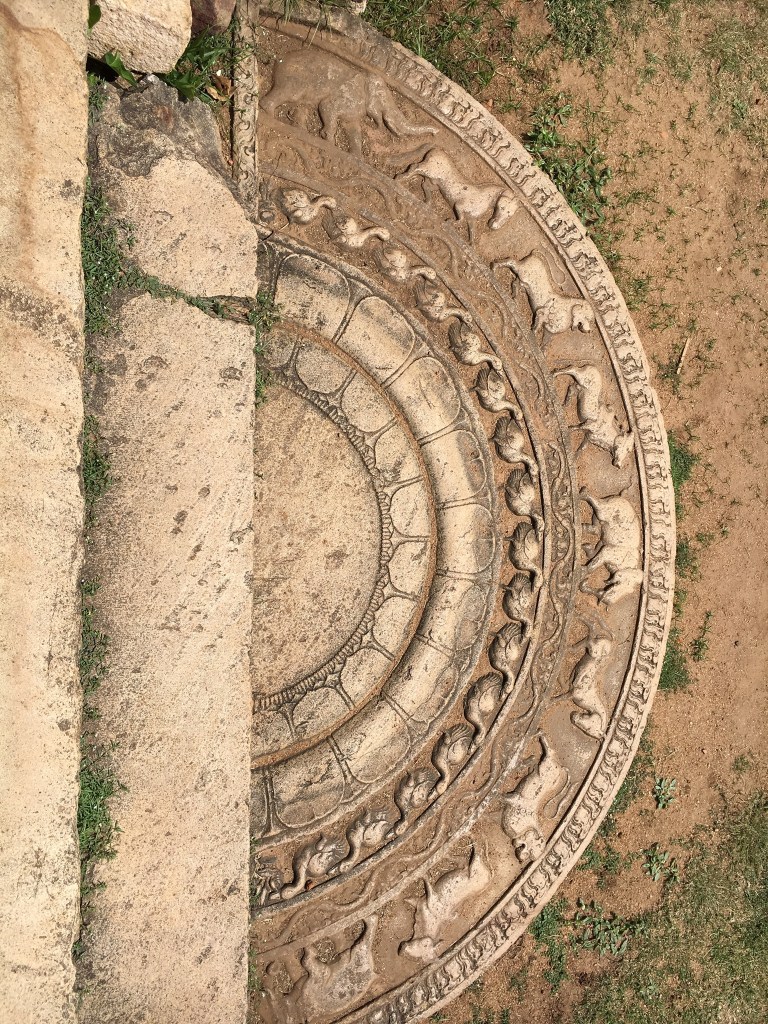
and a beautiful well preserved carved moonstone which quite captivated us. Moonstones are everywhere among the ruins. They are a semi-circular piece of carved stone placed at the foot of steps into buildings. The carving consists of a series of semi-circles – starting from the outside edge is a row of fire, then a row of animal repeats (elephant, horse, lion, bull to signify the cycle of birth, youth, sickness, death), then a creeper row, a row of swans, another floral row, and at the centre a lotus leaf.
There are just ancient ruins everywhere and many with quite some significance for Buddhism and its introduction to Sri Lanka. We both found it a bit hard to get excited about these ruins but couldn’t work out why that was the case. Now when I read back over it, it seems very impressive! I think maybe we went through it all a bit too quickly and didn’t have time to dwell at each site so we could take in the significance. We were glad that we had started early though as by lunch time it was very hot. After some short eats (samosa, vegetable roti), we collapsed in the air conditioning back at the guest house. Over lunch Mohammed was keen to present us with some options for other tours we could do with him. He had been quite good we thought and when he gave us a similar price for a half day tour to Wilpattu National Park as our guesthouse, we decided to take up his offer. In case you think we are total pushovers, we didn’t take him up on his suggestion for an evening trip up to Mihintale, or for the next part of our trip to Sigiriya and surrounds, which we could do using buses for a fraction of the price.
I had allowed two days for the Anuradhapura ruins, but it turns out that the ticket (which does get checked at some places but not all) is only valid for one day and at US$25 each we did not feel inclined to pay for a second day. So we hired a couple of bicycles from the guest house and set off to see a couple of museums and try to re-visit one of the ancient monasteries that we quite liked (Abhayagiri). We had a lovely ride through some beautiful countryside, dotted with water lily filled ponds, rice fields and the ubiquitous cows. We missed out on one of the museums, and could only get into the grounds of the second one as the main part was closed for renovations. We did get to the monastery ruins which are set in a lovely woodland area. I think that riding through the old city was a more gentle experience than going from site to site via tuk tuk, and it gave more time to appreciate it all. The ruins started to make a bit more sense today. It seems that there were something like 3000 Buddhist monasteries in Sri Lanka at one time. Most of the sites here are the ruins of some of those monasteries. Each one that we saw had a dagoba, which were in good repair, surrounded by the ruins of what would have presumably been the monks sleeping, eating and educational areas. We ended up back in town, checked out where to get our bus to Dambulla (for Friday), and went to the library to read the local English newspapers, before again collapsing in the air conditioning of the guest house. There was some trouble in Kandy, and the government declared a national state of emergency which did not affect us, except that Facebook and messenger were slowed down and eventually became inaccessible .


The trough was used for serving rice to the many monks
The next day we went to Wilpattu National Park, with a 5.30am start from the guest house so that we arrived at the opening time of 6.30am. We were very underprepared for the cool morning. The combined effect of the cool air temperature and traveling in open air vehicles had us huddled together trying to keep warm in our shorts and t shirts. But that did not stop us from enjoying a 4 hour drive through the gorgeous Sri Lankan jungle and delighting in the array of animals and birds that we saw: deer, peacocks and peahens (lots), jungle fowl (the pretty national bird of Sri Lanka), mongoose, monitor lizards, blue kingfishers, painted and frill neck storks, lots of white egrets, crocodiles, eagle (actually on the ground right next to us), and a boar. There were lots more birds that we saw and many more that we could hear.


The highlight though was seeing a leopard through the bushes. The 6 or so jeeps converged on the spot and we all sat in the quiet hoping that the leopard would come out from under cover, but it was not to be. The terrain of the park varied and included dense jungle, patches of open grassland, sandy areas, and several large lakes. Even though it is the end of the dry season, there was still plenty of water in the lakes.


As Mahamed had invited us to dinner at his house that evening, we had a search around the shops for a gift for him his new wife Banu. It was not an easy task given we had no idea of their tastes and had not seen their house before. In the end we settled on a small decorative statue and hoped that they would at least appreciate the gesture, if not the actual gift. We had a pleasant evening at his place, a small house that was neat as a pin. Banu cooked a selection of very tasty dishes including fish, spicy potatoes, curried beans, and of course rice.
The next morning we set on our way to our next destination, Sigiriya. We broke the bus trip in Dambulla, to visit the caves there. Following the lead from one of our yachtie friends, we left our bags with the lady at the Golden Buddha, and ground our way up quite a long stone staircase in the heat to the cave site. Alas though we had managed to miss the ticket office, which was down the bottom of another staircase from the cave site. That was our first mistake. The second was assuming that there would be a toilet up at the caves. As I was in desperate need of one by this stage, I was elected to go back down the stairs to find the toilet, and get the tickets. Mission accomplished, it was a very grumpy and over-heated Lesley that trudged back up the stairs. But you will be pleased to know that it was well worth it. The series of five caves, especially the largest one, were really something -painted ceilings, jam packed with statues of Buddha, and with a few statues of Hindhu gods included for good measure.


We collected our bags and walked back into town to catch the bus to Sigiriya. We must have sat in the full, hot and stuffy bus, on plastic covered seats, for half an hour before we got underway and found some relief from the breeze (thank goodness Phil was next to the window). Our guesthouse (Paradise Inn) was down a lane way off the main road in a lovely setting, and our host provided us with a cold refreshing drink on arrival.
The main order of business for tourists in Sigiriya is a visit to Lion Rock. This is a very large rock formed from the remains of a volcanic magna plug, around which the volcano had been eroded over the years. There is considerable evidence of ancient civilisations utilising both the top of the rock and the area around it. Apparently there is some dispute as to whether the ruins on the top of the rock are that of a Budhhist monastery or the palace of King Kassapa. Either way, this area is very impressive indeed and would be a highlight of any trip to the area. We got another early start and after a delicious and generous Sri Lankan breakfast at the guesthouse, we managed to get to the entrance just after it opened. What a magnificent place this is! We climbed the rock first as we had heard stories of crowds so thick on the stairs that it would be almost impossible to fall over!


Check out the carved lions paw – there was one each side of the stairs
On the way up to the top, we passed a hollowed out area containing paintings of topless women in various poses (sorry no photos allowed). The view from the top was spectacular, and the ruins up there provided hours of entertainment particularly for Phil as he studied their formation and tried to understand the way in which the place had been used.


The gardens around the rock were beautiful and we spent an hour or so exploring and enjoying them.


Finally, we visited the museum which was quite good. The scope of construction in this whole site is amazing, and the amount of brick work and carving in rock is extraordinary. There were even large water storage areas carved into the rock. The weather was perfect for the climbing -overcast with a couple of light showers of rain but haziness was the down side so the view from the top was not as spectacular as it would be on a clear day. We finished off the day with a very nice (but barely spicy) curry served in the undercover outdoor dining area at the guesthouse.
The next day we hired some bikes from the guesthouse and rode to Pidurangala Rock -another large rock a few kilometres away from Lion Rock. Climbing to the summit involved yet more stone (and therefore uneven) steps and a scramble over boulders at the end. The people coming down had all commented on this boulder scramble being tough but absolutely worth it. They were wrong and they were right. In some ways the boulder scramble was easier than the steps. The view at the top was just spectacular, so we were very glad we made the effort. We spent the rest of the day leisurely exploring the area around Sigiriya on the bikes, enjoying a spot of street food for lunch at a market.


Sigiriya has a few resident elephants that we had seen a couple of times giving tourists a ride through town. On our way into town for sundowners one afternoon, we were lucky enough to see them having their swim in the river. There were three of them in the water with their handlers, one of whom was giving them a back scrub. The elephants seemed to be enjoying themselves, although the male was a bit agitated perhaps by the crowd that had assembled to watch.


We moved on when it started to rain and settled in upstairs in one of the restaurants. We then witnessed two of the elephants returning from their swim and stopping outside at some of the restaurants to receive snacks from the proprietor. Quite a sight.


Phil pouring our “tea” in an unlicensed restaurant
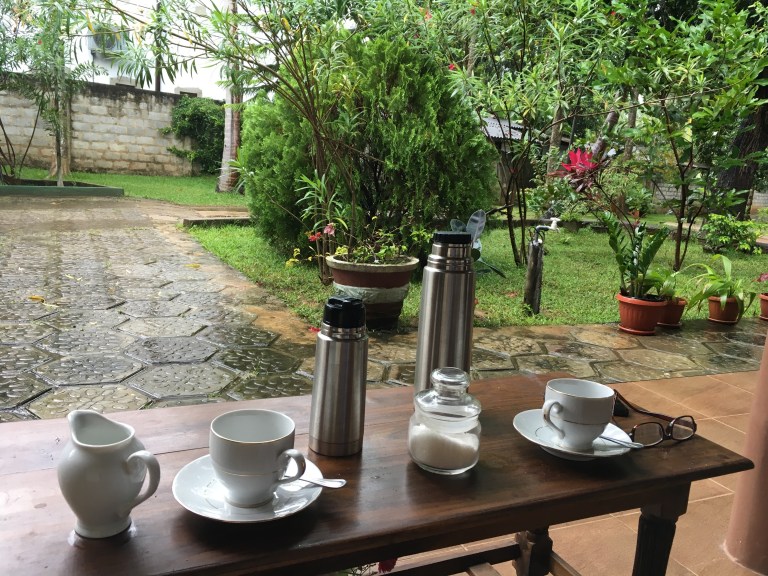
For our last day in the ancient city area we had planned a trip to Polonnaruwa, another town that had once been one of the ancient capitals. We just couldn’t rustle up the enthusiasm for it though, feeling we had seen enough ruins and Buddhist temples and statues. We had really enjoyed riding the bikes so we decided to forgo Polonnaruwa and do a longer bike ride out to a large lake/dam and enjoy some more of the beautiful countryside. However, the skies opened shortly after breakfast and it rained quite heavily for the best part of the day. As there is not much in town except restaurants and a few supermarkets, we had to be satisfied with drinking tea/coffee on the porch at the guesthouse, reading and listening to podcasts.
Fortunately, the rain had cleared somewhat the next day which made catching the two buses back to Trincomalee easier. We returned to the boat to find everything in good order, despite it having been quite windy and very rainy the previous day.
 paseafique
Only my heart only 1.think thank you and thank you.☺☺☺☺👍
LikeLiked by 1 person
Thank you and thank you for all again.
LikeLiked by 1 person
Great trip love reading it. I can understand being cranky after all those steps twice, & phil looks quite at home pouring tea love Elsie xx
LikeLike
WE LOVE READING ABOUT YOUR WONDERFUL ADVENTURES
THE PHOTOGRAPHS ARE GREAT. BABY AUBREY IS JUST THE ICING ON THE CAKE (thank you for including us on your wonderful journey)
keep safe, look after each other
love Aunty Rose
LikeLiked by 1 person
Thanks Aunty Rose-great to have you “on board”
LikeLike
What a wonderful time you are having – such great adventures!! We love reading about it all. So glad all is well with the boat. Keep safe, Happy travelling!
LikeLiked by 1 person
Great post. You’ve captured Anuradhapura and Wilpattu perfectly and inspired us to check out a few others 😍
LikeLiked by 1 person