
Gulping awesomeness from a fire hose – that is the best way to describe my first experience of cruising around Phang Na Bay, Thailand. This is the bay between Phuket Island and the Thai mainland and it is packed full of tall vegetated islands, of many shapes and sizes, surrounded by milky green water.
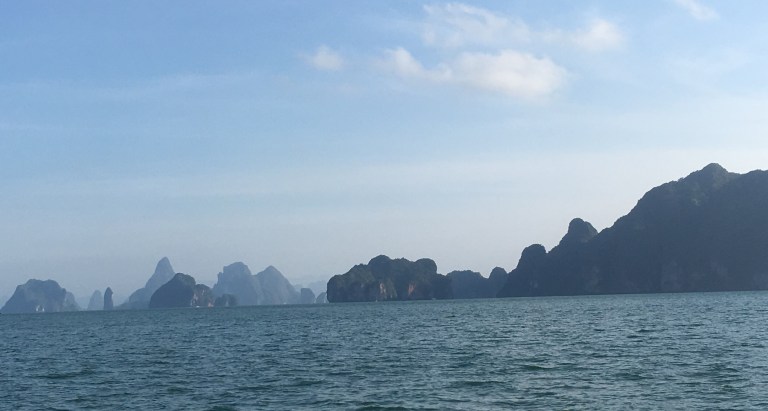
I just know that I will be overusing superlatives in my attempt to convey the essence of our time here. The islands provide endless entertainment, with many sandy beaches and little bays, warm water, old limestone caves, hongs (more about these later), a range of vegetation, and lots of birds. Afternoon thunderstorms and squalls are not uncommon and cool the end of the day very nicely. The cloud formations are amazing to watch.
The first major anchorage was Ko Phanak, where we arrived late afternoon and settled in.

Ko Phanak
Phil had planned the itinerary for the next day and boy did we pack a lot in. We visited a beach in a gorgeous bay in the early morning and had it to ourselves for a while until a tourist boat arrived. Next stop, a cave that was close by. Back to the boat for morning coffee and to pack a picnic lunch. The rest of the day was spent visiting 4 hongs. A hong is a secluded bay of sorts formed from a sinkhole in the limestone island. Note the sinkhole close to the top of he island in the picture below. Inside, the hong is surrounded by very high sheer cliffs, and there will be vegetation, usually at least mangroves but also other trees and bushes, and wildlife. Many of the hongs in this area can be accessed via a sea cave, which has joined up with the sink hole. Often access is only possible at medium to low tide. If you look along the edge of the island just above the water line in the photo below, you can just see some small openings- one of these will the sea cave access to the hong.

We walked into one hong, took the dinghy into another two, and we could only view the fourth hong from an opening in a cave. Being inside the hongs is an amazing experience- secluded, quiet except for the sound of insects and birds (and sometimes monkeys) and serene. As we dinghied around the island from one hong to the next, we enjoyed the spectacular scenery of Ko Phanak itself. We had lunch in a simply delightful bay, sitting in the dinghy in the shade.


Walk-in hong, Ko Phanak- Phil about to emerge from the tunnel into the hong, some kind of little lung fish in the mud, view inside
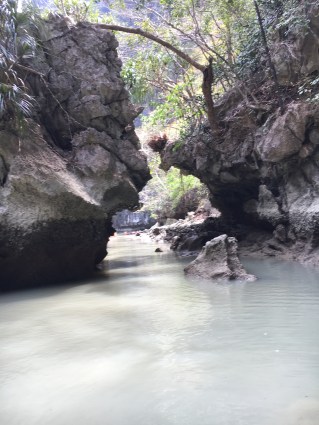
First dinghy-in hong: view from the dinghy as we explored inside; water was getting low so we had to be quick in this one


Second dinghy-in hong: view of entrance from other side of hong, steep side wall, exiting the hong- we sure had to duck our heads to get through here!


Stalagmite in cave through which we walked to get to the view of the hong below

Lunch time stop, Ko Phanak
We visited a number of other hongs during our time in Phang Na Bay, each of them a bit different in some way. One particularly pretty one was on Ko Roi.  We walked into this one as it was close to low tide. This hong was sandy and almost completely filled with vegetation, unlike others we had seen which were muddier and with less dense vegetation. There were mangroves in the middle and trees and shrubs closer to the sheer cliff walls. It seemed to have a stream running through it, but we think this was just the last of the tide in the lower lying parts of the hong. It was very lush and green and we were able to walk through it following a bit of a path. There was a fair colony of bats in this hong.


Ko Roi hong
Caves are also a highlight in this bay. A friend had told me that Flamingo Cave was a must see and he was certainly right. We accessed this cave by taking the dinghy up to a ladder (of sorts), and stepping from the dinghy onto the ladder and up through the fairly small opening. Phil had first found this cave by noticing the ladder when sailing past the island when he was up here last year. This cave would have been truly spectacular when the limestone was wet and active. It is full of large stalagmites and stalactites, and the colours were amazing – pinks and greens. There was quite a bit to explore as it consisted of a number of chambers and tunnels.


Flamingo cave
Another interesting cave that we visited was on Ko Thalu. This one was accessed by dinghy through a large archway and up to some stairs which took us quite high up on the island, and then into the cave- a very large chamber. This cave went through to the other side of the island to another opening high up in the cliff. However access to the opening was via a steep climb using ropes. It was so worth the effort to get up there as you can see from the pictures of the view.


Ko Thalu cave: entrance was just through and to the left of the archway, steep climb, rewarding view
We visited both these caves while anchored at Ko Yang- a simply stunning anchorage beside a dramatic sheer cliff attached to a lower island.


Ko Yang


A common sight in the afternoons
Phang Na Bay apparently has the largest area of healthy mangroves in Thailand. Coming from Queensland I associate mangroves with undesirable low lying muddy areas full of sand flies, mosquitoes and crocs, so I did not expect to find the mangrove areas here so beautiful. We dinghied through one mangrove forest, as I call then, on our way back from the cave with a view. It was a gorgeous ride with steep cliffs on one side of the narrow waterway and the mangroves on the other side. Just so beautiful.


We detoured through another mangrove area on another occasion and spent ages watching a lone monkey going about her business. I first spotted her making her way through the mangroves climbing along the roots and was surprised when she actually dived head first into the water and started swimming short lengths in between the bushes. Initially it looked like she was following us, but after we observed her for a while, she dived in and swam across the creek to the other, rocky, side. She struggled to get out of the water and was clearly not sure where to put her feet, but eventually managed to scramble up onto the rocks. What a scrawny bedraggled sight she was until she dried off! Once dry, she seemed to be better able to make her way across the rocks to some bushes which we think was her intended destination. It was a lovely experience to just be able to sit there quietly in the dinghy and observe the monkey in her natural habitat. By the way, there are no crocs in these mangroves.
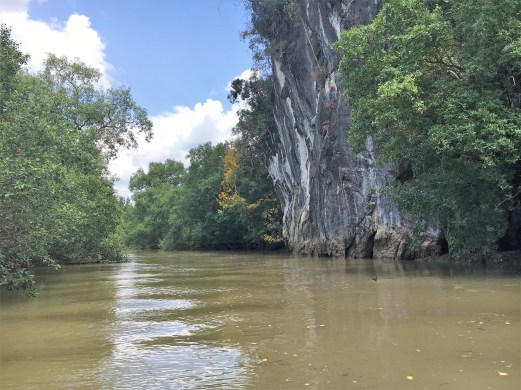

Sun protection: this photo is for you Mum; we actually do use the umbrella for shade while tootling around in the dinghy
An interesting and different destination was the Muslim village at Ko Paynee a short way up a river that empties into the very north of Phang Na Bay. This village was established about four generations ago by a group of travelers from Indonesia and has grown to about 3000 people. Virtually the whole village is built on stilts out over the water as the island itself has very little land. The villagers make their living from fishing and tourism- there are many large restaurants along the river front and a steady stream of power boats bring tourists here for lunch as part of a day tour that takes in other nearby sights. A number of the villagers work on James Bond Island, selling trinkets and souvenirs. We whiled away a morning wandering around the village – it certainly is a different way to live as there are virtually no open spaces; just covered walkways over the water and houses and shops built on stilts on each side of the walkways. Some time ago, the children were showing a keen interest in soccer, so the village built a floating soccer field and apparently teams from the village have won several regional championships. Living there is not without its risks though. We met one young man whose floor in his house had just collapsed leaving his bed, television and other goods floating in the somewhat muddy water below. There was a major structural problem with his house that would be next to impossible to fix, and meanwhile the house was not habitable.


Muslim village, Ko Paynee

Catastrophic floor collapse
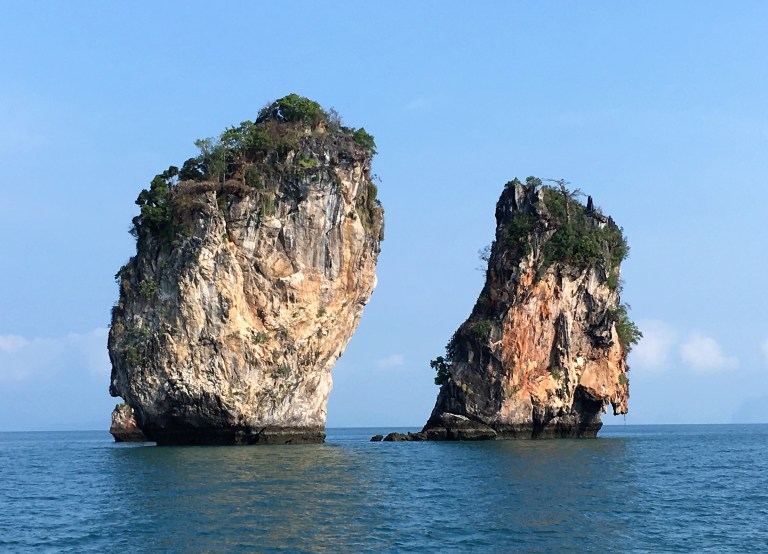
Many people come to this part of Thailand for a holiday and I’m sure are astounded by the islands, caves and hongs that are accessible to them via power boats and traditional long tails. But they still spend most of their time on land with day tours out in the bay. The experience for those of us who are lucky enough to spend an extended period sailing through the bay is quite different in that you are totally immersed in this most spectacular area day and night. There is magnificent scenery ALL around you ALL the time- some days the horizon was completed filled with these tall dramatic islands. The colours are a wonderful mix of milky green water, cornflower blue sky, white and red-orange cliffs, and many different shades of green in the trees and bushes, some with red leaves, some with white flowers – the contrast is gorgeous. We have had a fabulous time here with the hongs and caves providing entertainment, the water inviting afternoon swims, the scenery inspiring awe, fresh fish and prawns from passing fisherman, sunny skies and cooling afternoon rain. Our visas will run out soon, so it is time to move further south to Malaysia for what I expect will be quite a different experience.
 paseafique
Wow!! WOW!!!! Soooo beautiful!! Thanks for the post and pictures! Love ya!! Robyn
LikeLike
Hi Lesley & Phil
Wow, wow & more wow. Lovely pictures and great descriptive journal – keep safe and
keep the blogs coming…wonderful being able to hear of your trip – cheers Andrea
LikeLike