
The Andaman Islands are arranged in a roughly north/south orientation and the port of entry, Port Blair, is situated towards the southern end, but there are still some destinations further south from Port Blair. Circumnavigation of the island group would probably take longer than our allotted 30 days, due to the closure of the Andaman and Homfrey Straits to foreign vessels, and a large section of the west coast where yachts must remain 5 nm off shore. The previously typical route of using these straits to short cut from east/west or vice versa is therefore no longer viable. So we basically did a round trip on the east side, taking in some very nice islands to the east of the main island group, then going north for a bit, and then back south again with some pleasant stops on the way back to Port Blair. The prevailing winds at this time of the year are north-east, and so this meant again sailing somewhat to windward for the first part of our loop. Back to living on a lean during the day.
Most of smaller islands that we visited here are all variations on a theme: relatively low, covered in lush green vegetation, white sandy beaches (some with long beach spits at one end), crystal clear water, and rocky fringes. So very pretty landscape which makes for great vistas when sailing past or at anchor. Some of the anchorages were a bit rolly as the islands do not offer a lot of protection from any swell which may develop. Most of the islands also once had fabulous coral reefs apparently, but unfortunately there was a massive bleaching event in 2010 and according to those who know, the reefs are now nothing compared to before 2010. So in general the snorkeling was not very interesting with the exception of a couple of places where there was abundant fish life. Still it was beautiful in the water.
We particularly enjoyed a couple of these islands. We spent a very pleasant afternoon ashore at Havelock island beach number 7, going for a long walk among the gorgeous tall trees along the foreshore, enjoying a couple of drinks in the late afternoon at a very nice resort nestled in the trees, and then having a delicious Indian meal at one of the streetside restaurant/cafes. Our skills and my nerve were tested getting back to the boat that night, as there was a bit of a surf through which we had to negotiate the dinghy (waves sound much bigger in the dark) and then find the boat using our memory of the few landmarks we could make out in the dark. We had not left a boat light on as we had not anticipated being ashore for so long, and the almost full moon rose a little later than we had anticipated, but I pleased to report we got back on board without mishap.

Sir Hugh Rose Island was another lovely stop- a very small island indeed. The snorkeling there was quite interesting as there were many long rocky ledges radiating out from the island and the fish just love to dart in and out from the ledges. Among other things we saw a small school of 4-5 blue groupers, and a turtle swimming past.
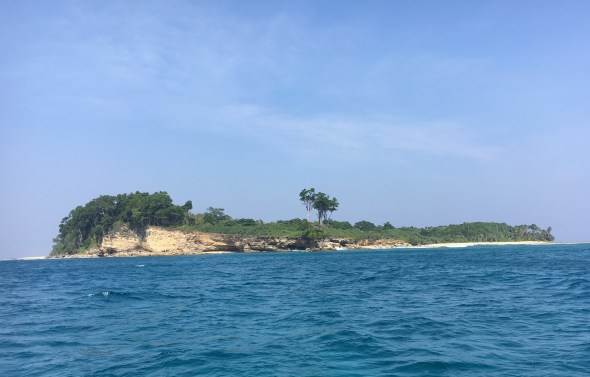
The two Lawrence Islands, Henry and John, are separated by the Kwangtung Strait which is 100-200 metres wide. We spent a lovely hour or so one afternoon sailing through the strait and then spent the night anchored in the southern end of the strait off Henry Lawrence Island- another spectacular vista. We found out later that this strait is off limits so sometimes ignorance is bliss. The information from the authorities about areas off limits for sailing (as opposed to anchoring and landing) was virtually non-existent.


John Lawrence Island
The highlight island for us though was Barren Island which is an active volcano. It was a considerable undertaking to get there as it is about 60 nm east of the main Andaman Islands. The winds were in our favour and so we decided to make a go of it. It took us 9 ½ hours to get there but the conditions were just right for a very pleasant day’s sailing. We had departed early in the morning to ensure we got to Barren with enough light to anchor the boat. One of my favourite aspects of sailing is the gradual revelation of a new destination as it takes shape from the just visible haze to a clear picture over usually several hours. The revelation of Barren Island as we approached it was just the start of an awe inspiring experience. The cone of the volcano towers over the rest of the small steep and rocky (barren) island, and there is a large black old lava flow snaking its way down to the blue clear water.
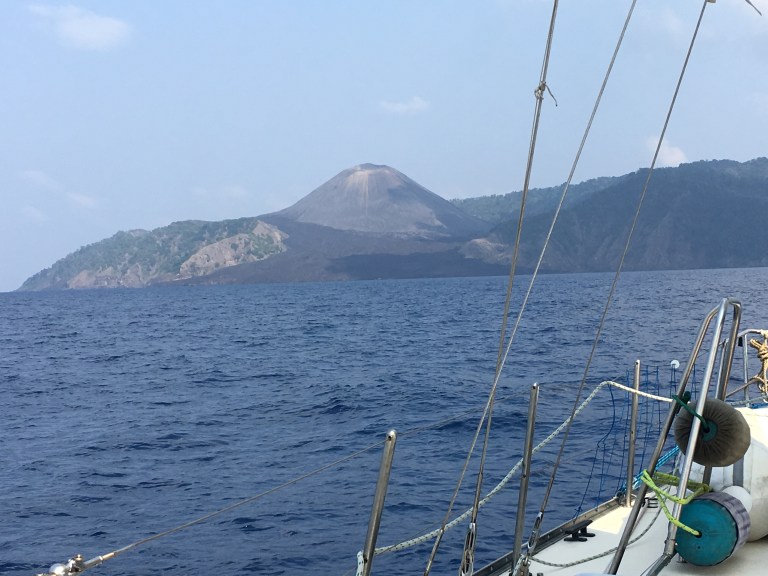
The volcano gave the occasional puff of smoke which really added to the atmosphere as we approached it (literally as well as figuratively). We anchored in a small cove on the west side of the island, out of sight of the volcano cone and also supposedly out of range of any falling ash/grit according to the cruising guide. We also put out a stern line to a rock to ensure the boat was secure and stop any side ways drift onto the rocky shore. Once this was done, the boat was actually sitting over 35m of water. We had done this exact same thing before when we anchored next to a volcano at Banda Island in Indonesia.
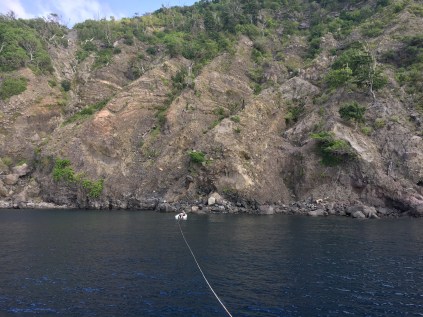
On that first evening just after sunset we took the dinghy a short way out so that we could see the top of the volcano while sitting in the dinghy (no landing is allowed on the island). We had anticipated that if we were lucky we might see a red glow from the top. Imagine our squeals and exclamations when suddenly there was a big spit of red sparks flying out of the volcano and spilling down all over the cone, against the backdrop of the dark sky. There were about three such displays as we watched but the first one was the most spectacular.
Next day was dedicated to a bit of sightseeing around the island by dinghy and snorkeling. The fish life is quite prolific there. No coral reefs, but black volcanic rock and black sand, which provide a dramatic background for the coloured fish. Visibility was reasonable and we spent a very enjoyable afternoon in and out of the water, viewing different spots. We had a “visit” from the Indian Coast Guard that afternoon as they flew overhead in their light aircraft and radioed us to check who we were etc. We dinghied out again that evening hoping to see another show but alas it was not to be. The mountain had been quieter that day with fewer puffs of smoke and less rumbles. However, it was just holding out on us because shortly after we got back to the boat, there were a couple of very loud booms followed by a red glow and sparks that we could actually see from the anchorage.
Despite the cruising guide’s assurance that our anchorage was away from the fall out zone, the boat was well and truly covered with black sand by the next morning. It was absolutely everywhere so we had to do a bit of a clean up before we could get underway. It actually took us a couple of days to really clean the boat properly.


It was a long trip back as there was little wind and we ended up motor sailing all the way. We had some entertainment not long after we left, with an Indian Coast Guard ship, a diving boat, and a tourist boat in the vicinity. The coast guard dispatched a smaller craft and boarded both the other boats for an inspection. There was a lot of radio traffic in preparation for that exercise so we were glued to the radio. At one stage, we thought they had radioed us, so we responded and initially it seemed like they wanted us to turn around and go back to where they were for inspection. However, it was the tourist boat they were interested in, not us thank goodness.
While Barren Island was the island highlight, Mayabunder in Bacon Bay was the highlight destination in the main island group. Bacon Bay is large, well protected, and host to a number of small islands dotted around in it. An absolutely gorgeous spot to spend a couple of days. Ashore in Mayabunder the people were very friendly, including the harbour master who was very helpful in guiding us to the best anchorage where we could easily land the dinghy to get ashore. The town was very interesting and we spent a morning just wandering around in there familiarising ourselves with it.


Bacon Bay
Austen Strait which separates Middle and North Andaman starts in Bacon Bay, and we managed to arrange for a local young fellow to come with us in our dinghy for a trip into the strait, as we were not allowed to go there on our own. Saw, the guide, is a member of a local Karen community so he was an interesting person to talk to. We spent a very pleasant few hours up the strait, and to my delight even spotted the famous Andaman blue kingfisher, but to Phils’ disappointment, no crocodiles.


Austen Strait
We spent the last few days of our time here based in Port Blair, so we could soak up the riotous atmosphere of an Indian city, enjoy the food, and visit some museums and historic sites. Ross Island, situated just outside the entrance to Port Blair, was the site of the first English settlement here, and was an interesting spot to visit. The buildings of the settlement are poorly preserved but you can get a sense of the great lifestyle the British enjoyed here – swimming pools, gentlemen’s clubs, tennis courts, churches etc, all seemingly built by convict labour. There were lots of deer and peacocks too.


Ross Island
The old jail at Port Blair was another interesting piece of history as this is where the British banished the Indian freedom fighters, as far away from the Indian mainland as possible. There is still lingering resentment of the British by the Indian population here, evident in the language used to describe the history. However, these islands were inhabited by indigenous people prior to both the English and the Indians settling here. Some areas of the Andamans have been set aside for various indigenous tribes, and one of these groups in particular aggressively resist any outside influence or visitors.
We also took the opportunity to get out of Port Blair and see some of the surrounding area by hiring a tuk tuk and driver for the day and heading down to a popular beachside picnic area south of Port Blair. Another gorgeous spot- tall trees providing deep shade for swings, seats and tables, a sandy beach, and a netted swimming area (beware the crocodiles!). As it was a Saturday, there were lots of locals, and probably some Indian tourists, there but few westerners. We were well entertained by a group of young Indian adults, playing cricket and practicing their Bollywood dance moves to their music. The return trip in the tuk tuk was a bit hair raising to say the least as our driver surely fancied himself as some kind of racing car driver. He was ducking and weaving, passing where there was seemingly no room to pass, and reaching speeds of which we thought a tuk tuk would not be capable. It had taken us about an hour to get there in the first place, and 40 minutes to do the return trip!
The clearing out process was a lot more straight forward than clearing in, although we spent an anxious time at the harbour master’s office where we were told it would take more than one day to get through the whole process. However, the officers there finally worked out our port charges, and we were on our way to customs with the receipt in hand. Customs and immigration were extremely helpful and had the process finalised very quickly, which enabled us to keep to our planned timetable of departing that same afternoon.
The Andaman Islands are a great holiday destination – many beautiful tropical islands grouped together in clear water, interesting history, and Indian culture. As there is only a domestic airport with flights from India, there are very few international tourists. It seems to be a popular honeymoon destination for the Indians. For yachties, it is an extremely attractive cruising destination, if you can put aside the trial of dealing with Indian bureaurocracy.
 paseafique
Magnificent information! Thank you. Have forwarded to some friends who are heading here. I hope Amandla doesn’t get covered in black dust if we are fortunate enough to visit. Look forward to seeing you in Sri Lanka.
LikeLike