April/May 2025
Once through the Panama Canal, we completed our Pacific preparations, making a few non-food related purchases including a new foam mattress for our bed, which was somewhat of a logistical challenge transporting it back to the boat via taxi and dinghy!
In between jobs, we visited old Panama City-not the old old Panama City, of which not much remains after good old Captain Morgan set fire to it.


Out and about in old Panama City
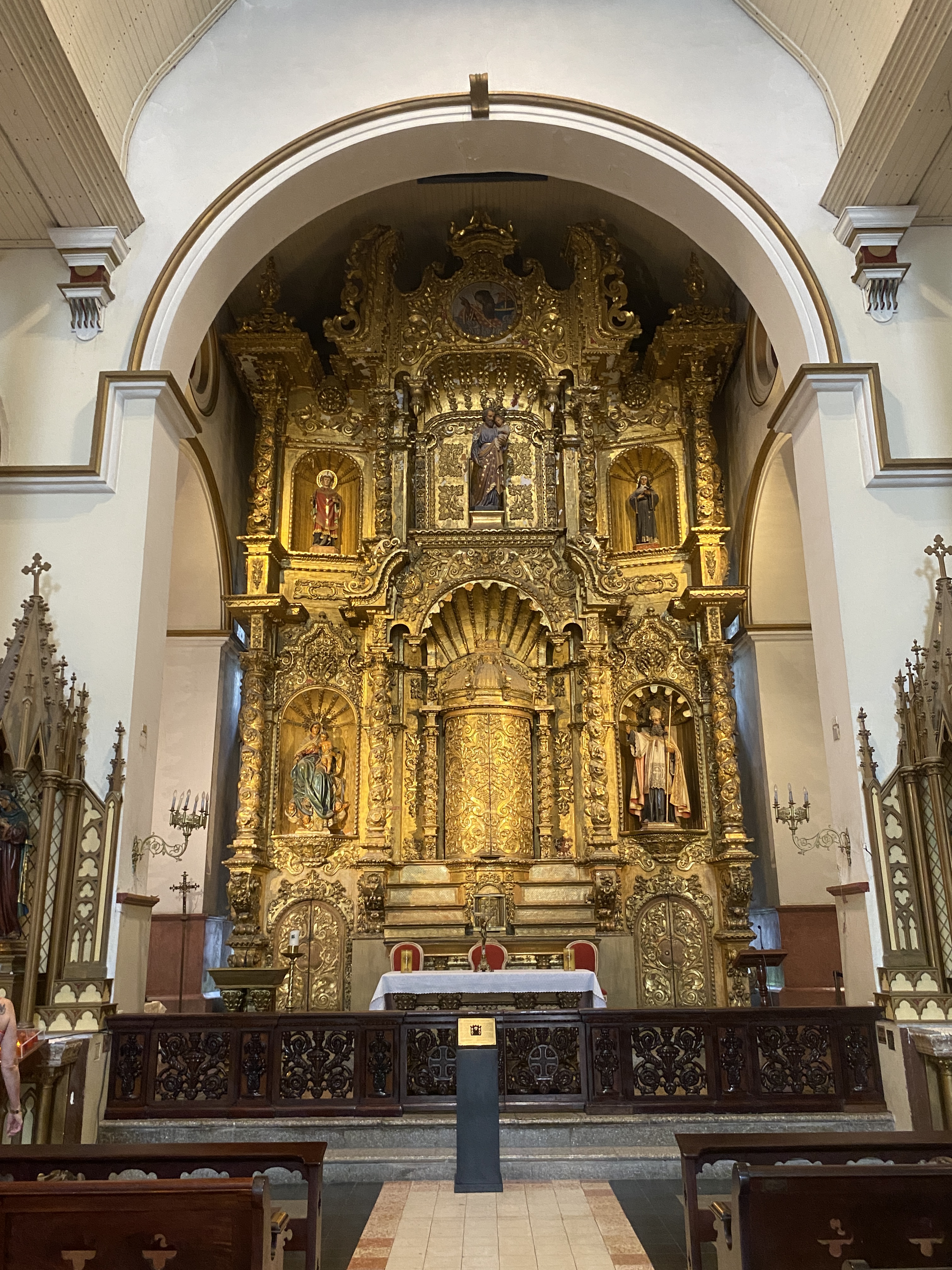
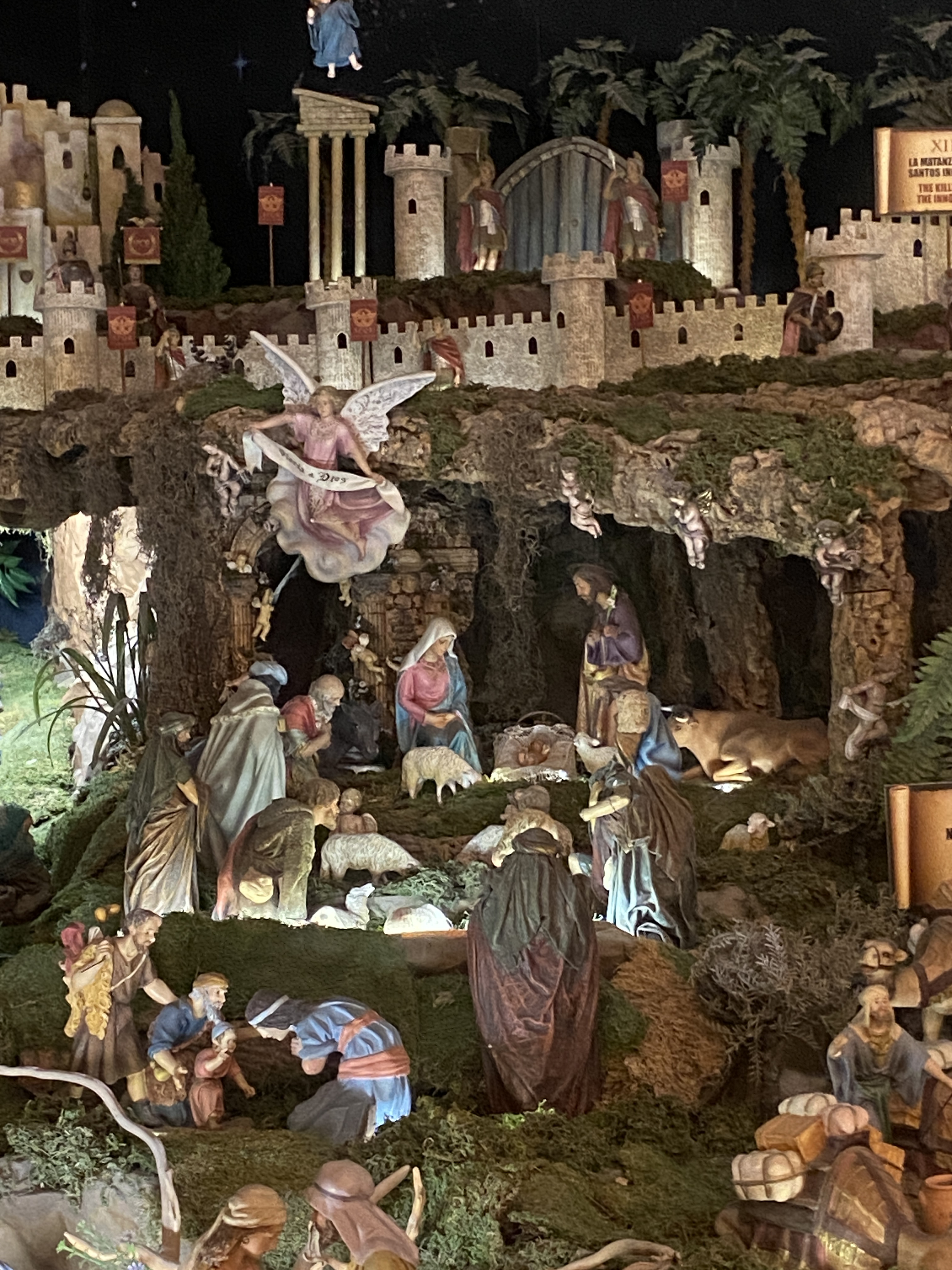
The Iglesia San Jose, Church of Saint Joseph, with its gold altar, and amazing depiction of the events leading up to Christ’s birth and his early life
We visited two museums: the Panama Canal Museum (interesting and informative), and my favourite, the Mola museum.
A mola is a piece of embroidered cloth used to make the bodices worn by Kuna people of the San Blas region of Panama. These have a significant place in Kuna culture as the designs have a spiritual function in keeping the wearer safe from evil spirits. The handiwork involved is very intricate and each one takes many hours to make.
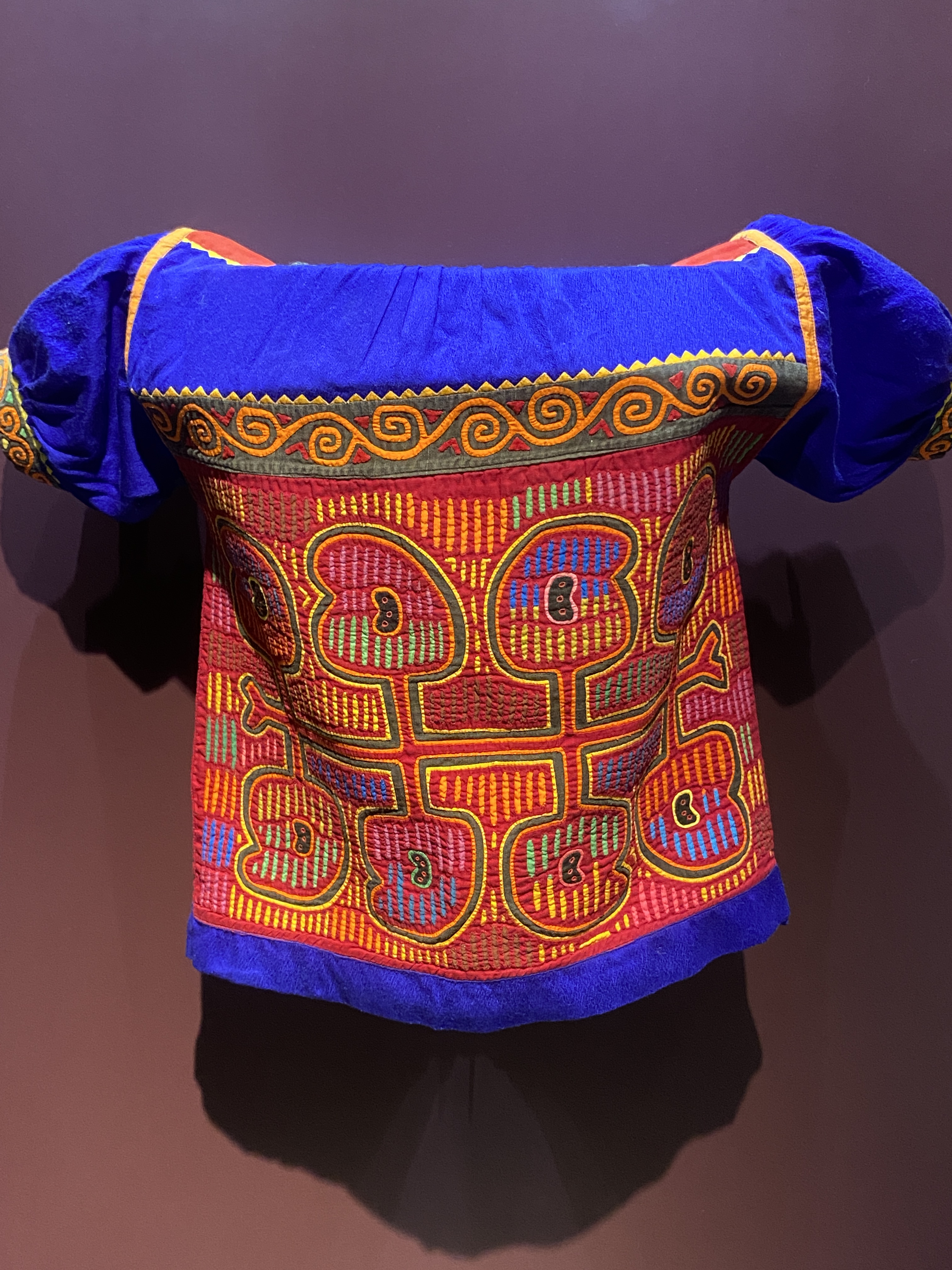

Two of the gorgeous mola exhibited in the museum. The left hand one features triangles which represent huts and so protection by the home, and vertical slots representing the sun shining through the bamboo walls of the home indicating protection by family. The right hand one features labyrinths to trick evil spirits into getting lost, and zig zag teeth to eat the spirits that don’t get lost.
We also achieved one of our ambitions for Panama -seeing a sloth up close. This one was having a lovely afternoon nap on a small building in a car park near the marina!

The cutest Panamanian!

An evening out with some other the Eggs and Bacon Bay Yacht Club members also preparing to leave Panama for the Pacific crossing. They all left a few days before us so it was good to keep in touch with them during the crossing.
In the lead up to departure, I was imagining all sorts of scenarios for the passage. Interestingly none of them involved gorgeous downwind sailing. I was nervously anticipating that we would be often surrounded by sudden severe squalls and thunderstorms at night, and that something would go wrong while we would be trying to deal with these conditions. I imagined that a window might break letting buckets of water down below, or that we would lose a sail into the sea due to a broken halyard. Worst of all I was I worried that something would happen to Phil and I would have to manage the boat on my own.
However, we were as ready as we were ever going to be. The boat was absolutely laden with food, drinks, water and fuel. All our systems were running well and we had a range of spare parts to cover most contingencies. The satellite phone had been activated. While the weather window was not ideal, we felt it was the best we were going to get for quite some time. So on Tuesday 29 April 2025, we began to weigh anchor to start the longest passage we had done to date, and also the longest one we would ever do.
But Panama didn’t want to let us go and had made sure that our anchor was well and truly holding us in place. Our anchor had hooked another old anchor with very big chain attached -what an ugly muddy stinky mess! It took nearly half a hour for Phil to get it off our anchor but he managed it using a few ropes he tied to it so he could hold that mess up while dropping our anchor off it. A lucky escape for us -lucky it wasn’t dark or windy, and lucky that Phil didn’t have to go in the water to untangle it. He did get covered in that stinky mud though!

What a job it was to unhook our anchor from another old one we had managed to get hooked up with
After that tricky start, we spent the morning sailing downwind on flat seas with scattered high cloud and sunny breaks -champagne sailing. I was making the most of it as in a 3-4 week passage, I knew it certainly was not going to be ideal conditions all the way. I even made a cake-the first time I had done so at sea. The day and night continued uneventfully. There was lightening off in the distance which, along with crossing the shipping channel, kept me on guard for the first part of my watch.
A cloudy sky greeted us on our second morning and we didn’t see the sun for the rest of the day. I started my passage routine of checking for messages and sending position reports, and then after breakfast, did a welfare check on our fresh food supplies and turned the eggs over. Apparently the air sac inside the egg getting stuck to the shell allows air into the egg which hastens rotting. Turning the eggs regularly helps to stop the air sac from getting stuck. For the record, it seemed to work as we didn’t have to throw any eggs overboard. We even had a few left at the end of the passage.
A small squall brought a wind shift, ending the downwind sailing for the time being. We had a rainy afternoon with periods of motoring when the wind dropped off. With so little sunshine we needed to charge the batteries anyway.
During my watch that night the wind did exactly as forecast and gradually increased so we were soon sailing again, probably with the help of current which we were pursuing. Although there were few stars out, it was a beautiful evening. The air was fresh following the rain, and the sea was relatively flat. The tiny bioluminescent creatures glittered in our wake like tiny diamonds on rippling black satin.
Our daily average for the first 2 days was 127 nm so 5.3 kts per hour.
Days 3 to 15 of our passage were testing as conditions were mostly not good and stuff happened. The first four days were spent sailing to windward and tacking some way off the coast of Colombia. We knew when we left Panama that this would likely be the case but knowing it and doing it are two different things. Nothing for it but to saddle up, put a reef in the main, and sit it out until we got far enough south so we could head west with the SE trade winds behind us. I had been feeling sorry for myself at the start of this upwind section but the emergence of a crescent moon from behind a dark cloud, creating a silver pathway to the boat almost -and I say almost-made up for it.

Sailing to wind – not the most comfortable point of sail
Fishing gear set by professional fishermen is never ending issue for yachts underway. Often it’s only marked by a plastic container, a small buoy or at best a flag. In any case it’s very hard to spot in the waves and swell at a distance so by the time you see it, it is sometimes too late and the line has become hooked on your propeller, rudder or keel. Imagine trying to get that off while at sea! So it was to our horror that we realised one morning that we had just passed close to some fishing gear marked with a flag and had caught it probably on our centreboard which was down at the time.
With his usual quick thinking, Phil had raised our centre board, slowed the boat down and managed to get close enough to grab the line with the boat hook. Turns out the rope went up into the centre board case with the centre board so it was trapped in there. Fortunately that was an easy fix -lower the center board and it came free, and Phil could cut the line. At that point, we saw a fishing boat making a bee line for us. We thought that they might ask for money but all they wanted was their gear back and with a smile and thumbs up, they were on their way.

The Colombian fishermen, who unlike some in other countries, did not demand money for any damage to their fishing gear
Unbeknown to us at the time, this was not the end of the matter. Four days later, I went up into the cockpit to hang something on the line, and noticed splashing in the water a little way behind us. I watched hopefully anticipating maybe some dolphins, but it became clear that we were towing something – the other half of the fisherman’s gear that we cut away! Fortunately, Phil could reach the line with the boat hook from the back of the boat and pulled it all in, while we slowed the boat down to make it easier. It was a very long line sprinkled with strong hooks, some of which were baited with fish heads. Yewwww! Phil got it all onto the cockpit floor but the other end of it was caught in the centre board casing, which explains why we had been unable to get the center board all the way up a day or so ago. As the winds were light and conditions calm, Phil decided to get in the water and see what was going on under the boat. Kitted up with snorkel and flippers, and a rope around his waist to secure him to the boat, in he went. He was actually able to free the remaining rope and fishing line from the centre board casing quite easily and was soon back on the boat, much to my relief. We had been towing that thing for 103 hours! Poor Paseafique! As if a belly full of water, fuel, and provisions wasn’t enough.

Tidying up and bagging the fishing line for disposal at a later stage
We had some extra company for part of our passage -boobies. The feathered sort that is! A couple made themselves comfortable up front one afternoon -as comfortable as you can be when hanging on up the front of a boat doing a bit of hobby horsing into the waves, and being washed by said waves at the same time. They spent the night up there and came and went a few times over the next few days. At least there was enough water going over the bow to clean up after them. Other yachts have tried all sorts of tricks to get their colonies of boobies to budge -like glad wrap or tinsel around the lines to stop them perching , or air horns and water pistols to encourage them to fly off. Problem is that your boat is the only thing for miles around and if you stop them from being up the front, they will start eyeing off the top of the mast (where our precious wind instruments are) or the solar cells. So cleaning off their poo up front is preferable to broken instruments or reduced solar input and poo on the cells.
The boobies were about the only wildlife that we saw for the whole passage, apart from a pesty colony of ants that we must have picked up on some fruit before we left Panama. Unfortunately we had got out of the habit of dunking things like banana bunches in salt water before taking them on board and we paid the price. We spent quite a bit of time tracing ant tracks so we could put various chemicals out to try to eliminate them.
By day 7, we had finally got far enough south that we could turn towards our waypoint to the south of Galapagos. What a morale booster that was as it would be unlikely that we would need to tack again.
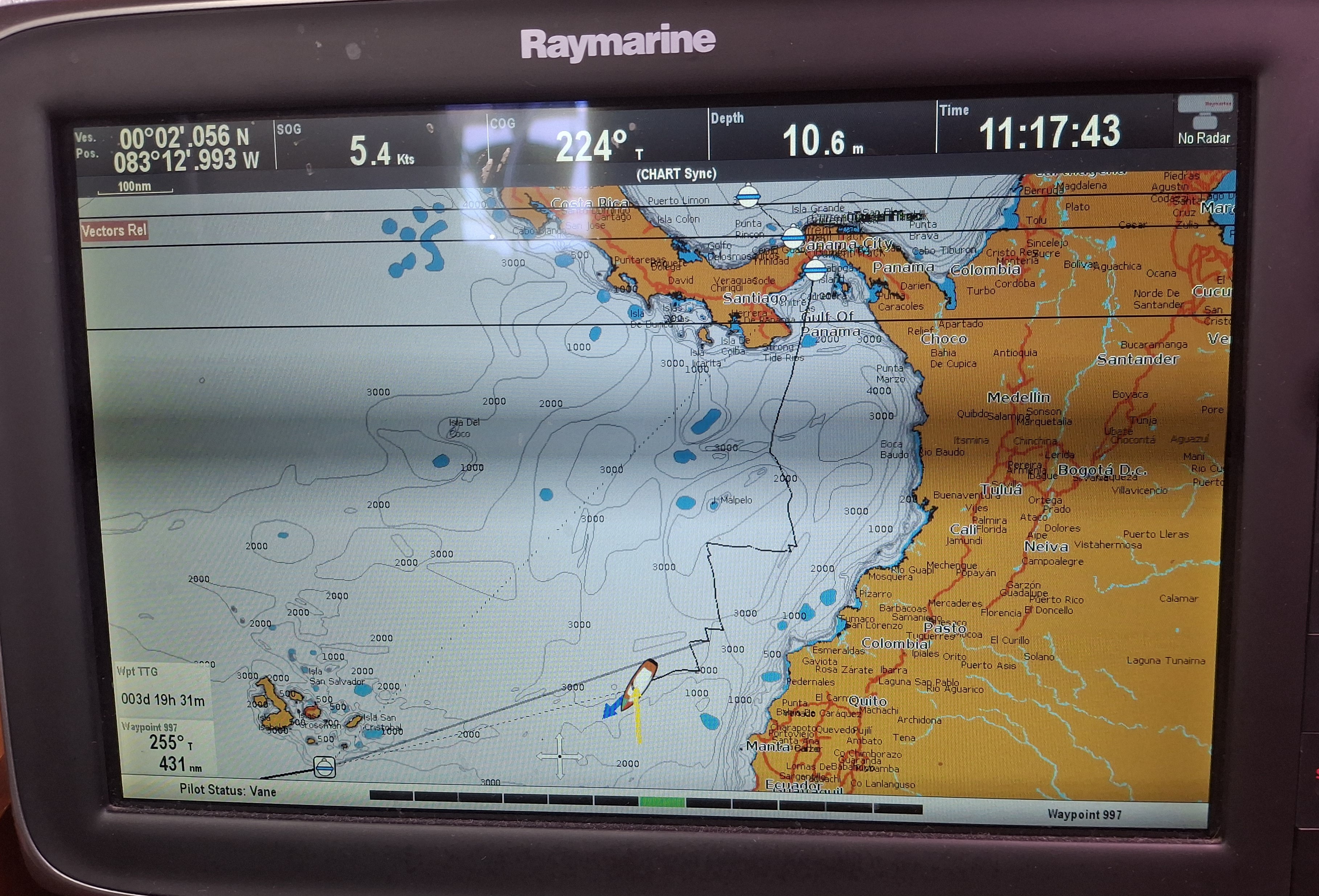
Getting south was a bit of a challenge as you can see from the zig zag of our track
Shortly after that we crossed the equator -the 4th time for Phil and the 3rd time for me. Despite the fact that we were all ready standing at the chart table with cameras poised, we both missed the exact moment that the latitude clicked over to 00 00.000! it was a remarkable moment in that as soon as we crossed the equator, the seas smoothed out and with the blue skies and sunshine, it was a perfect vista. It was also noticeably cooler- close to the equator but a cooler beeeze. Go figure!

Paying our dues to Neptune
Three days later, we got to the waypoint south of Galapagos and then turned slightly again onto the rhum line to our destination. This was the cause of some celebration as we thought that conditions would be much better from here on. But it was not to be. We had our only real squall of the passage which was a relatively small and tame one (wind got up to around 40 knots). It came during the day so at least we saw it coming and were prepared. We also had some other very rough and uncomfortable periods. One night was particularly bad with confused seas and waves thumping and sloshing over the boat. The wind was not really all that strong at 25 knot gusts but the motion was just awful. We concluded that we had cross current which the weather forecast confirmed.

A squall off in the distance
I’ve said many times that sailing teaches me things about life. This passage with conditions changing from one day to the next, and sometimes from one hour to the next, once again highlighted the roller coaster of good times and bad times both on the water and in life. It’s worth keeping in mind that things can change any minute, and practice accepting the good times and bad times with equal grace.
Our daily average for the middle part of the passage was 160 nm so 6.7 kts per hour.
From here on (days 16 to 26) conditions improved greatly and we got to experience classic downwind sailing in a gentle Pacific Ocean where the days simply melted into each other as we gently glided along towards our destination. The stars in the clear night sky were simply stunning, including of course our friend, the Southern Cross.

Twilight at sea, one of my favourite times on passage
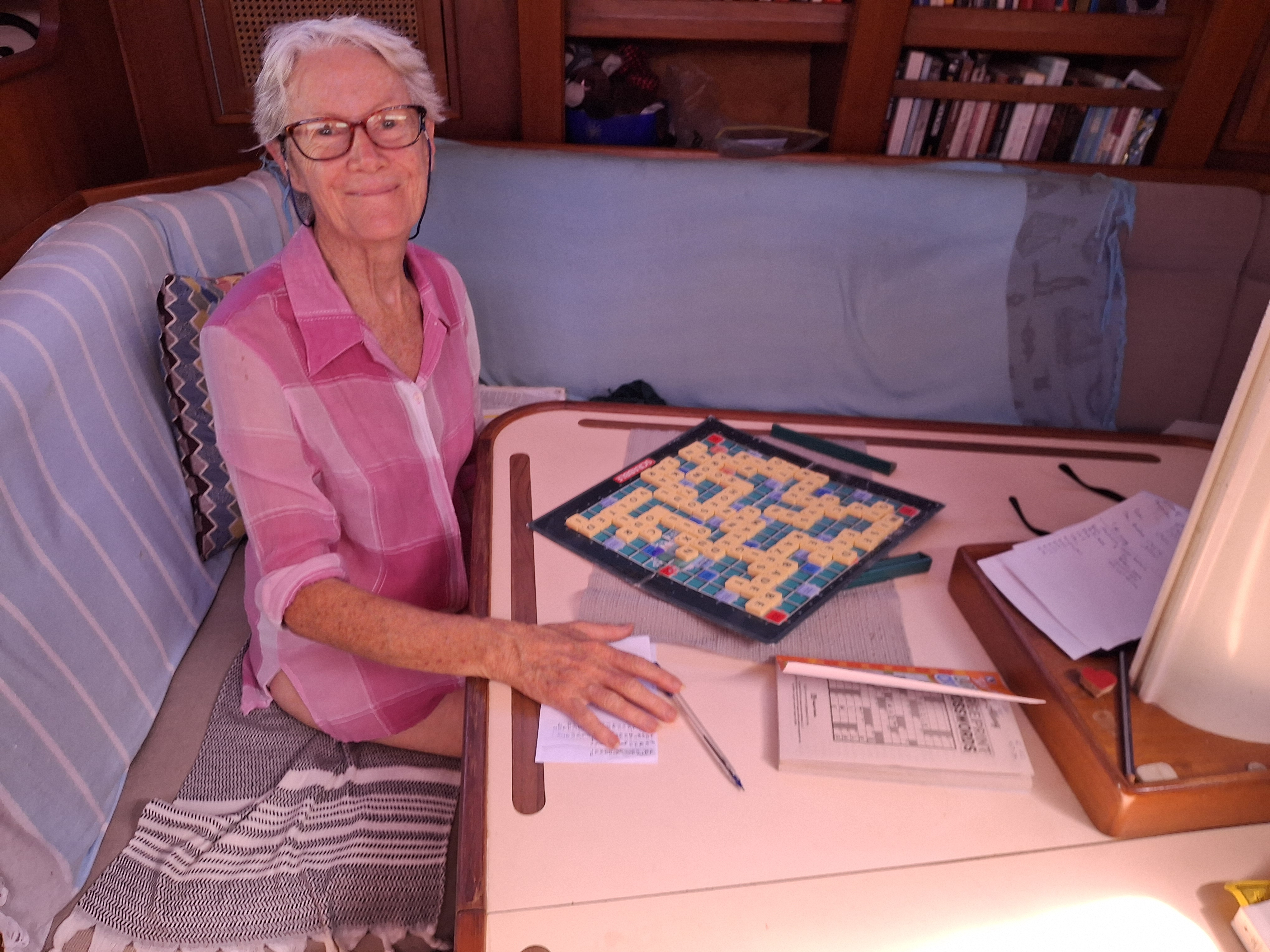
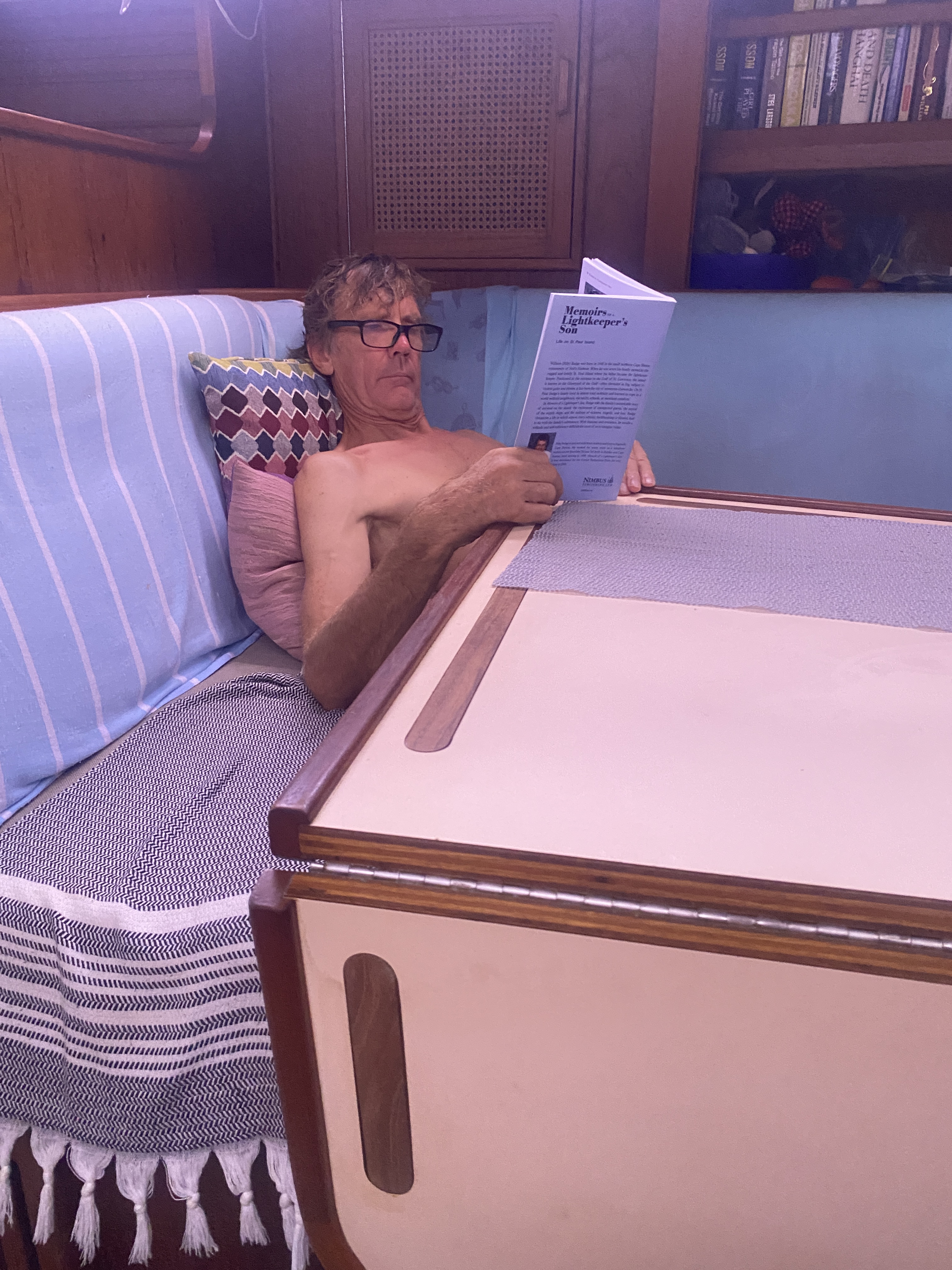
There was time to relax
The fabulous conditions didn’t mean the end of stuff happening though. Neptune wasn’t finished with the centreboard and we also had some spinnaker drama.
One morning, we heard a thudding noise outside of the boat and we raced into the cockpit to see what might have happened. All looked normal up top but behind us Phil caught a glimpse of some wood floating in the water. We concluded that we had probably hit it. After that we gradually became aware of the sloshing sound of water in the centre board casing, along with a noise that sounded like the board rubbing on the inside of the casing as the boat was moving. Both of these noises were unusual. Given how easily the centre board came up a few days prior, we came to the conclusion that when we hit the log, it broke off the bottom of the centre board. You might think this sounds like a serious scenario but it’s not really. The centre board is designed to break if it hits something hard enough. We can easily sail without it, especially if going down wind.

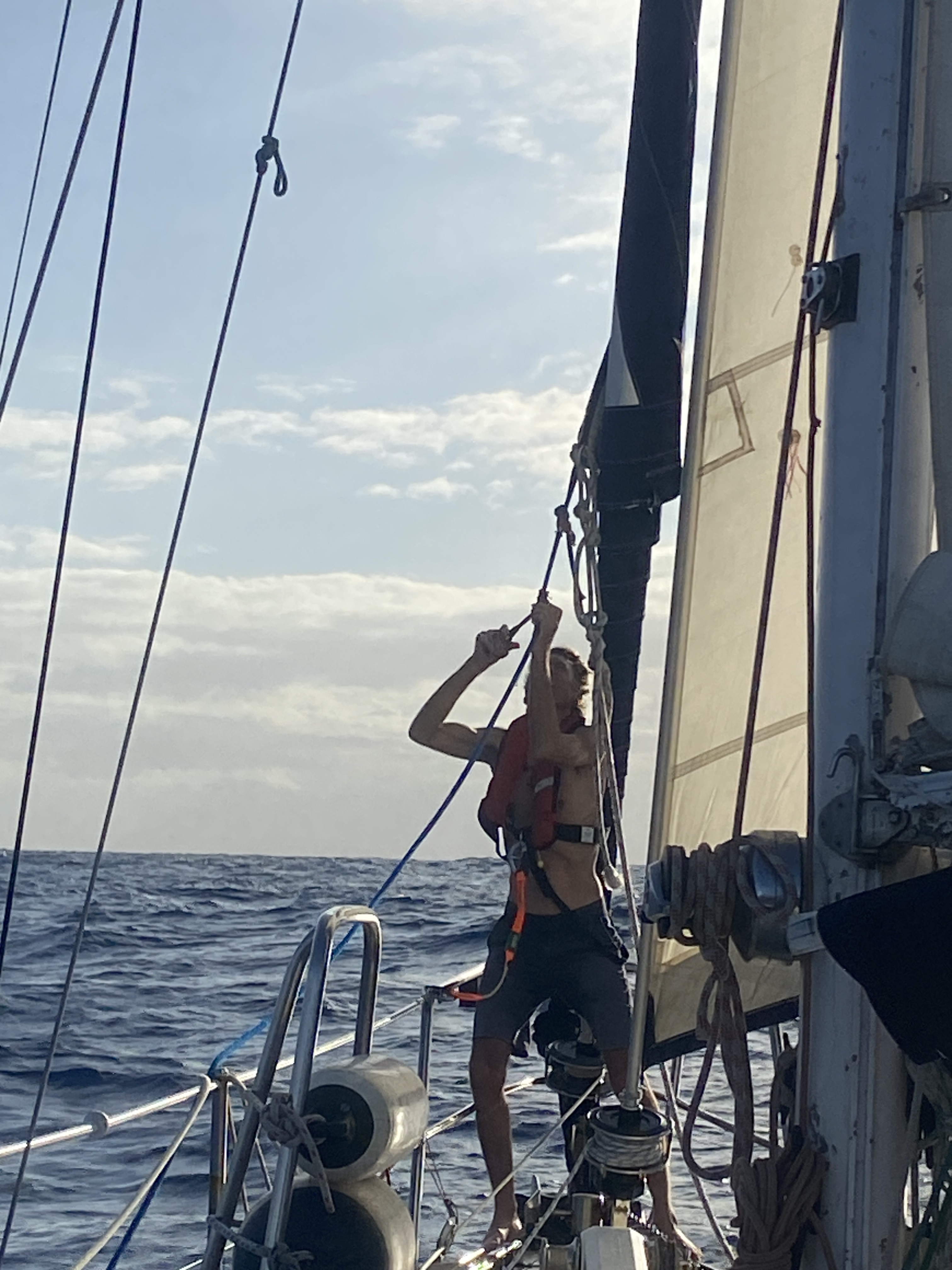
Phil attending to some foredeck jobs: removing dead fish, this one from the main sail bag, and tying some leather around the headsail sheet to prevent chafe which was a major problem for our running rigging
We got to the afternoon of the second last day before Phil started muttering the dreaded (to me) “S” word -spinnaker. As we would arrive at our destination island very late in the night, we had decided to stop at a closer small Marqueasean island, Ua Huka. As the wind had dropped out, we needed to increase the boat speed if we wanted to arrived at Ua Huka before dark.
We got the spinnaker up and soon the boat speed was picking up nicely and the ride was more comfortable.

First time flying this new to us spinnaker
Murphy was lurking around though and soon one of the sheets broke due to chaffing as it moved back and forth in the beak of the pole. Then the wind and boat rocking got hold of the spinnaker and wrapped it around the forestay into a nice mess. It took at least a hour with both of us up forward to get it unwound enough that we could let it down. What a relief that we got it down without it, or us, going in the water and without tearing it. So it was banished below and we went back to white sails and gave up on the idea of getting to Ua Huka before dark.
We sailed along slowly during the afternoon. The closer we got to Ua Huka, the longer it was taking. Just before sunset, Phil was thrilled to be the one to let out the “Land ahoy” cry. And there in the distance almost completely shrouded in cloud was an island. The first land we had seen for 3 1/2 weeks!

We had just seen Ua Huka in the distance – the end was in sight
It quickly disappeared into the night though. Luckily a few squalls were skirting around us and brought just enough wind to really give us a push along, cutting down the time to get there. Wow -here I am saying it was lucky that there were a few squalls around!
We ate dinner at our usual passage time, and then Phil went for a rest to freshen up ahead of arrival and anchoring. And wouldn’t you know just as he did that, another squall started to skirt past us and the wind really picked up this time so I needed to shorten sail for a while until it past by and I could let the headsail out again.
We could see the shape of Ua Nuka and some features in the dark as we sailed west along its southern shore where a few lights showed evidence of some settlement. A big dark cloud crept up behind us and increased the tension somewhat. That last thing we wanted was a squall while trying to anchor in the dark in an unknown bay. Having cleared a couple of smaller islands, covered in squawking birds, we rounded up into the bay, dropped the sails and got the anchor down.
We had done it! None of the bad things that I had imagined would happen eventuated. We managed the few challenges that we had quite well. Our daily average for this last part of the passage was 183nm and 7.6 knots. In total we covered 4,306 nm over 25.8 days with only 3.5 hours of motoring due to insufficient wind. Were we excited??? Feeling accomplished??? Nope, the predominate emotion for both of us was relief that we had made it without really serious boat problems or injuries. Maybe the excitement and accomplishment would come once we have been ashore and it becomes a reality.

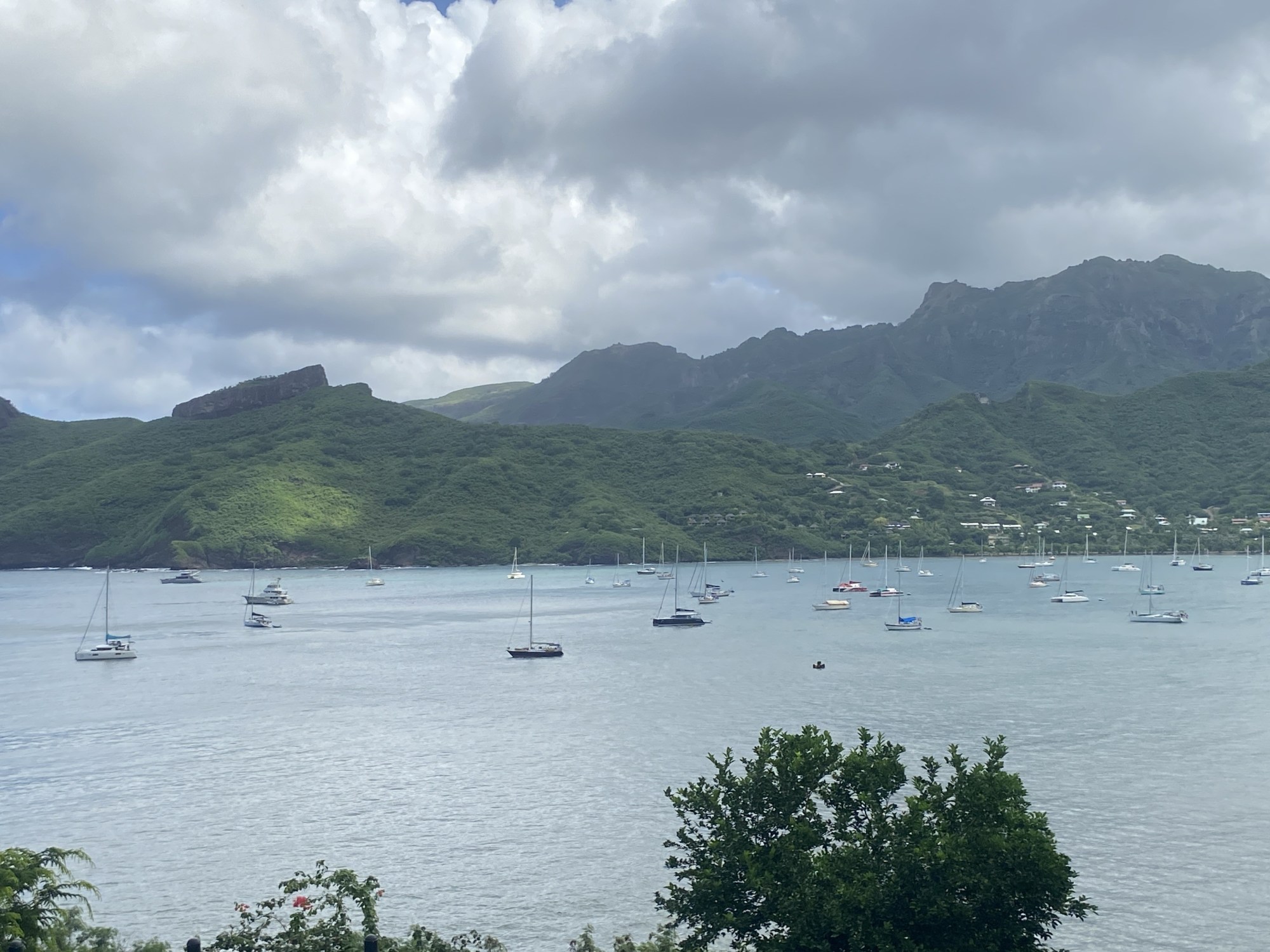
Ua Nuka as seen in the morning light when we departed for Nuka Hiva, where we could complete the formalities of checking in, and do some re-stocking
 paseafique
I am still reading your blog posts years after meeting you in Madagascar in 2018 with Lisa and Fabio! I just find the whole lifestyle of all you round-the-world cruisers to be fascinating and impressive. Was the departure date for this sailing 29 April 2025 or 2005? I’ve been under the impression you were writing about fairly current events, but maybe you are catching up on long-ago trips. Maybe just a typo …
Happy and smooth sailing to you!
LikeLike
Hi Lexi. Im so glad that you find the blogs interesting still after all these years. I do remember meeting you with Fabio and Lisa. Thanks for letting me know about the typo -it’s so easy to miss something like that.
LikeLiked by 1 person