
September 2023
To quote our tour guide Ahmed, “Morocco is a mixed salad”. He was talking about the different backgrounds of the Moroccan people but it could equally apply to the natural assets of country -Morocco has beach, mountains, forest, rivers, ski slopes (who would have guessed?) and of course desert. We loved our time there, and the Moroccan people stole our hearts with their winning smiles, their warmth and generosity.
We entered into Morocco at Tangier in mid-Sept after a very good day sail from La Linea Spain, in company with our buddies Adrian and Marianna on Anthem. In doing so we had to traverse one of the hot spots where orcas had been sighted and some boats had a closer interaction than they would have preferred. The Iberian orcas have been interacting with boats around the Atlantic Portuguese and Spanish coasts and disabling their rudders, sinking a few boats and sending others into the nearest port for rudder repair. Recently, this activity has extended into the western end of the Mediterranean Sea. There are all sorts of theories seeking to explain this new behaviour but suffice to say no-one really knows why it’s happening, except the orca themselves. Further, there are few, if any really proven deterrence strategies. The best method is to follow all the social media regarding sightings and avoid the known hot spots. As there had not been any recent sightings in the western Med, we were quietly confident that the orcas had moved out of the Med and gone north chasing the tuna. Nonetheless, we took a conservative route around the hotspot, and kept a keen look out.
I was looking forward to exploring Tangier after having read about its wild period in the early 1900’s. According The Lonely Planet, at that time, Morocco was divided up between France and Spain but Tangier was turned into an international zone, with no less than nine countries each having a sector. In theory the reigning Sultan controlled all this, but he probably didn’t have much actual power. Between 1912 and independence in 1956, expats poured into Tangier and things got “interesting” with a mix of artists, writers, socialites, drug addicts, spies, and sexual deviants. After independence the city went into a decline until 2007 when the King started to invest in developing the port (now the largest in Africa) and a fast speed rail link to Casablanca. Apparently, this has encouraged investment with one example being by Renault who produce 400,000 vehicles per year in a plant near Tangier that is fully powered by bio-fuel using the residue of the Moroccan olive oil industry! As it turned out we didn’t have much opportunity to explore the city as we were too busy visiting the rest of the country.

A few days later we excitedly met our old friends Jack and Jan (who we first met in Indonesia in 2015), and new friends Dani and Al, who had left their boats in Gibraltar and La Linea respectively, and taken the ferry across to join us and Adrian and Marianna for a 10-day tour of Morocco. Our spirits were high that evening as we shared sundowners on Anthem, before we all settled down for the night- Jack and Jan with us on Paseafique, and Dani and Al with Adrian and Marianna on Anthem.

Next morning, all bright eyed and bushy tailed, we were met by our guide Ahmed, and driver Nordin, and we were off on our Moroccan adventure. We didn’t have to wait long before our first stop which was the town of Chefchouen, in the Rif Mountains just south of the Mediterranean coastline in the north west of Morocco. This town was once THE place in Morocco for smoking cannabis (kif), and there are still fields of cannabis plants in the area.
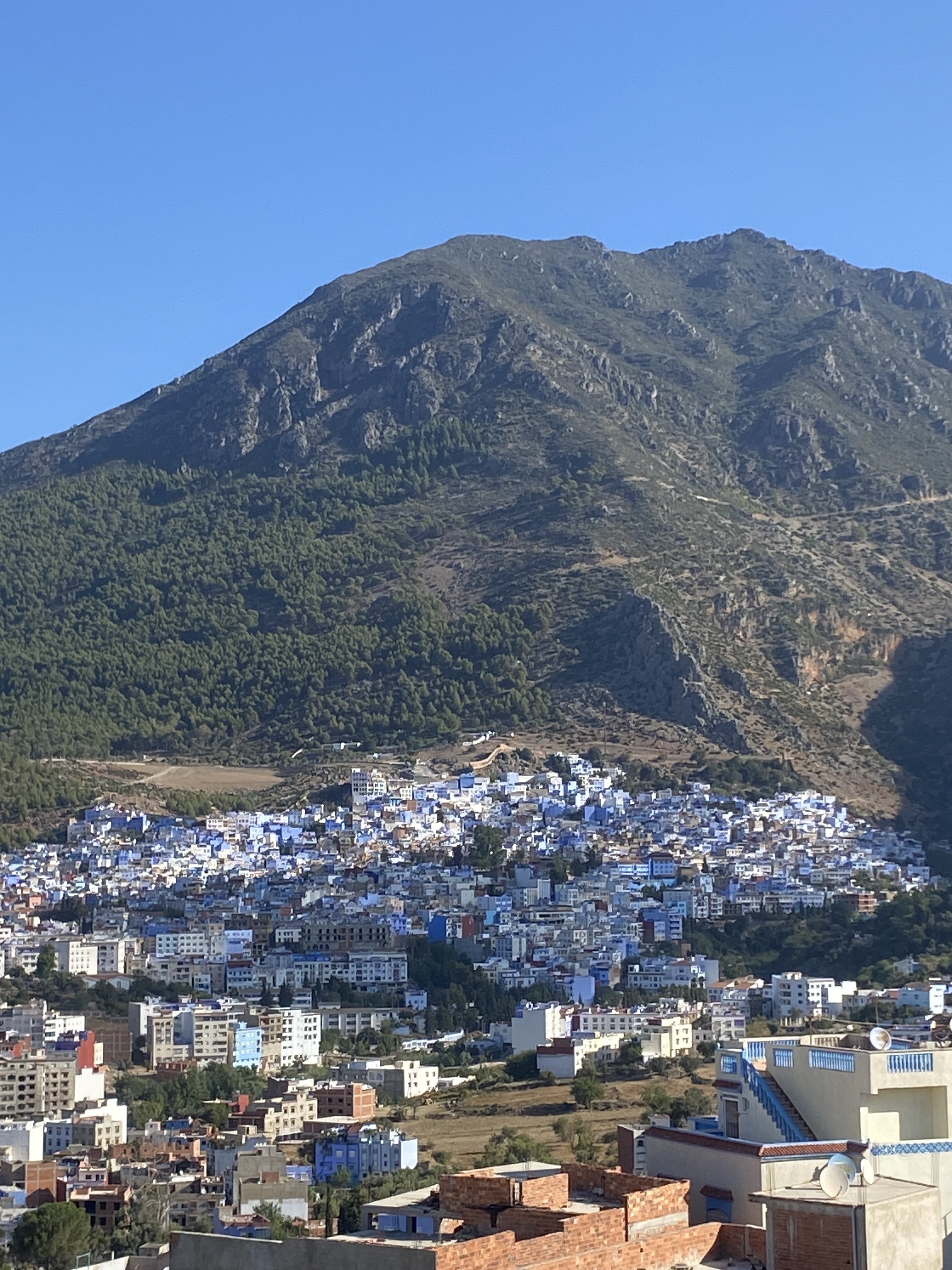
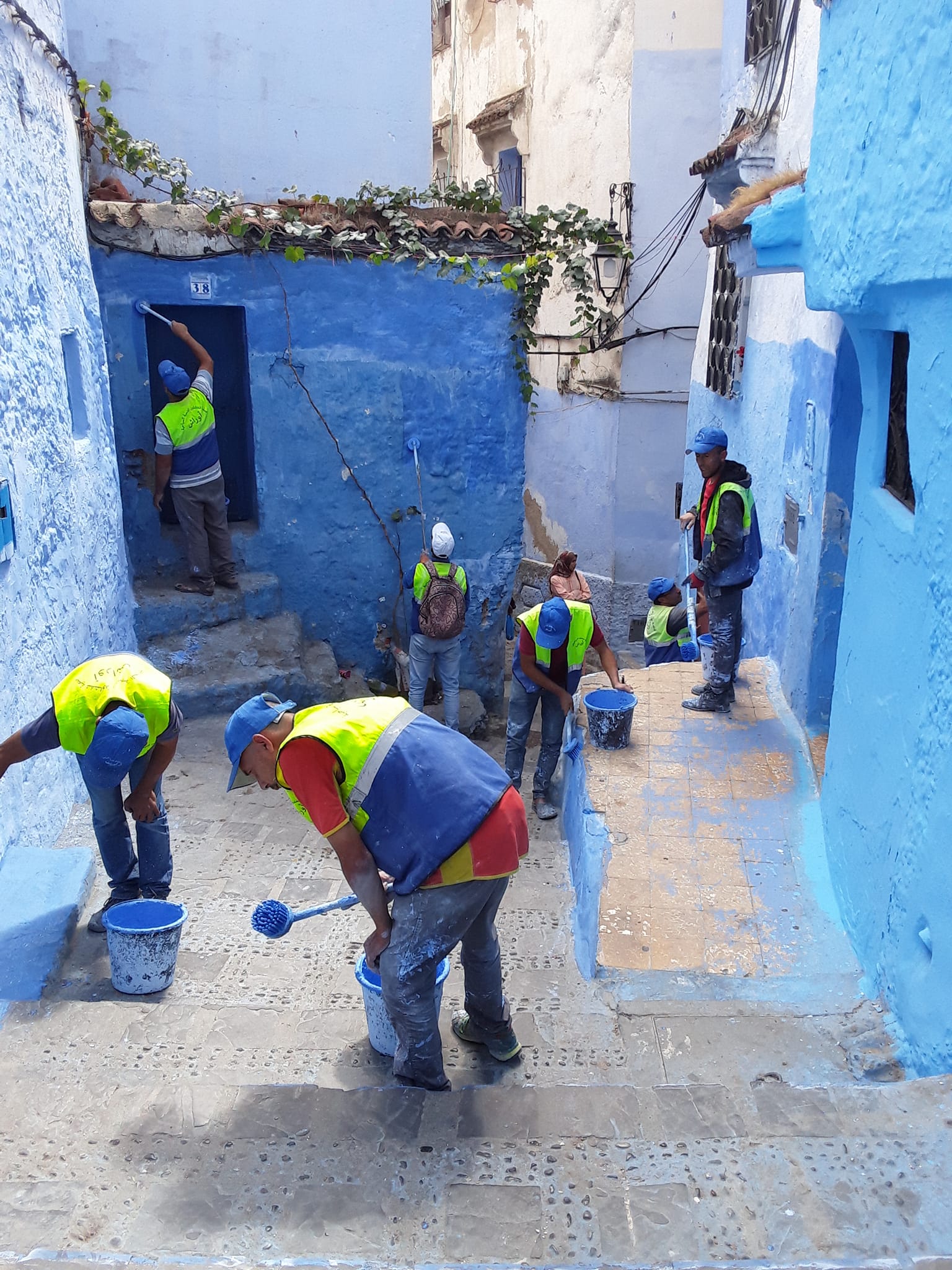
Chefchouen is also known as the Blue City and yes it’s because it’s pretty much all painted blue. No-one really knows the reason but there are a few theories. One is that the early inhabitants painted it blue to keep the mosquitoes away. Another is that the Jewish population painted their area blue -one of the sacred colours, and the rest of the population followed suit. A more cynical theory is that the novelty of a monochromatic town attracts the tourists, and that may be indeed why it is kept blue for now. Regardless of the reason, the blue has a calming effect and I really liked the feeling despite the many tourists that crawl the many laneways scouting for the perfect “blue” photo.
We were surprised to learn that Jewish people have been in Morocco for at least 2000 years when many fled to North Africa. Around 700, the Jewish population increased particularly around Fez, and for 300 years or so, Jewish communities thrived and lived peacefully alongside the Arabs. There was a period of persecution though associated with a particularly strict Islamic leadership during which times the Jews had to convert to Islam or face death, and they were made to live in separate areas to the Muslim population. They were never made to leave the country though and many more came to Morocco to escape the Spanish inquisition. The spirit of tolerance and acceptance was demonstrated by Sultan Mohammad V who refused to send the Jews to the concentration camps in Europe during the Second World War, famously declaring that there are no Jews in Morocco, only Moroccans.
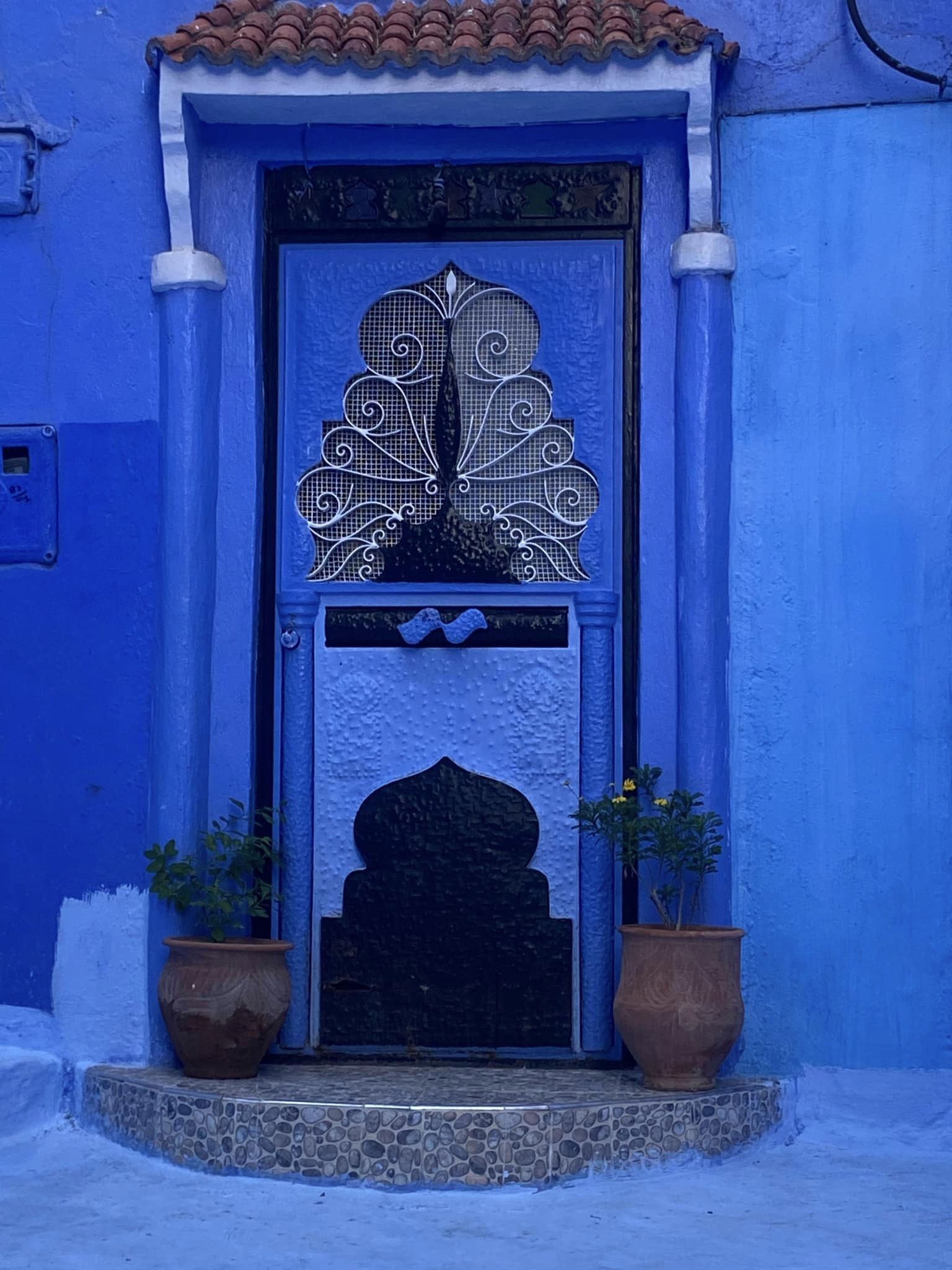
Our first night in Chefchouen was spent in a delightful small family run riad in a side lane tucked away from the hustle and bustle. A riad, for those unfamiliar with this term, is a house built around an open courtyard. Often times, the courtyard provides the only light and air to the rooms.

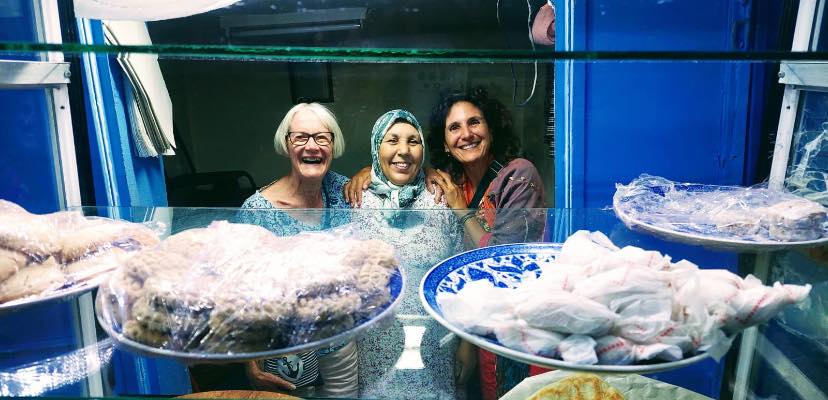
Marianna, Adrian and I had a wonderful interaction one evening when we decided upon returning to our hotel after dinner that we wanted a little sweet something to finish the evening. Luckily we found a little shop selling home made biscuits just near our hotel. The shop was run by a middle-aged woman who was busy making the dough even at that late hour. She didn’t speak a word of English but that didn’t stop her from holding a lengthy one-way conversation with us. It was almost as if she thought if she talked to us enough, we would start to understand her language which was probably an Armazigh dialect, Armazigh being a group of closely related languages spoken by the indigenous Berber people. She recruited a fellow from a near-by shop to help interpret but even that did not make much difference. She had a warm heart and being delighted with our visit, Marianna and I received lots of fleshy hugs. Next morning, Marianna and Adrian were out early for a walk and dropped by to “chat” to her. She generously gave them three small boxes of biscuits for us to share and refused to let them pay anything. She gave us far more than we bought from her but the free biscuits were nothing compared to the delightful interaction we had with her.
I managed a short early morning walk before breakfast and enjoyed that quiet time immensely. The smoke from the fire in the community bakery gave an eerie atmosphere as it drifted over the deserted lanes. I had been past this bakery the day before and learned that in the past the villagers made their bread dough at home and then brought it here for baking. Locals gradually appeared making their way to work. Small trucks were making their deliveries before the narrow streets became impassable with people. By the time I was on my way back to the riad, a few early bird stall holders were opening their shops.

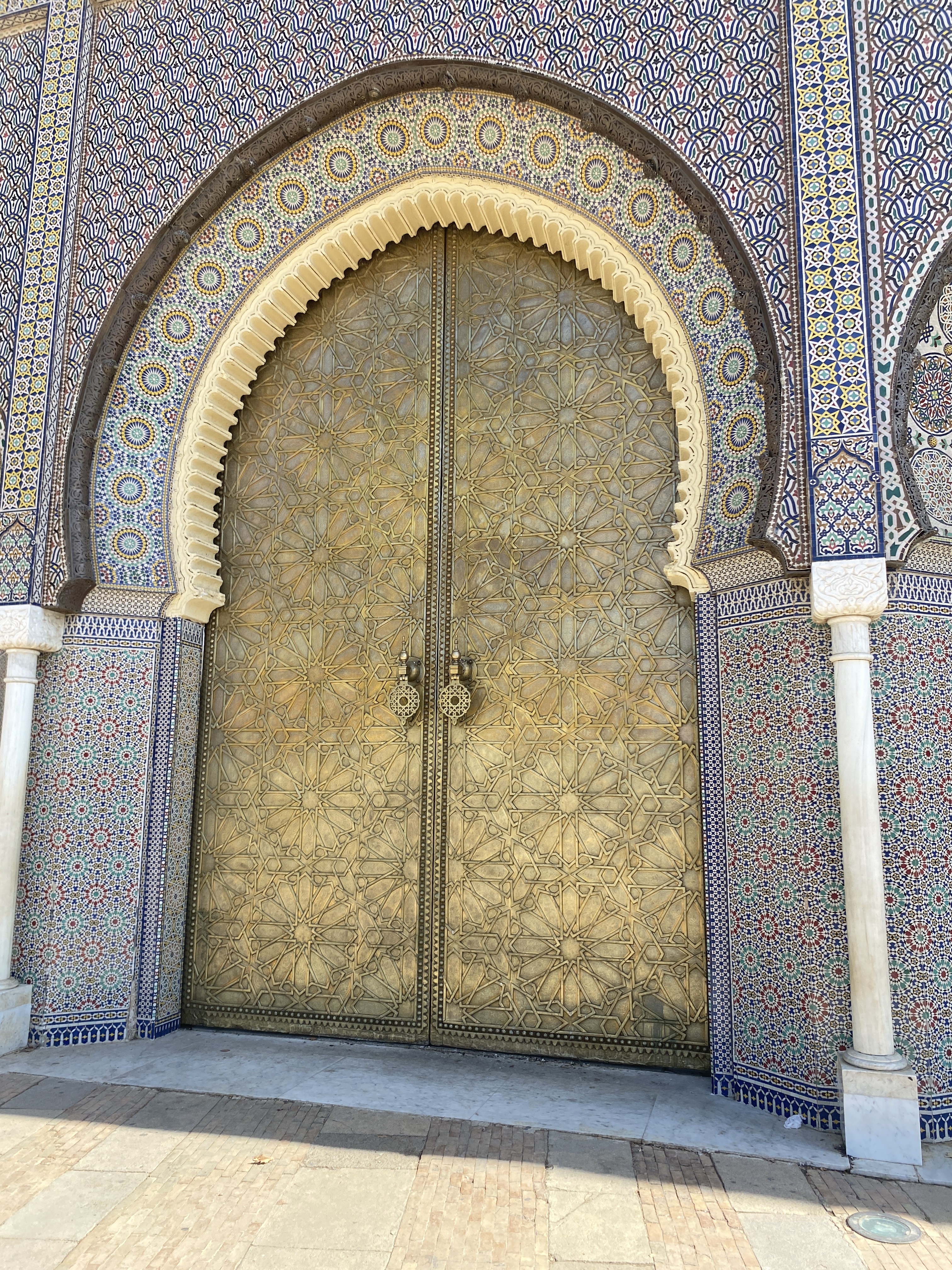
In most of the travel we have done, the accommodation is not usually a destination in itself but our riad in Fez certainly was. We were greeted at the door by two smiling young men looking very much the part in their fez hats, named after the city from where the red berries providing the crimson dye originated. When we entered the courtyard there was a collective “Wow!!!” from our group. What a sight!!! Tiles of different colours and shapes, gold lights, heavily embroidered fabric and of course beautiful carpet.

In the midst of this opulence, an afternoon tea was beautifully presented on a table covered with a gold cloth. Later that evening, we all shared a sumptuous feast in the courtyard. Luckily we didn’t have far to go before we could crawl into our beds like snakes with a belly full of food that would take a week to digest. Next morning we were greeted with a breakfast of gargantuan proportions and were relieved to learn that any left-over food is shared with the staff and the people who live in the neighbourhood. We saw quite a number of examples of this generosity of spirit in Morocco.

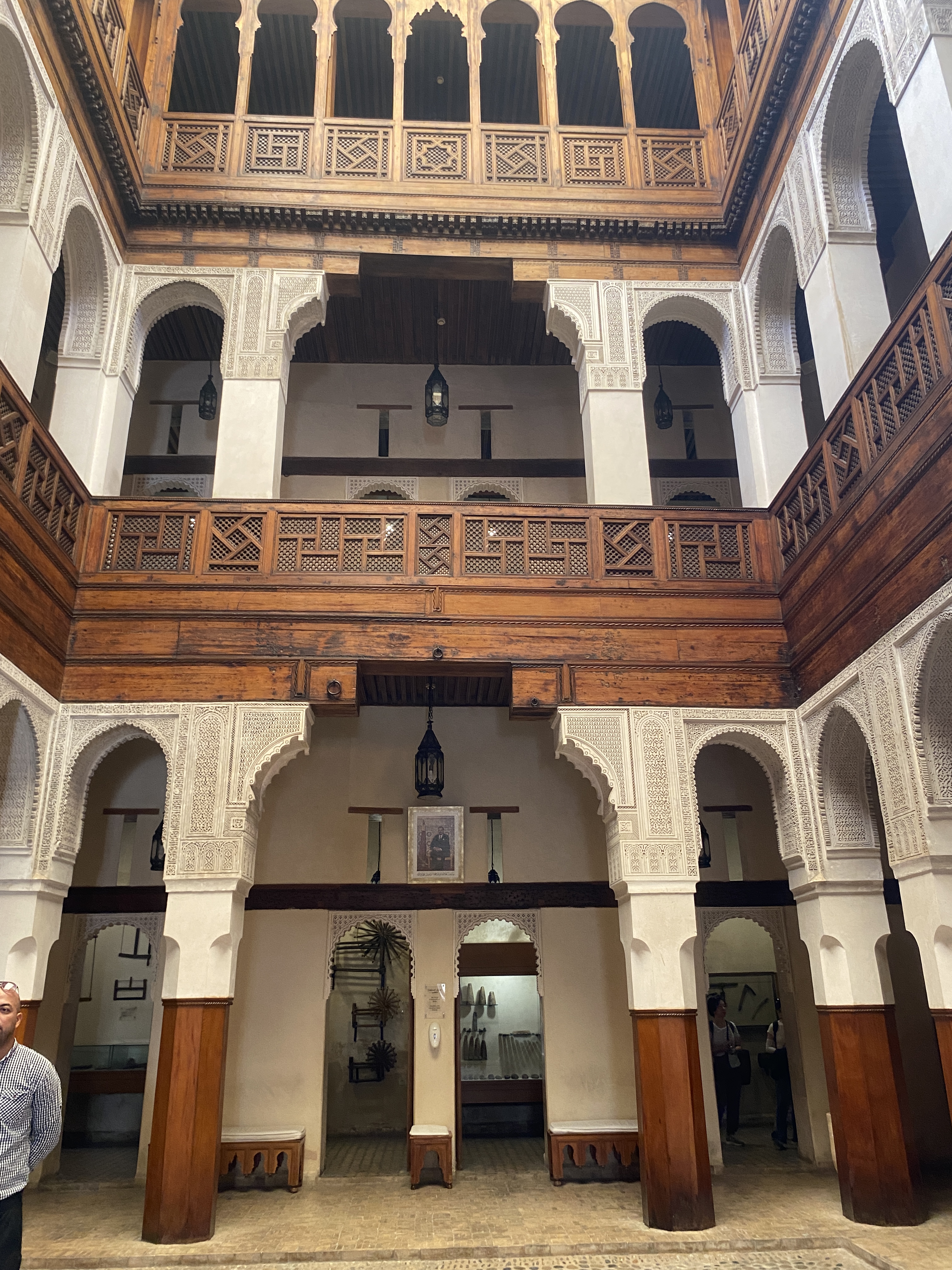
Fez with its population of 1.5 million people is considered to be the intellectual, cultural and spiritual capital of Morocco, even though it has lost its status as the political capital. Around the year 800, Arabs fleeing Spain settled on one side of the river bringing craft and culinary skills, and families from Tunisia settled on the other side bringing a strong tradition of learning. It was united into a single city in 1070.
We had a local guide for the day in Fez which was a bit of a mixed blessing. Guides are usually very knowledgeable and we find the historical and local information to be very interesting. You can generally cover more ground in a day than you otherwise would. But of course their favourite factories and shops are always on their route. We did find though that the “hard sell” was not as vigorous in Morocco as other places we have been.
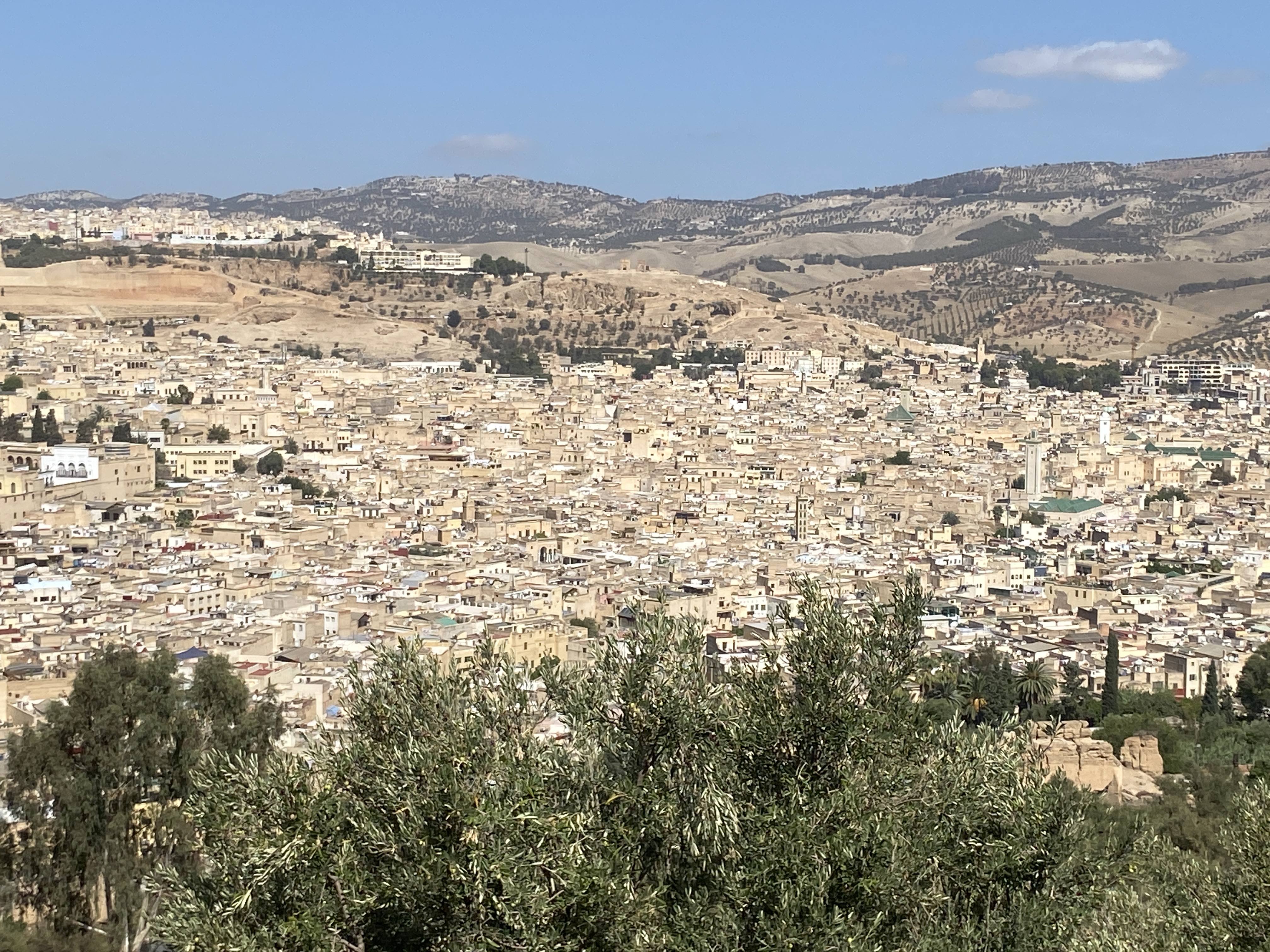
After viewing the medina from a nearby vantage point we descended into it for a fascinating walk through. It is 220 hectares, has some 9000 alleyways, and is more densely populated than Manhattan! It is the largest pedestrian only zone in the world (I think). Many of the alleyways are only just wide enough to take a donkey and cart. It is an absolute seemingly chaotic maze of shops, workshops, snack bars, restaurants, and homes. Our guide shepherded us through there with some difficulty, not because he didn’t know the way but because keeping the eight of us in his sight was a challenge given the crowds and our group’s tendency to wander off in different directions. It was a pity in some ways that we had a guide as I think we all would have enjoyed it more if we could have ambled through there at our own pace, stopping at places that grabbed our attention. On the up-side, our guide did know the good coffee shops that had toilets. Interestingly, the homes in the medina all have a postal address and receive mail deliveries –training a new postman must be a challenge.
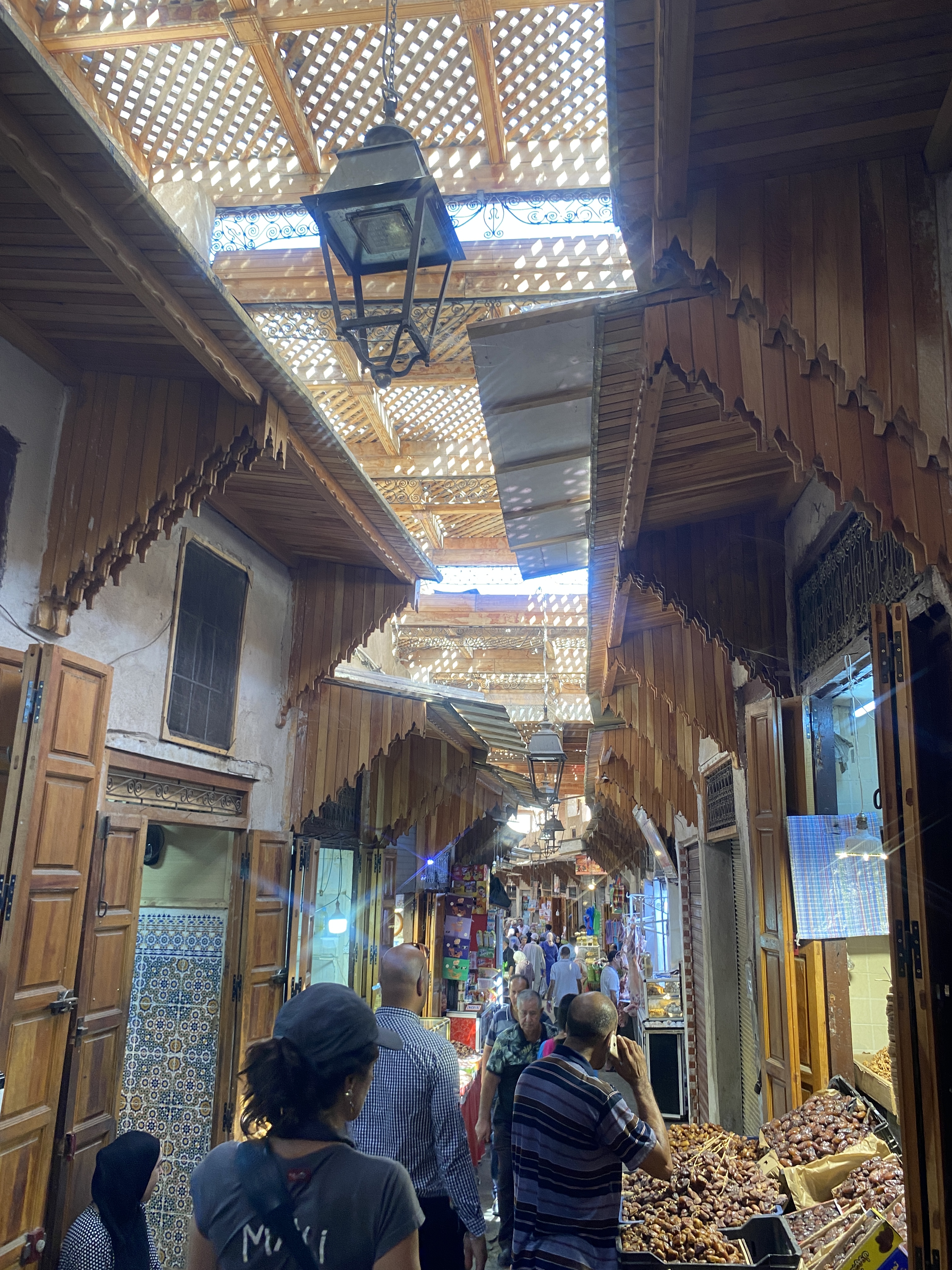
As Australians we just are not practiced in the art of bargaining, which of course is the only way transactions are made in the shops within the Fez medina. When our guide introduced us to a shop keeper from whom he had made some purchases in the past, I started to get an inkling that bargaining is very much a social interaction, as well as a business transaction. It forms the basis of a personal relationship between the vendor and purchaser. Our guide and the shop keeper had clearly become friends and there was lots of good humour and chit chat between them.

We spent the following three days immersed in the desert, oases, valleys and gorges between Fez and Marrakesh. On leaving Fez, we passed through the middle Atlas Mountains and stopped in Ifrane for morning tea. I was very surprised to learn that there are ski fields nearby here -imagine going skiing in Morocco!

With much anticipation, we arrived in Merzouga on the edge of the desert, and here we found 8 camels saddled up and linked together, patiently waiting for us. I was a bit nervous about this camel ride. Well not so much the ride, although I had heard how uncomfortable it can be, but the staying on the camel while he (they were all male camels) stands up and sits down. Even though the desert sand would be a soft landing, I didn’t want to risk another broken bone! Ahmed, our guide, spoke to the camel handlers to ensure that they would keep a close eye on me and my camel so with this reassurance I was all in.
One by one, my 7 travel companions were “installed” on their camels and finally it was my turn -placed on the first camel, presumably because that’s where the handlers walk. Once I was in the “saddle”, the camel was encouraged to stand, I gripped the “handle bars” for dear life, and we were up!
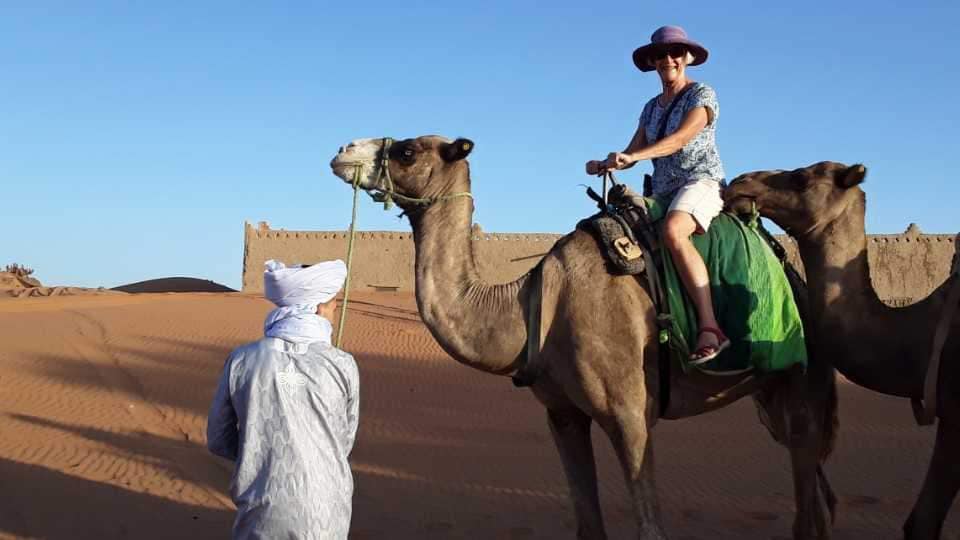
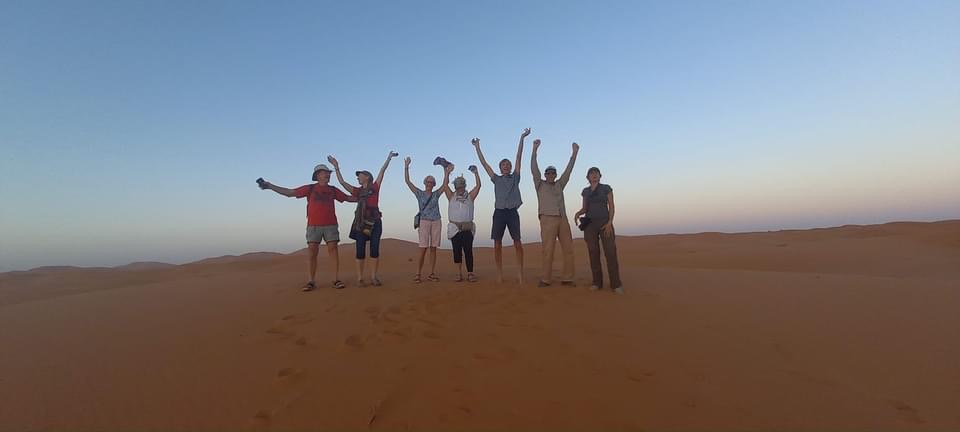
The ride through the sand dunes, while extremely uncomfortable, was a unique experience. Initially there was lots of giggling and chit chat amongst the group but eventually we plodded along (well, the camels did) in the twilight silence. We were very lucky to have perfect conditions -no wind and clear sky.
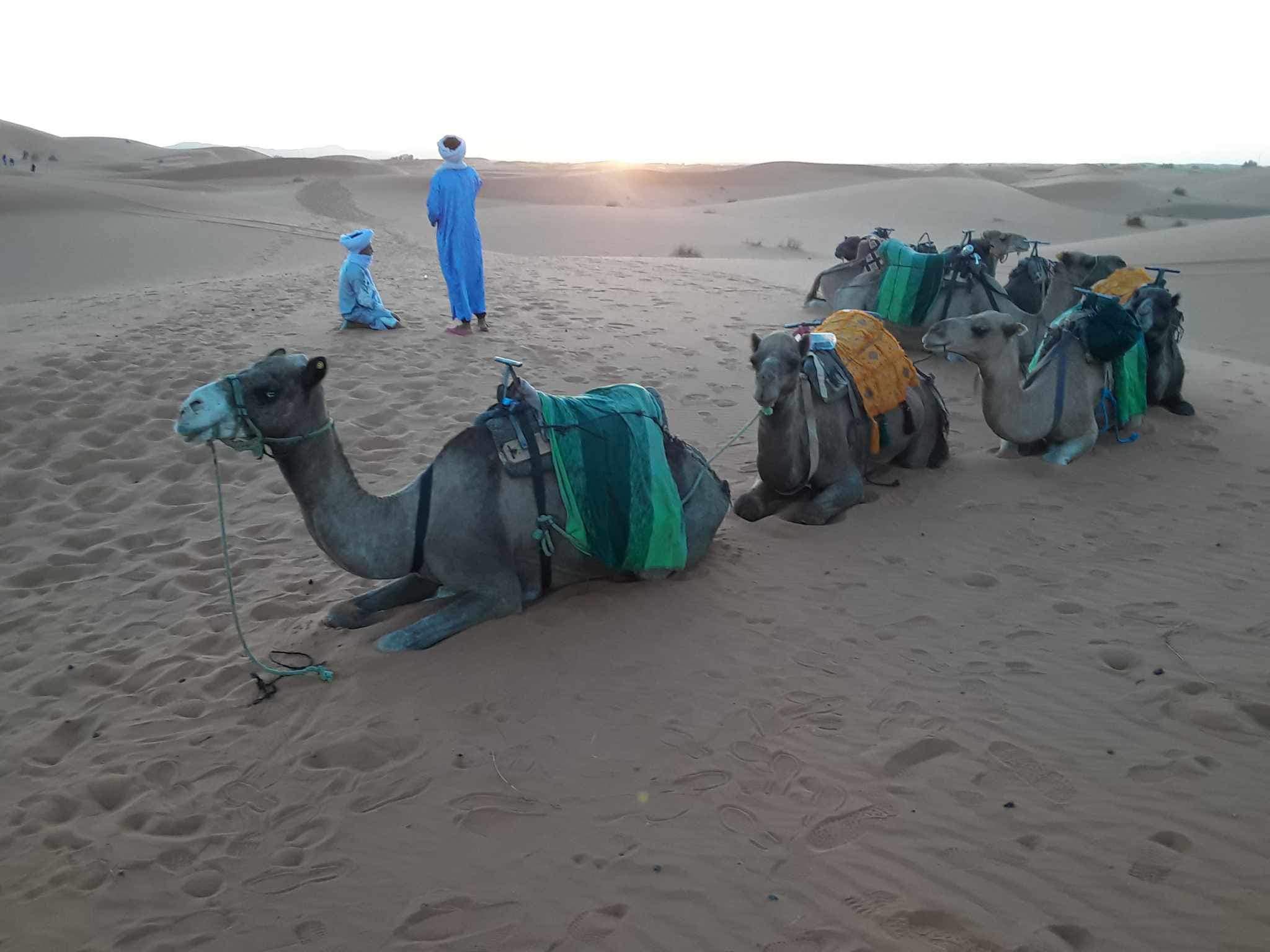
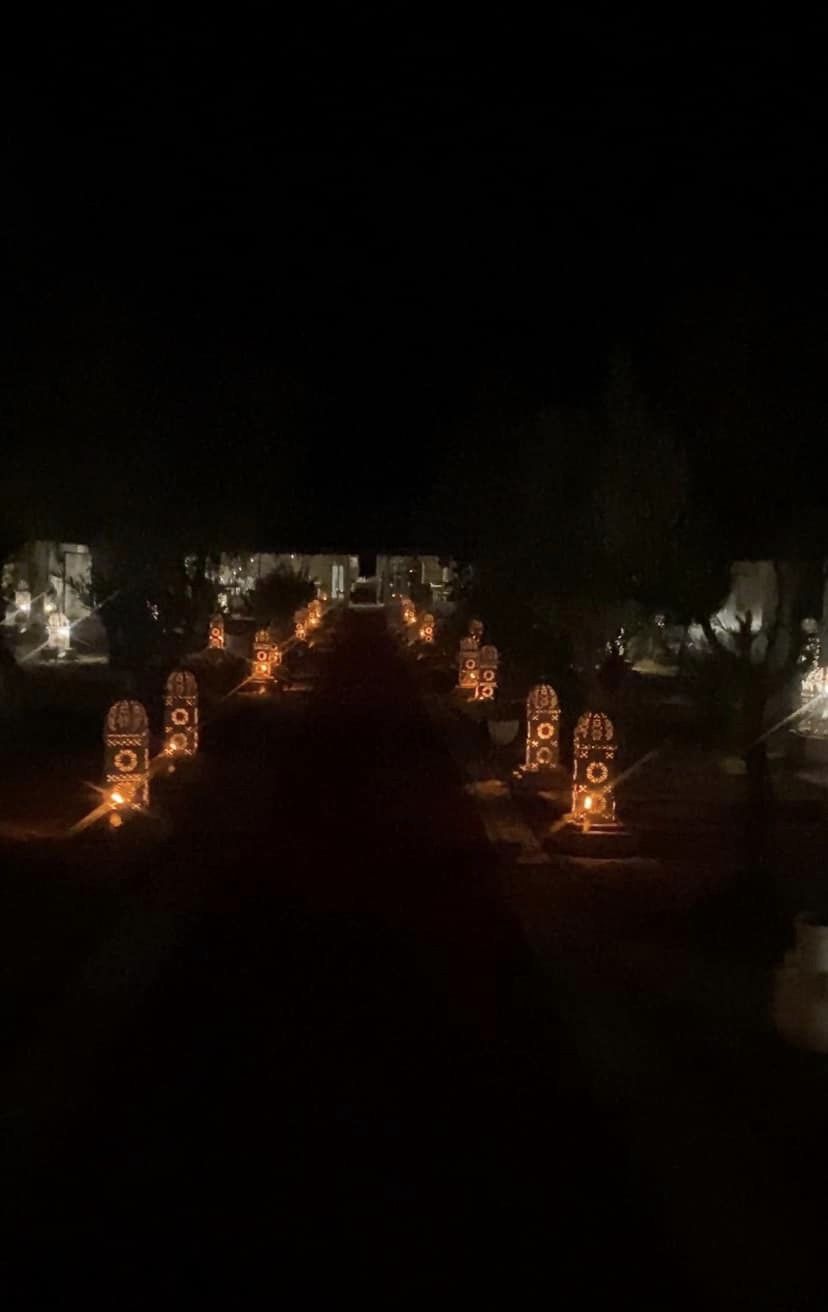
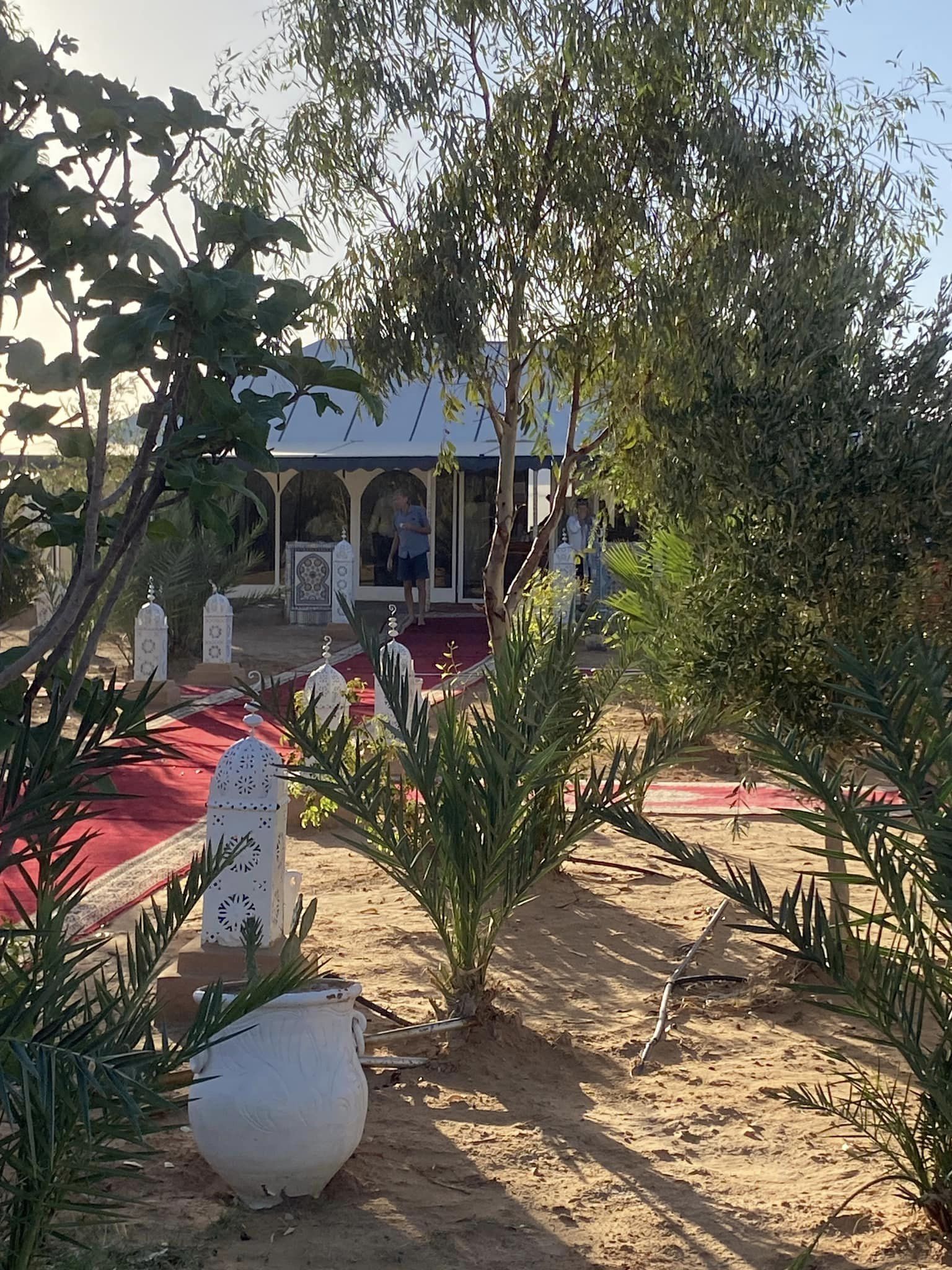
After 90 minutes, and a break to watch the sunset, we arrived in our desert camp in the dark, and gratefully dismounted the camels. I dare say that the camels were grateful too! I can understand why the guys leading the camel trains across the desert used to walk beside the camels, rather than ride them. We hobbled along the red carpet linking the dismounting area with the dining tent, soaking in the magical setting created by the many low twinkling lights showing us the way. After a late but tasty dinner, and some Moroccan music by the camp fire, we retired to our very well-appointed tents for the night.

Our tour guide, Ahmed, is a desert man and lives in the area near Merzouga. He identified himself as a Berber, which is a term that actually derives from the word barbarian but has been resurrected with some pride among the indigenous people of Morocco. The Berbers, or Imazighen, are descended from the earliest inhabitants of Morocco who were likely related to the ancient Egyptians. The Imazighen in the Rif and Atlas Mountains made life very difficult for the invading Romans and other Europeans with fierce resistance and savy co-operation between the various Imazighen tribes.
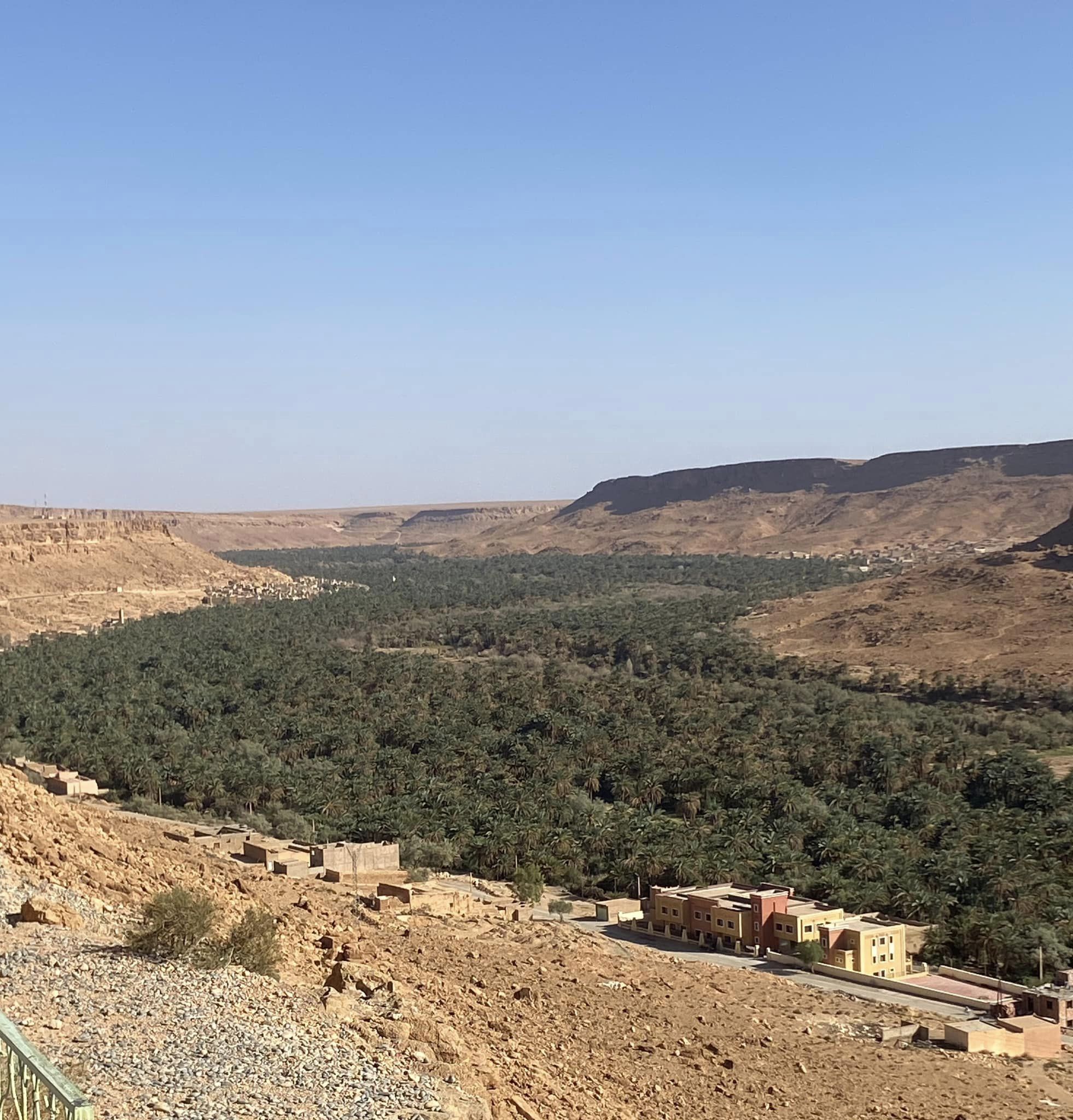
Ahmed really came into his own in the desert area. He took us into an oasis and showed us how the watering system works. We were surprised to learn that no people, or animals, live in the oasis. It is only used for cultivation. The oasis is crisscrossed with irrigation ditches which delineate the many plots. Each family in the area have a plot which they use to grow vegetables, herbs and the ubiquitous dates.

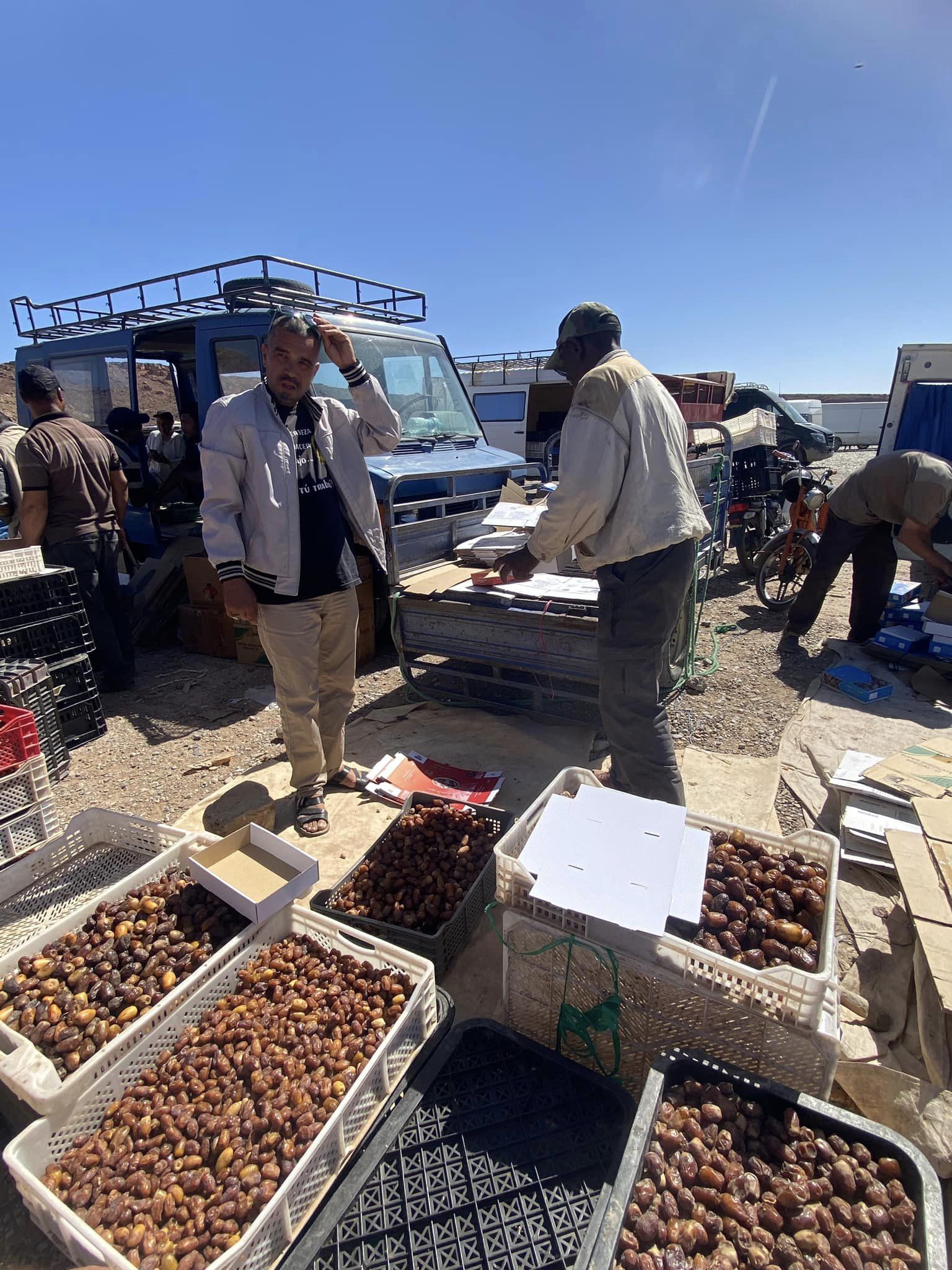
We had told Ahmed that we were interested in buying a bulk quantity of dates to split between us, so he took us to a local date market and helped in finding some quality dates and negotiated a price for us. We bought 13 kgs between the 4 couples and shared some with Ahmed and Nordin, our driver. In addition to dates, Morocco is also rich in fossils. In fact Ahmed’s father made his living as a fossil digger. We visited a fossil “factory” where the fossils are cleaned up and turned into some very creative pieces. The residue is given to the local boys who then chip away at it to find smaller fossils which they then sell to tourists on the road sides to supplement their family’s income.

In Merzouga, we met a very interesting hotel owner, Yusef, who was once a small boy who benefited greatly from this kind of patronage – not from fossil “tailings” but from surplus bread left out by a local hotel owner. Yusef came from a very large family and food was scarce at times, so finding some bread outside the hotel on his way home from school really made an impact on him. It fostered a dream to one day become a hotel owner himself so he could also give back to the local community. Against all the odds, this is exactly what he did.

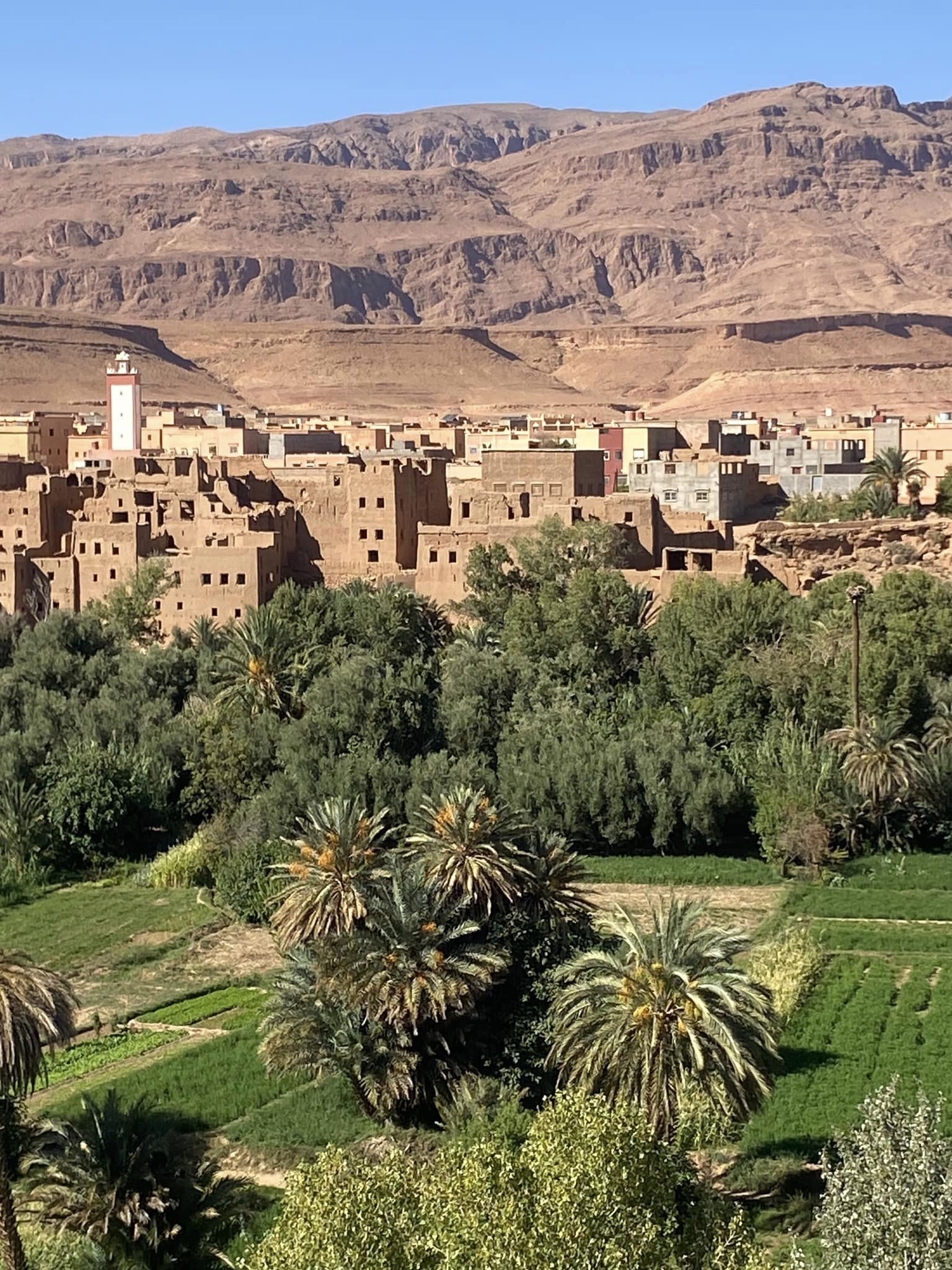
We were treated to some magnificent views as we drove through the Dades Valley and Todra Gorge on our way from the desert to our final stop in Marrakesh – steep rugged mountains and gorges, winding (very winding) roads, verdant valleys and lush oases. All just so beautiful.


Marrakesh, a rival city to Fez, was the capital of the Almavorid empire, an imperial Berber muslim dynasty. I’m not going to do much on Marrakesh history as I’m racing against time to get this blog finished before we leave the Canary Islands tomorrow morning for the Cape Verdes. I was interested to note though that Rabat was chosen as the modern capital of Morrocco, to avoid choosing either Fez or Marrakesh, in the same way that Canberra was built as the capital of Australia to avoid the rivalry between Sydney and Melbourne.
Unfortunately, by the time we got to Marrakesh some of us were a bit worse for wear and clearly suffering from some kind of illness, which we later discovered was covid when we got back to the boat and did a test. Still we managed to enjoy a tour through the medina- another maze of shops and homes as in Fez, but it is not a pedestrian only zone which at times makes for tricky navigation it with all the motorbikes zipping through there. The medina here has 257 sections, each of which has the four key elements of life – a fountain, a mosque, a bakery and a hammam. There are 50,000 shops and scattered through the area are 95 caravanserai. These are the inns which provided accommodation for the caravans of people and camels that brought goods across the desert to Marrakesh for trade. It takes 72 days to bring a caravan from Timbuktu to Marrakesh, and at one time there were about 100 caravans arriving each day, each of which comprised many camels and their handlers.


The main square in Marrakesh, Djemaa el Fna, is the place to be every evening. It started life as a food market, with the mountain people coming down each day to sell their crops. Now it transforms into a giant outdoor show every evening, as it fills with snake charmers, drummers, street performers, fortune tellers, dance troops, acrobats, storytellers, and street food stalls. UNESCO has recognised this as a place of unique cultural exchange. You would think it would be packed with tourists, but while they are present, this is clearly a favourite place for the locals. It is packed and buzzing every night.

My highlight experience in Marrakesh would have to be a visit to a hammam. Even though we had spent quite some time in Turkey, I had never mustered the courage to indulge in this centuries old steam bath tradition. So armed with on-line reviews, I chose a local hammam (rather than one in a hotel) that sounded like it was tourist friendly while giving an authentic experience. It proved to be just as the reviews promised. The staff were very welcoming and helped guide us through the process, without speaking any English. After stripping down to our undies, we were soaped up and left to relax on the hot floor for a while before being lovingly scrubbed within an inch of our lives. There were a few local women enjoying the hammam and it was very lovely to see two women who were giving their children the soap up and scrub down experience. We finished off with a massage and then a cup of mint tea and stepped back out into the hubbub of the medina and floated back to our hotel. A perfect end to a magical time in Morocco.
 paseafique
As usual a wonderful write up of your travels. Thank you very much.
LikeLike